Analogy: Word, Number and Letter Relationships
1. Meaning of analogy
An analogy compares relationships, not merely things that belong to the same topic. In A : B :: C : D, read “A is related to B in the same way that C is related to D”. First describe A → B in a short sentence, then apply that sentence to C. The direction must stay the same.
Example: Bird : Nest :: Bee : Hive. The relation is animal → typical shelter. “Honey” is connected to bees, but it describes a product, so it does not preserve the relation. Being associated with the third word is not enough.
This chapter covers verbal, numerical and letter analogies, matching pairs, combined operations and the basic method for figure analogies. The online bank has 20 verbal, 20 number, 20 letter and 20 advanced mixed questions. Many foundation questions state the relation explicitly so that you can learn the method before solving inference questions.
2. A reliable five-step method
- Read the first pair carefully, including its order.
- Name a precise relationship: part → whole, unit → quantity, x → x², or a letter shift.
- Check the relationship against the complete first pair.
- Apply it to the third item without changing its direction or operation order.
- Compare the predicted answer with all options and reject relation mismatches.
For Wheel : Bicycle :: Key : ?, the relation is component → whole. A keyboard is a whole containing keys. “Lock” is associated with a key but expresses tool → object operated, a different relationship. Context determines which sense of a word is intended; the options and first pair must support the same sense.
3. Verbal relations: identify the exact category
| Relation | Example | Direction check |
|---|---|---|
| Member → class | Rose → Flower | A rose is a kind of flower |
| Part → whole | Page → Book | A page is part of a book |
| Material → product | Clay → Pot | Clay is used to make a pot |
| Creator → work | Poet → Poem | A poet creates a poem |
| Tool → function | Knife → Cut | Cutting is a typical function |
| Worker → tool | Tailor → Scissors | A tailor uses scissors |
| Instrument → quantity | Thermometer → Temperature | The instrument measures the quantity |
| Unit → quantity | Metre → Length | The unit expresses the quantity |
| Organ → sense | Eye → Sight | The organ supports the sense |
| Young → adult kind | Lamb → Sheep | A lamb is a young sheep |
| Synonym | Rapid → Swift | Similar meaning in this context |
| Antonym | Expand → Contract | Opposite meaning in this context |
Do not collapse all these into “related words”. A ruler is an instrument for length; a metre is a unit of length. They relate to length differently. Likewise, potter → pot and clay → pot have the same second word but different relations.
4. Verbal traps, context and precision
Direction: Page : Book does not match Library : Books. The first is part → whole; the second points from a place to its contents. If an option is Book : Page, its direction is reversed.
Level of specificity: Rose : Flower is member → class. Rose : Garden is plant → place; both are plausible associations but only one matches a class relationship. Prefer the relation stated or demonstrated by the question.
Word sense: “Act” can mean an action or a division of a play. Chapter : Book :: Act : Play uses the literary division sense. Translate meanings, not isolated words. “Contract” is a verb meaning become smaller in Expand : Contract; it is not a legal document here.
Typical versus universal: A bird–nest analogy uses a conventional shelter relation, not a claim that all birds always live in nests. Do not introduce an exception that changes the question’s intended relation; equally, do not turn a conventional association into a universal scientific rule.
5. Number analogies: start with simple operations
Check addition/subtraction, multiplication/division, squares/cubes, roots and then combined operations. Try the same transformation on every supplied example. Do not choose a rule because it happens to fit only one convenient number.
Examples:
- Square: 4 : 16 :: 7 : 49, because y = x².
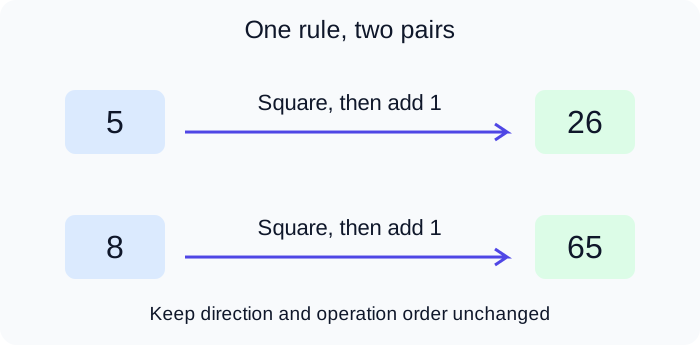
- Square plus one: 5 : 26 :: 8 : 65, because y = x² + 1.
- Product with the next integer: 5 : 30 :: 9 : 90, because y = x(x + 1).
- Positive square root: 49 : 7 :: 121 : 11. The word positive distinguishes the requested root from the two solutions of x² = 121.
- Triple then subtract two: 6 : 16 :: 11 : 31, because y = 3x − 2.
Maintain operation order. For x = 5, x² + 1 = 26 while (x + 1)² = 36. Multiplying before adding is different from adding before multiplying.
6. Digit-based analogies
A rule can act on the whole number or on its individual digits. Decide which one the question establishes. For a two-digit number with tens digit t and units digit u, the number is 10t + u.
| Digit rule | Example | Worked target |
|---|---|---|
| Sum | 35 → 8 | 68 → 6 + 8 = 14 |
| Product | 46 → 24 | 79 → 7 × 9 = 63 |
| Reverse | 27 → 72 | 46 → 64 |
| Sum of squares | 34 → 25 | 57 → 25 + 49 = 74 |
| Absolute difference | 82 → 6 | 93 → 6 |
For three-digit 456, “hundreds × units + tens” gives 4 × 6 + 5 = 29. It does not mean 456 × something. If a reversal produces a leading zero, distinguish a digit string such as 03 from the numerical value 3; follow the question’s format.
7. Can one pair determine a unique rule?
Not always. The pair 2 : 4 fits both doubling and squaring. For input 3 these give 6 and 9. A single pair cannot mathematically prove that one of infinitely many possible functions is intended. Exam questions usually expect a simple conventional relation, with examples, wording and options helping to select it.
In this chapter, explicit-rule foundation questions remove that ambiguity. Advanced inference questions restrict the rule family when needed. If two equally simple relations satisfy all given information but lead to different offered answers, identify the ambiguity instead of pretending the answer is certain.
Worked inference: y = a×x² + b, with fixed integers a and b. Given 2 → 11 and 3 → 21, subtraction gives 10 = a(9 − 4), so a = 2. Then 11 = 2×4 + b gives b = 3. For x = 7, y = 2×49 + 3 = 101. The specified family makes the two examples sufficient.
8. English-letter positions and cyclic shifts
Use A = 1, B = 2, …, Z = 26. A forward shift adds positions; a backward shift subtracts them. Wrap from Z to A only when a cyclic alphabet is specified or clearly established. In our shift questions the cyclic convention is explicit.
Examples: ACE → BDF shifts every letter forward by 1. DOG under the same rule becomes EPH. For a backward shift by 2, CAT becomes AYR: C → A, A → Y and T → R. Check each character; do not read the group as a word and guess a related word.
For a position p shifted by k, the cyclic result is ((p − 1 + k) mod 26) + 1, where mod returns a value from 0 to 25. On paper, boundary letters can be handled by adding or subtracting 26 once for small shifts.
9. Opposite letters and reversal are different
Alphabet-opposite pairs are A–Z, B–Y, C–X, D–W and so on. Their positions sum to 27, so the opposite of position p is 27 − p. DOG becomes WLT: D → W, O → L, G → T.
Reversing a group changes its order, not the letters: DOG becomes GOD. Replacing each letter by its opposite changes identities while preserving order. A question may combine both, but do not substitute one operation for the other.
Useful anchors: A–Z, E–V, I–R, M–N. There is no single self-opposite letter in the 26-letter English alphabet because the midpoint is between M and N. These are alphabet-position opposites, not mirror images of letter shapes.
10. Multi-step letter analogies
Write intermediate results. “Reverse, then shift forward by 1” turns DOG → GOD → HPE. Reversing after a uniform shift gives the same result in this particular case, but that coincidence does not hold for position-dependent shifts.
Example: reverse DOG, then shift the new first, second and third letters by +1, −2 and +3. First DOG → GOD. Next G → H, O → M and D → G, yielding HMG. If you shift the original positions first and then reverse, you get a different answer. Always attach positional instructions to the stage specified.
For mixed groups such as A3C, state whether the digit changes, whether only letters are shifted and whether positions are counted separately. Do not silently apply alphabet arithmetic to numbers or vice versa.
11. Pair selection, sets and figure analogies
Some questions ask for a matching pair rather than a missing fourth term. For Kilogram : Mass, Second : Time preserves unit → quantity. Ruler : Length is instrument → quantity, and Mass : Kilogram reverses direction. Test both words in every option.
For number sets such as (3, 9, 27), a proposed relationship must involve the relevant positions consistently. If the rule is “second is the square and third is the cube of the first”, (4, 16, 64) fits. Do not judge only the first two entries and ignore the third.
For figure analogies, compare A to B using one feature at a time: rotation angle/direction, reflection axis, position, number of elements, shading and size. Apply the same transformation to C. Rotation is not reflection: an arrow pointing up rotated 90° clockwise points right; reflected across a vertical line, it still points up. Use asymmetric figures to distinguish transformations that symmetric shapes can conceal.
12. Worked elimination of close options
Question: Page : Book :: Brick : ? Options: Clay, Wall, Kiln, Builder. Name the first relation: a page is a component of a book. A brick is a component of a wall, so Wall fits. Clay is a material used to make the brick; kiln is a place used in production; builder is a user of bricks. Each distractor is associated with bricks, but each expresses a different relationship.
Question: 5 : 26 :: 8 : ?, explicitly using x² + 1. Options: 63, 64, 65, 81. Squaring gives 64; adding one gives 65. Choosing 64 stops one operation too early. Choosing 81 incorrectly squares x + 1. Read the complete rule rather than a familiar part of it.
13. Revision and exam practice
- Preserve the arrow: A → B and C → answer must have the same direction.
- Prefer a precise sentence over “these are connected”.
- Distinguish member/class, part/whole, material/product and worker/tool.
- Separate whole-number operations from digit operations.
- Distinguish x² + 1 from (x + 1)².
- Use A = 1 to Z = 26; opposite positions add to 27.
- Reverse order and opposite-letter substitution are different operations.
- In several-step questions, keep intermediate results.
- Check every supplied example and every relevant feature.
- If the rule is genuinely underdetermined, do not claim certainty.
Practise in three rounds: identify the relation without options, calculate the answer, then explain why one tempting distractor is wrong. Record errors by type—relation, direction, arithmetic, letter boundary or operation order—so revision targets the actual mistake.
Practice set: 30 questions
Practice 01
Complete the analogy using the relation animal → typical shelter: Bird : Nest :: Bee : ?
- A. Hive
- B. Web
- C. Den
- D. Stable
Practice 02
Complete the analogy using the relation tool → primary action: Pen : Write :: Knife : ?
- A. Read
- B. Hear
- C. Cut
- D. Measure
Practice 03
Complete the analogy using the relation component → whole made from components: Page : Book :: Brick : ?
- A. Wall
- B. Paper
- C. Clay
- D. Kiln
Practice 04
Complete the analogy using the relation instrument → measured quantity: Thermometer : Temperature :: Barometer : ?
- A. Distance
- B. Electric current
- C. Atmospheric pressure
- D. Time
Practice 05
Complete the analogy using the relation word → close synonym: Rapid : Swift :: Silent : ?
- A. Quiet
- B. Noisy
- C. Distant
- D. Heavy
Practice 06
Complete the analogy using the relation word → opposite meaning: Increase : Decrease :: Expand : ?
- A. Enlarge
- B. Contract
- C. Continue
- D. Repeat
Practice 07
Complete the analogy using the relation member → broader class: Rose : Flower :: Sparrow : ?
- A. Bird
- B. Nest
- C. Wing
- D. Tree
Practice 08
Complete the analogy using the relation polygon → number of sides: Triangle : Three sides :: Pentagon : ?
- A. Four sides
- B. Five sides
- C. Six sides
- D. Eight sides
Practice 09
Use the rule "square" on each input: 4 : 16 :: 7 : ?
- A. 49
- B. 48
- C. 50
- D. 52
Practice 10
Use the rule "square plus 1" on each input: 5 : 26 :: 8 : ?
- A. 64
- B. 66
- C. 65
- D. 68
Practice 11
Use the rule "product of x and x + 1" on each input: 5 : 30 :: 9 : ?
- A. 89
- B. 91
- C. 90
- D. 93
Practice 12
Use the rule "divide by 4" on each input: 20 : 5 :: 36 : ?
- A. 8
- B. 10
- C. 9
- D. 12
Practice 13
Use the rule "sum of the two digits" on each input: 35 : 8 :: 68 : ?
- A. 14
- B. 13
- C. 15
- D. 17
Practice 14
Use the rule "sum of the squares of the two digits" on each input: 34 : 25 :: 57 : ?
- A. 73
- B. 75
- C. 77
- D. 74
Practice 15
Use the rule "square of x + 1" on each input: 5 : 36 :: 8 : ?
- A. 80
- B. 82
- C. 81
- D. 84
Practice 16
Use the cyclic English alphabet (after Z comes A): shift each letter forward by 1. ACE : BDF :: BDF : ?
- A. CEG
- B. DFH
- C. BDF
- D. EGI
Practice 17
Use the cyclic English alphabet (after Z comes A): shift each letter forward by 5. BDF : GIK :: GIK : ?
- A. LNP
- B. MOQ
- C. KMO
- D. NPR
Practice 18
Use the cyclic English alphabet (after Z comes A): shift each letter backward by 4. ABC : WXY :: BCD : ?
- A. XYZ
- B. YZA
- C. WXY
- D. ZAB
Practice 19
Use the cyclic English alphabet (after Z comes A): replace each letter by its opposite (A ↔ Z, B ↔ Y). ABC : ZYX :: DOG : ?
- A. XMU
- B. VKS
- C. WLT
- D. YNV
Practice 20
Use the cyclic English alphabet (after Z comes A): reverse the order, then shift each letter forward by 1. ABC : DCB :: DOG : ?
- A. IQF
- B. GOD
- C. JRG
- D. HPE
Practice 21
Use the cyclic English alphabet (after Z comes A): reverse the order, then shift each letter forward by 1. ACE : FDB :: RST : ?
- A. VUT
- B. TSR
- C. WVU
- D. UTS
Practice 22
The same rule y = a×x² + b applies, with fixed integer a and b. Given 2 : 11 and 3 : 21, complete 7 : ?
- A. 101
- B. 100
- C. 102
- D. 104
Practice 23
The same rule y = a×x² + b applies, with fixed integer a and b. Given 2 : 18 and 3 : 38, complete 5 : ?
- A. 101
- B. 103
- C. 102
- D. 105
Practice 24
The same rule y = a×x² + b applies, with fixed integer a and b. Given 2 : 21 and 3 : 46, complete 4 : ?
- A. 81
- B. 80
- C. 82
- D. 84
Practice 25
First reverse the three-letter group. Then shift its new first, second and third letters by 1, -2, 3 positions respectively; positive means forward and negative backward, wrapping A–Z. ACE : FAD :: DOG : ?
- A. INH
- B. HMG
- C. GLF
- D. JOI
Practice 26
First reverse the three-letter group. Then shift its new first, second and third letters by 4, -5, 6 positions respectively; positive means forward and negative backward, wrapping A–Z. BDF : JYH :: RAT : ?
- A. XVX
- B. YWY
- C. WUW
- D. ZXZ
Practice 27
For each three-digit input, multiply the hundreds digit by the units digit, then add the tens digit. 234 : 11 :: 456 : ?
- A. 28
- B. 30
- C. 29
- D. 32
Practice 28
For each three-digit input, multiply the hundreds digit by the units digit, then add the tens digit. 527 : 37 :: 839 : ?
- A. 74
- B. 75
- C. 76
- D. 78
Practice 29
Choose the pair with the same directional relationship as Carpenter : Furniture.
- A. Poet : Poem
- B. Poem : Poet
- C. Pen : Poet
- D. Page : Book
Practice 30
Choose the pair with the same directional relationship as Oak : Tree.
- A. Tree : Oak
- B. Fish : Water
- C. Fin : Fish
- D. Shark : Fish
Answers and explanations
Answer 01
A. Hive
Bird relates to Nest as animal → typical shelter. In the same direction, Bee relates to Hive. The relation must match, not just the topic.
Answer 02
C. Cut
Pen relates to Write as tool → primary action. In the same direction, Knife relates to Cut. The relation must match, not just the topic.
Answer 03
A. Wall
Page relates to Book as component → whole made from components. In the same direction, Brick relates to Wall. The relation must match, not just the topic.
Answer 04
C. Atmospheric pressure
Thermometer relates to Temperature as instrument → measured quantity. In the same direction, Barometer relates to Atmospheric pressure. The relation must match, not just the topic.
Answer 05
A. Quiet
Rapid relates to Swift as word → close synonym. In the same direction, Silent relates to Quiet. The relation must match, not just the topic.
Answer 06
B. Contract
Increase relates to Decrease as word → opposite meaning. In the same direction, Expand relates to Contract. The relation must match, not just the topic.
Answer 07
A. Bird
Rose relates to Flower as member → broader class. In the same direction, Sparrow relates to Bird. The relation must match, not just the topic.
Answer 08
B. Five sides
Triangle relates to Three sides as polygon → number of sides. In the same direction, Pentagon relates to Five sides. The relation must match, not just the topic.
Answer 09
A. 49
Rule: x². It gives 4 → 16 and 7 → 49. Apply the operation to the input before comparing options.
Answer 10
C. 65
Rule: x² + 1. It gives 5 → 26 and 8 → 65. Apply the operation to the input before comparing options.
Answer 11
C. 90
Rule: x(x + 1). It gives 5 → 30 and 9 → 90. Apply the operation to the input before comparing options.
Answer 12
C. 9
Rule: x ÷ 4. It gives 20 → 5 and 36 → 9. Apply the operation to the input before comparing options.
Answer 13
A. 14
Rule: tens + units. It gives 35 → 8 and 68 → 14. Apply the operation to the input before comparing options.
Answer 14
D. 74
Rule: tens² + units². It gives 34 → 25 and 57 → 74. Apply the operation to the input before comparing options.
Answer 15
C. 81
Rule: (x + 1)². It gives 5 → 36 and 8 → 81. Apply the operation to the input before comparing options.
Answer 16
A. CEG
ACE → BDF follows the stated transformation. Apply the same operation to BDF: BDF → CEG. Preserve the stated operation order.
Answer 17
A. LNP
BDF → GIK follows the stated transformation. Apply the same operation to GIK: GIK → LNP. Preserve the stated operation order.
Answer 18
A. XYZ
ABC → WXY follows the stated transformation. Apply the same operation to BCD: BCD → XYZ. Preserve the stated operation order.
Answer 19
C. WLT
ABC → ZYX follows the stated transformation. Apply the same operation to DOG: DOG → WLT. Preserve the stated operation order.
Answer 20
D. HPE
ABC → DCB follows the stated transformation. Apply the same operation to DOG: DOG → HPE. Preserve the stated operation order.
Answer 21
D. UTS
ACE → FDB follows the stated transformation. Apply the same operation to RST: RST → UTS. Preserve the stated operation order.
Answer 22
A. 101
The output difference is 10 = a(9 − 4), so a = 2. Then b = 11 − 4×2 = 3. For x = 7, y = 2×49 + (3) = 101.
Answer 23
C. 102
The output difference is 20 = a(9 − 4), so a = 4. Then b = 18 − 4×4 = 2. For x = 5, y = 4×25 + (2) = 102.
Answer 24
A. 81
The output difference is 25 = a(9 − 4), so a = 5. Then b = 21 − 4×5 = 1. For x = 4, y = 5×16 + (1) = 81.
Answer 25
B. HMG
Reverse DOG to GOD. The shifts give G → H, O → M, D → G, hence HMG.
Answer 26
A. XVX
Reverse RAT to TAR. The shifts give T → X, A → V, R → X, hence XVX.
Answer 27
C. 29
456: 4 × 6 + 5 = 29. The operation uses individual digits, not the whole number.
Answer 28
B. 75
839: 8 × 9 + 3 = 75. The operation uses individual digits, not the whole number.
Answer 29
A. Poet : Poem
Carpenter : Furniture expresses creator → product. Poet : Poem has the same relation and direction; related vocabulary alone is insufficient.
Answer 30
D. Shark : Fish
Oak : Tree expresses member → class. Shark : Fish has the same relation and direction; related vocabulary alone is insufficient.
Online exams
Four tests contain 20 questions each: verbal, number, letter and advanced mixed analogies. The complete test contains all 80 questions. State the relation before answering and check direction and operation order.
This is AI-generated information.