Puzzle Test: Floors, Boxes, Scheduling and Matching
1. What is a reasoning puzzle?
A puzzle gives a finite set of people or objects and several restrictions. Find an arrangement that obeys every restriction at the same time. Unlike a number series, you do not invent the rule: the supplied clues define it. A valid-looking arrangement that breaks one negative clue is wrong.
Common formats are floors, stacked boxes, days or months, comparison/ranking, distributions into groups and matching people with subjects, cities or professions. Seating puzzles have their own chapter; here the focus is order and assignment. Unless specified, do not assume equal group sizes, consecutive dates, a person’s gender or that every attribute is distinct. Read these conditions explicitly.
2. Build the right table before solving
Identify four things: entities, positions, attributes and constraints. For a six-floor building draw six rows, with 6 at the top and 1 at the bottom. For a weekly schedule put Monday before Tuesday. For a person–subject puzzle use columns for day, person and subject. Mark a confirmed entry, a possible entry and an excluded entry differently.
| Format | Best layout | First check |
|---|---|---|
| Floors | Vertical numbered rows | Lowest floor number and vacant floors |
| Boxes | Bottom-to-top numbered stack | Whether spaces are allowed |
| Days/months | Chronological rows | Which dates are available |
| Person–attribute matching | One row per slot, one column per attribute | Whether every attribute is used once |
| Group distribution | One column per group | Capacity and minimum/maximum conditions |
Never put two confirmed people in a one-person slot. Once a person is fixed, remove that person from every other position. If two different subjects are required, do not assign the same subject twice.
3. Translate clue language accurately
Immediately above/below means one position away. Two floors above means a position difference of 2, so one floor lies between. Two people between means a difference of 3 when every position is occupied. “A is above B” gives a direction but no fixed distance. “A is not immediately above B” excludes one position, not every position above B.
“Either end” means the first or last permitted slot. “Neither end” excludes both. “Before” is normally non-immediate; “immediately before” is immediate. “At least two between” means a position difference of at least 3. “At most two between” permits differences 1, 2 and 3. “Only one between A and B” does not specify which is first.
Use simple equations when helpful. With bottom-to-top positions, A two above B is p(A) = p(B) + 2. Exactly k occupied positions between A and B means |p(A) − p(B)| = k + 1. The occupied-position qualification matters if vacant floors are allowed.
4. Floor puzzles: full worked example
Five people A–E live on floors 1–5, one per floor; floor 1 is lowest. Clues: C is on floor 5. A is immediately below C. B is two floors below A. D is below B.
- Fix C on 5.
- A is immediately below, so A is on 4.
- B is two floors below 4, hence B is on 2. Floor 3 lies between A and B.
- D is below floor 2, so only floor 1 remains for D.
- E takes the remaining floor 3.
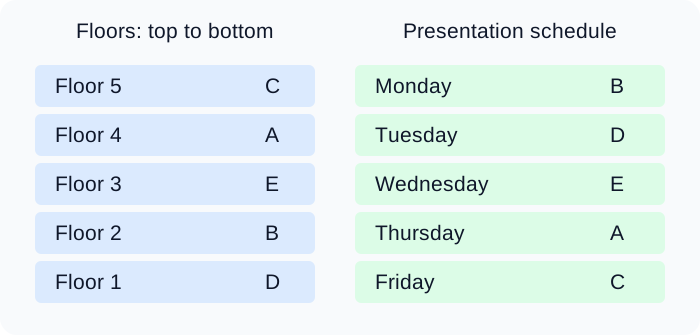
Final top-to-bottom order: C–A–E–B–D. E lives immediately above B. One person lives between A and B. Recheck all four clues; an unused name is placed only after the remaining slot is established.
5. Box stacks and linked blocks
A stack uses the same arithmetic as floors, but its wording often says “from top” and “from bottom”. For n boxes, position from top + position from bottom = n + 1. The third box from the top of a seven-box stack is fifth from the bottom.
If A is immediately above B, keep the block B–A when writing bottom-to-top. If C is immediately above A, the block becomes B–A–C. A block can slide among possible positions until another clue anchors it. Do not reverse the block when you change the drawing direction.
Example: P, Q, R, S, T are stacked. P is bottommost; Q is immediately above P; R is immediately above Q; T is immediately above R. S must be topmost. Bottom-to-top: P–Q–R–T–S. There are two boxes between Q and S. A clue about empty spaces must be represented separately; “two boxes between” is not necessarily “two levels between” if gaps exist.
6. Day schedules and consecutive blocks
List the allowed days first. If there is one event on each day Monday–Friday, the slots are consecutive calendar days. If only Monday, Wednesday and Friday are available, the next listed slot after Monday is Wednesday, but the next calendar day is Tuesday. Never replace one meaning with the other.
Worked example: A–E present Monday–Friday once each. B presents Monday; D presents immediately after B; A presents two days after D; E presents before A but after D. Therefore B is Monday, D Tuesday, A Thursday, E Wednesday and C Friday. The order is B–D–E–A–C.
“Before A but after D” is a bounded interval. If more than one free slot remains in that interval, retain the alternatives. It is unsafe to select the nearest slot without an immediate clue.
7. Month, date and multi-slot schedules
A calendar month difference is not a fixed number of days. January to March is two month steps, with February between. If a question lists January, March and June only, March is the second listed slot; it is not the second month of the year. Use the clue’s calendar unit.
When two events happen each month, use a two-column table such as early/late or 5th/20th. Specify whether “immediately before” means the previous chronological event or the previous day. Do not assume every month has 30 days or turn an unspecified year into a leap year.
For mixed date clues, first filter impossible dates, then connect people. A date such as 31 April is invalid; whether 29 February exists depends on the year. Calendar arithmetic is covered separately; a scheduling puzzle usually needs only the dates actually provided.
8. Person–subject matching: solve two dimensions
Suppose A, B and C present Monday–Wednesday. Subjects P, Q and R are each used once. A presents Monday. B presents R. Q is presented immediately before R. C does not present Q.
A is already Monday. B can be Tuesday or Wednesday. If B were Wednesday, Q would be Tuesday, which must then belong to C; that violates C’s clue. Thus B is Tuesday with R. A is Monday with Q, and C is Wednesday with P.
| Day | Person | Subject |
|---|---|---|
| Monday | A | Q |
| Tuesday | B | R |
| Wednesday | C | P |
The clue “B presents R” links person to subject, not to a particular day. It becomes a day assignment only when one of those entries is positioned. Keep such links together while testing cases.
9. Comparison, ranking and group distribution
For “A is taller than B; B is taller than C”, write A > B > C. This compares relative rank; it does not supply actual heights. With only A > B and A > C, the order of B and C remains unknown. “Second tallest” becomes a fixed slot only after the number of people and treatment of ties are known.
For distributions into teams, record each team’s capacity first. If six people must be divided into teams of three, filling one team determines the other. “A and B are not together” is an exclusion, while “A is with B” is a block. “At least one woman in each team” gives a minimum, not exactly one. Only use gender labels supplied by the question.
Example: A–F form two teams of three. A and B are together; C cannot be with A; D is with C; E is with A. The teams must be A–B–E and C–D–F. Team names can be interchangeable unless anchored by another clue.
10. How to branch without losing track
Start with fixed positions, large gaps and blocks: these usually restrict more cases. Place uncertain blocks in separate labelled cases. Copy only the information shared by all cases into a common table. Apply negative clues as soon as the relevant position becomes known.
Example: in five slots, A is two positions before B and C is immediately after B. The A–B–C placements can be (1,3,4) or (2,4,5); (3,5,6) is impossible. If D occupies slot 1, the first case fails because A cannot share it. The second case survives. The remaining person fills slot 3.
When a branch fails, record the exact contradiction: duplicate slot, repeated attribute, unavailable position or broken clue. This prevents returning to the same failed case. If you get no solutions, first check orientation and the difference-versus-between rule before deciding the question is faulty.
11. Unique solution versus definite answer
A full arrangement can be non-unique while one answer is certain. With A fixed in position 1 and B in position 2, C and D may swap in positions 3 and 4. A’s immediate successor is definitely B; the last person cannot be determined.
For “must be true”, a statement must hold in every valid arrangement. For “could be true”, one valid arrangement is sufficient. “Cannot be true” means none permits it. Never use a single trial arrangement as proof that a statement must hold.
For data sufficiency, test statement I alone, II alone, then both if needed. Do not carry information from the first trial into the second. Read the answer-option scheme because exams may label these combinations differently.
12. Common traps and correction checks
- Reverse orientation: label top/bottom or earliest/latest before placing names.
- Wrong gap: k intervening occupied slots means k + 1 position steps.
- Invented immediacy: “above” and “before” do not mean “immediately”.
- Repeated attributes: a one-to-one assignment uses every named attribute once.
- Incomplete negative clues: check “not”, “neither”, “at most” and “at least” separately.
- Answering the wrong entity: the question may ask for a subject, not the presenter.
- Assuming uniqueness: search for a surviving alternative when a question is not fully anchored.
- Mixing cases: a person assigned in Case 1 cannot be imported into Case 2 without deduction.
13. An efficient exam routine
Read the setup, draw the table, translate clues, place anchors, connect blocks, test cases and finally answer all questions from the same solution. Reuse the diagram for a five-question set. Mark the exact person or attribute mentioned in each question before reading the options.
For timed practice, record time spent on setup separately from time spent answering. If the table remains highly open, move to another set and return later. Review a wrong answer by locating the first violated clue, not by memorising the final order. Progress from floors and boxes to schedules, then to multi-attribute puzzles.
14. Quick revision card
Position difference = intervening occupied positions + 1. Top rank + bottom rank = total + 1. A fixed link between two entities is not a fixed position. A chronological slot is not necessarily a consecutive calendar day. One surviving example proves possibility; all surviving cases are needed to prove necessity. Read every clue again after completing the table.
Practice set: 30 questions
Draw a table for each set before reading its solution. The full online bank contains five questions for each of 16 sets. The following are 30 selected questions.
Practice 01
Set 1: Six people A–F live on six different floors, one per floor. Floor 1 is the lowest and floor 6 the highest. The stated order is bottom to top. C is exactly 3 floors above B. E is exactly 2 floors below F. B is exactly 1 floor above D. Who occupies position 3?
- A. A
- B. B
- C. F
- D. E
Practice 02
Set 1: Six people A–F live on six different floors, one per floor. Floor 1 is the lowest and floor 6 the highest. The stated order is bottom to top. C is exactly 3 floors above B. E is exactly 2 floors below F. B is exactly 1 floor above D. How many people occur strictly between D and A?
- A. 3
- B. 0
- C. 1
- D. 2
Practice 03
Set 2: Six people A–F live on six different floors, one per floor. Floor 1 is the lowest and floor 6 the highest. The stated order is bottom to top. B is exactly 3 floors below C. E is exactly 2 floors above C. D is exactly 2 floors above A. Who occupies position 6?
- A. B
- B. E
- C. C
- D. F
Practice 04
Set 2: Six people A–F live on six different floors, one per floor. Floor 1 is the lowest and floor 6 the highest. The stated order is bottom to top. B is exactly 3 floors below C. E is exactly 2 floors above C. D is exactly 2 floors above A. How many people occur strictly between F and D?
- A. 3
- B. 1
- C. 0
- D. 2
Practice 05
Set 3: Six people A–F live on six different floors, one per floor. Floor 1 is the lowest and floor 6 the highest. The stated order is bottom to top. B is exactly 3 floors below C. B is exactly 2 floors above E. D is exactly 1 floor above F. Who occupies position 3?
- A. A
- B. C
- C. B
- D. D
Practice 06
Set 3: Six people A–F live on six different floors, one per floor. Floor 1 is the lowest and floor 6 the highest. The stated order is bottom to top. B is exactly 3 floors below C. B is exactly 2 floors above E. D is exactly 1 floor above F. How many people occur strictly between B and D?
- A. 1
- B. 3
- C. 0
- D. 2
Practice 07
Set 4: Six people A–F live on six different floors, one per floor. Floor 1 is the lowest and floor 6 the highest. The stated order is bottom to top. B is exactly 3 floors above C. D is exactly 2 floors above B. F is exactly 2 floors below E. Who occupies position 6?
- A. A
- B. B
- C. C
- D. D
Practice 08
Set 4: Six people A–F live on six different floors, one per floor. Floor 1 is the lowest and floor 6 the highest. The stated order is bottom to top. B is exactly 3 floors above C. D is exactly 2 floors above B. F is exactly 2 floors below E. How many people occur strictly between C and B?
- A. 3
- B. 2
- C. 1
- D. 0
Practice 09
Set 5: Six boxes A–F form a vertical stack without gaps. Position 1 is the bottom and position 6 the top. The stated order is bottom to top. F is exactly 3 positions below A. F is exactly 2 positions above D. B is exactly 1 position below E. Which box occupies position 3?
- A. F
- B. B
- C. A
- D. E
Practice 10
Set 5: Six boxes A–F form a vertical stack without gaps. Position 1 is the bottom and position 6 the top. The stated order is bottom to top. F is exactly 3 positions below A. F is exactly 2 positions above D. B is exactly 1 position below E. How many boxes occur strictly between C and B?
- A. 2
- B. 0
- C. 1
- D. 3
Practice 11
Set 6: Six boxes A–F form a vertical stack without gaps. Position 1 is the bottom and position 6 the top. The stated order is bottom to top. F is exactly 3 positions below D. D is exactly 2 positions below C. E is exactly 3 positions above A. Which box occupies position 6?
- A. A
- B. C
- C. E
- D. B
Practice 12
Set 6: Six boxes A–F form a vertical stack without gaps. Position 1 is the bottom and position 6 the top. The stated order is bottom to top. F is exactly 3 positions below D. D is exactly 2 positions below C. E is exactly 3 positions above A. How many boxes occur strictly between B and C?
- A. 0
- B. 1
- C. 3
- D. 2
Practice 13
Set 7: Six boxes A–F form a vertical stack without gaps. Position 1 is the bottom and position 6 the top. The stated order is bottom to top. B is exactly 3 positions above E. E is exactly 2 positions above A. F is exactly 2 positions below C. Which box occupies position 3?
- A. F
- B. A
- C. E
- D. D
Practice 14
Set 7: Six boxes A–F form a vertical stack without gaps. Position 1 is the bottom and position 6 the top. The stated order is bottom to top. B is exactly 3 positions above E. E is exactly 2 positions above A. F is exactly 2 positions below C. How many boxes occur strictly between A and E?
- A. 1
- B. 2
- C. 0
- D. 3
Practice 15
Set 8: Six boxes A–F form a vertical stack without gaps. Position 1 is the bottom and position 6 the top. The stated order is bottom to top. F is exactly 3 positions below B. B is exactly 2 positions below C. A is exactly 2 positions above E. Which box occupies position 6?
- A. B
- B. A
- C. E
- D. C
Practice 16
Set 8: Six boxes A–F form a vertical stack without gaps. Position 1 is the bottom and position 6 the top. The stated order is bottom to top. F is exactly 3 positions below B. B is exactly 2 positions below C. A is exactly 2 positions above E. How many boxes occur strictly between D and A?
- A. 0
- B. 2
- C. 1
- D. 3
Practice 17
Set 9: Six people A–F each give one presentation on different days from Monday to Saturday, one per day. Positions 1–6 are chronological, with no skipped days. B is exactly 3 days before E. E is exactly 2 days before D. A is exactly 1 day after C. Who occupies position 3?
- A. A
- B. E
- C. C
- D. D
Practice 18
Set 9: Six people A–F each give one presentation on different days from Monday to Saturday, one per day. Positions 1–6 are chronological, with no skipped days. B is exactly 3 days before E. E is exactly 2 days before D. A is exactly 1 day after C. How many people occur strictly between A and F?
- A. 3
- B. 2
- C. 1
- D. 0
Practice 19
Set 10: Six people A–F each give one presentation on different days from Monday to Saturday, one per day. Positions 1–6 are chronological, with no skipped days. E is exactly 3 days before C. A is exactly 2 days after C. F is exactly 1 day after B. Who occupies position 6?
- A. F
- B. A
- C. E
- D. D
Practice 20
Set 10: Six people A–F each give one presentation on different days from Monday to Saturday, one per day. Positions 1–6 are chronological, with no skipped days. E is exactly 3 days before C. A is exactly 2 days after C. F is exactly 1 day after B. How many people occur strictly between E and C?
- A. 1
- B. 0
- C. 3
- D. 2
Practice 21
Set 11: Six people A–F each attend one event in different months from January to June, one per month. Positions 1–6 are chronological. All clues count calendar months, not days. F is exactly 3 months after D. C is exactly 2 months after F. E is exactly 3 months before B. Who occupies position 3?
- A. D
- B. F
- C. A
- D. E
Practice 22
Set 11: Six people A–F each attend one event in different months from January to June, one per month. Positions 1–6 are chronological. All clues count calendar months, not days. F is exactly 3 months after D. C is exactly 2 months after F. E is exactly 3 months before B. How many people occur strictly between E and F?
- A. 1
- B. 3
- C. 0
- D. 2
Practice 23
Set 12: Six people A–F each attend one event in different months from January to June, one per month. Positions 1–6 are chronological. All clues count calendar months, not days. F is exactly 3 months before A. D is exactly 2 months before C. B is exactly 3 months before D. Who occupies position 6?
- A. B
- B. E
- C. D
- D. C
Practice 24
Set 12: Six people A–F each attend one event in different months from January to June, one per month. Positions 1–6 are chronological. All clues count calendar months, not days. F is exactly 3 months before A. D is exactly 2 months before C. B is exactly 3 months before D. How many people occur strictly between E and C?
- A. 0
- B. 2
- C. 1
- D. 3
Practice 25
Set 13: Five people A–E present on Monday to Friday, one person per day. Each presents exactly one distinct subject P, Q, R, S or T; every subject is used once. Positions 1–5 are chronological, without gaps. D is exactly 3 days after A. Subject P is presented exactly 1 day before A. Subject T is presented exactly 2 days before B. Subject Q is presented exactly 1 day after C. Subject S is presented exactly 2 days after C. Who presents subject S?
- A. D
- B. B
- C. A
- D. C
Practice 26
Set 13: Five people A–E present on Monday to Friday, one person per day. Each presents exactly one distinct subject P, Q, R, S or T; every subject is used once. Positions 1–5 are chronological, without gaps. D is exactly 3 days after A. Subject P is presented exactly 1 day before A. Subject T is presented exactly 2 days before B. Subject Q is presented exactly 1 day after C. Subject S is presented exactly 2 days after C. Which subject does C present?
- A. Q
- B. S
- C. R
- D. T
Practice 27
Set 14: Five people A–E present on Monday to Friday, one person per day. Each presents exactly one distinct subject P, Q, R, S or T; every subject is used once. Positions 1–5 are chronological, without gaps. E is exactly 3 days before B. Subject S is presented exactly 1 day after B. Subject Q is presented exactly 2 days after D. A presents subject T. Subject P is presented exactly 1 day after E. Who presents subject S?
- A. E
- B. C
- C. D
- D. A
Practice 28
Set 14: Five people A–E present on Monday to Friday, one person per day. Each presents exactly one distinct subject P, Q, R, S or T; every subject is used once. Positions 1–5 are chronological, without gaps. E is exactly 3 days before B. Subject S is presented exactly 1 day after B. Subject Q is presented exactly 2 days after D. A presents subject T. Subject P is presented exactly 1 day after E. Which subject does A present?
- A. Q
- B. P
- C. R
- D. T
Practice 29
Set 15: Five people A–E present on Monday to Friday, one person per day. Each presents exactly one distinct subject P, Q, R, S or T; every subject is used once. Positions 1–5 are chronological, without gaps. E is exactly 3 days before D. Subject R is presented exactly 1 day after D. Subject Q is presented exactly 2 days after C. Subject P is presented exactly 1 day before A. Subject T is presented exactly 2 days before B. On which day does C present?
- A. Thursday
- B. Tuesday
- C. Monday
- D. Friday
Practice 30
Set 16: Five people A–E present on Monday to Friday, one person per day. Each presents exactly one distinct subject P, Q, R, S or T; every subject is used once. Positions 1–5 are chronological, without gaps. B is exactly 3 days after D. Subject R is presented exactly 1 day before D. Subject T is presented exactly 2 days before A. E presents subject Q. Subject P is presented exactly 2 days after E. Which subject is presented immediately after D?
- A. T
- B. R
- C. P
- D. Q
Answers and explanations
Answer 01
A. A
The only arrangement satisfying all clues is Floor 1: D; Floor 2: B; Floor 3: A; Floor 4: E; Floor 5: C; Floor 6: F. Read position 3 in the stated order.
Answer 02
C. 1
The only arrangement satisfying all clues is Floor 1: D; Floor 2: B; Floor 3: A; Floor 4: E; Floor 5: C; Floor 6: F. There are 2 position steps; subtract 1 to get 1 intervening items.
Answer 03
B. E
The only arrangement satisfying all clues is Floor 1: B; Floor 2: F; Floor 3: A; Floor 4: C; Floor 5: D; Floor 6: E. Read position 6 in the stated order.
Answer 04
D. 2
The only arrangement satisfying all clues is Floor 1: B; Floor 2: F; Floor 3: A; Floor 4: C; Floor 5: D; Floor 6: E. There are 3 position steps; subtract 1 to get 2 intervening items.
Answer 05
C. B
The only arrangement satisfying all clues is Floor 1: E; Floor 2: A; Floor 3: B; Floor 4: F; Floor 5: D; Floor 6: C. Read position 3 in the stated order.
Answer 06
A. 1
The only arrangement satisfying all clues is Floor 1: E; Floor 2: A; Floor 3: B; Floor 4: F; Floor 5: D; Floor 6: C. There are 2 position steps; subtract 1 to get 1 intervening items.
Answer 07
D. D
The only arrangement satisfying all clues is Floor 1: C; Floor 2: A; Floor 3: F; Floor 4: B; Floor 5: E; Floor 6: D. Read position 6 in the stated order.
Answer 08
B. 2
The only arrangement satisfying all clues is Floor 1: C; Floor 2: A; Floor 3: F; Floor 4: B; Floor 5: E; Floor 6: D. There are 3 position steps; subtract 1 to get 2 intervening items.
Answer 09
A. F
The only arrangement satisfying all clues is Position 1 from bottom: D; Position 2 from bottom: C; Position 3 from bottom: F; Position 4 from bottom: B; Position 5 from bottom: E; Position 6 from bottom: A. Read position 3 in the stated order.
Answer 10
C. 1
The only arrangement satisfying all clues is Position 1 from bottom: D; Position 2 from bottom: C; Position 3 from bottom: F; Position 4 from bottom: B; Position 5 from bottom: E; Position 6 from bottom: A. There are 2 position steps; subtract 1 to get 1 intervening items.
Answer 11
B. C
The only arrangement satisfying all clues is Position 1 from bottom: F; Position 2 from bottom: A; Position 3 from bottom: B; Position 4 from bottom: D; Position 5 from bottom: E; Position 6 from bottom: C. Read position 6 in the stated order.
Answer 12
D. 2
The only arrangement satisfying all clues is Position 1 from bottom: F; Position 2 from bottom: A; Position 3 from bottom: B; Position 4 from bottom: D; Position 5 from bottom: E; Position 6 from bottom: C. There are 3 position steps; subtract 1 to get 2 intervening items.
Answer 13
C. E
The only arrangement satisfying all clues is Position 1 from bottom: A; Position 2 from bottom: F; Position 3 from bottom: E; Position 4 from bottom: C; Position 5 from bottom: D; Position 6 from bottom: B. Read position 3 in the stated order.
Answer 14
A. 1
The only arrangement satisfying all clues is Position 1 from bottom: A; Position 2 from bottom: F; Position 3 from bottom: E; Position 4 from bottom: C; Position 5 from bottom: D; Position 6 from bottom: B. There are 2 position steps; subtract 1 to get 1 intervening items.
Answer 15
D. C
The only arrangement satisfying all clues is Position 1 from bottom: F; Position 2 from bottom: D; Position 3 from bottom: E; Position 4 from bottom: B; Position 5 from bottom: A; Position 6 from bottom: C. Read position 6 in the stated order.
Answer 16
B. 2
The only arrangement satisfying all clues is Position 1 from bottom: F; Position 2 from bottom: D; Position 3 from bottom: E; Position 4 from bottom: B; Position 5 from bottom: A; Position 6 from bottom: C. There are 3 position steps; subtract 1 to get 2 intervening items.
Answer 17
A. A
The only arrangement satisfying all clues is Monday: B; Tuesday: C; Wednesday: A; Thursday: E; Friday: F; Saturday: D. Read position 3 in the stated order.
Answer 18
C. 1
The only arrangement satisfying all clues is Monday: B; Tuesday: C; Wednesday: A; Thursday: E; Friday: F; Saturday: D. There are 2 position steps; subtract 1 to get 1 intervening items.
Answer 19
B. A
The only arrangement satisfying all clues is Monday: E; Tuesday: B; Wednesday: F; Thursday: C; Friday: D; Saturday: A. Read position 6 in the stated order.
Answer 20
D. 2
The only arrangement satisfying all clues is Monday: E; Tuesday: B; Wednesday: F; Thursday: C; Friday: D; Saturday: A. There are 3 position steps; subtract 1 to get 2 intervening items.
Answer 21
C. A
The only arrangement satisfying all clues is January: D; February: E; March: A; April: F; May: B; June: C. Read position 3 in the stated order.
Answer 22
A. 1
The only arrangement satisfying all clues is January: D; February: E; March: A; April: F; May: B; June: C. There are 2 position steps; subtract 1 to get 1 intervening items.
Answer 23
D. C
The only arrangement satisfying all clues is January: B; February: F; March: E; April: D; May: A; June: C. Read position 6 in the stated order.
Answer 24
B. 2
The only arrangement satisfying all clues is January: B; February: F; March: E; April: D; May: A; June: C. There are 3 position steps; subtract 1 to get 2 intervening items.
Answer 25
A. D
The only arrangement satisfying all clues is Monday: E / P; Tuesday: A / T; Wednesday: C / R; Thursday: B / Q; Friday: D / S. Match the person and subject in the Friday row.
Answer 26
C. R
The only arrangement satisfying all clues is Monday: E / P; Tuesday: A / T; Wednesday: C / R; Thursday: B / Q; Friday: D / S. Read the subject in the same row as the named person.
Answer 27
B. C
The only arrangement satisfying all clues is Monday: E / R; Tuesday: D / P; Wednesday: A / T; Thursday: B / Q; Friday: C / S. Match the person and subject in the Friday row.
Answer 28
D. T
The only arrangement satisfying all clues is Monday: E / R; Tuesday: D / P; Wednesday: A / T; Thursday: B / Q; Friday: C / S. Read the subject in the same row as the named person.
Answer 29
B. Tuesday
The only arrangement satisfying all clues is Monday: E / S; Tuesday: C / P; Wednesday: A / T; Thursday: D / Q; Friday: B / R. Read position 2: Tuesday.
Answer 30
D. Q
The only arrangement satisfying all clues is Monday: C / R; Tuesday: D / T; Wednesday: E / Q; Thursday: A / S; Friday: B / P. The named person presents on Tuesday; read Wednesday’s subject.
Online practice
Four level tests contain 20 questions each: floors, boxes, days/months and person–subject matching. The complete test contains all 80 questions. Build accuracy first, then speed.
This is AI-generated information.