Statement-Based Reasoning: Conclusions, Assumptions and Arguments
1. Identify what the question is testing
Statement-based reasoning asks you to evaluate what follows from information, what an argument takes for granted, whether evidence supports a claim, or what action addresses a problem. These are different tasks. A sensible suggestion is not automatically a necessary conclusion; a necessary assumption is not automatically sufficient to prove a plan will succeed.
For deduction questions, treat the supplied premises as true and do not add outside facts. For practical arguments, judge relevance, feasibility and the stated objective. The situations in this chapter are hypothetical. They are reasoning exercises, not claims about actual institutions.
2. Separate premise, conclusion and assumption
A premise is the information given as a reason. A conclusion is the claim the argument supports. An assumption is an unstated link needed to connect the premise to the conclusion or to make the proposed mechanism work.
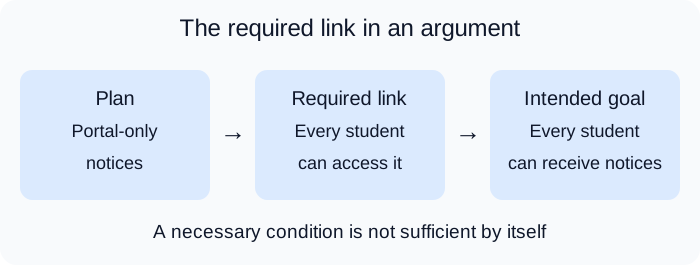
Example: “We will publish notices only on a portal, so every student will be able to receive them.” The proposed action is portal-only publication; the intended result is universal access to notices. A necessary bridge is that every student has a usable way to access the portal. It is not necessary that everyone likes the portal’s colour.
That bridge alone does not guarantee success: notices must also be uploaded correctly and made available on time. A condition can be necessary without being sufficient.
3. Statement–conclusion: necessity, not plausibility
A conclusion follows only if it is true in every situation consistent with the statements. To show that it does not necessarily follow, give one situation where all premises are true but the conclusion is false. This is a counterexample.
“All registered members have a card. Arun is a registered member.” Therefore Arun has a card. But “Arun has a card” by itself does not prove he is registered: the premises did not say only registered members can have cards.
“Some members are runners” guarantees at least one member who runs, not that all members run. “All A are B” does not by itself assert that A exist under the modern logical convention. Read the convention if an exam uses a different one; do not silently turn a universal claim into an existence claim.
4. Conditional rules: if, only if and unless
“If P, then Q” means P is sufficient for Q and Q is necessary for P. Two valid deductions are:
- P → Q and P, therefore Q.
- P → Q and not Q, therefore not P.
Two invalid shortcuts are Q therefore P, and not P therefore not Q. Q may happen through another route. A condition failing does not prove its outcome cannot happen otherwise.
“P only if Q” also means P → Q. “P if Q” means Q → P. “P if and only if Q” includes both directions. “P unless Q”, under the ordinary inclusive logical reading, means if not Q then P; it does not automatically prohibit both P and Q. Respect any explicit definition in the question.
Worked example: if a form is complete, a ticket is issued. No ticket was issued. The form cannot have been complete under that rule. If a ticket was issued, however, the form’s completeness is not established unless the reverse rule is also supplied.
5. And, or, not and quantifiers
“P and Q” needs both. Inclusive “P or Q” needs at least one and permits both. “Either P or Q, but not both” needs exactly one. “Not both” rules out their simultaneous truth but allows both to be false.
The negation of “P and Q” is “not P or not Q”. The negation of “P or Q” is “not P and not Q”. The negation of “all members attended” is “at least one member did not attend”, not “no member attended”. The negation of “some members attended” is “no member attended”.
Words such as all, some, only, never, always and at least affect the logical strength. “Many” is not “all”; “may” is not “must”. Keep the same population and time period when comparing statements.
6. Necessary assumptions and the negation test
Ask: if this proposed assumption were false, would the stated reasoning lose an essential link? If yes, it may be necessary. If the plan could still work through its stated mechanism without the assumption, it is not required.
A library proposes barcode checkout using existing labels. The scanner must be able to read those labels. Negating that condition breaks the proposed mechanism. “The plan is the cheapest conceivable option” is not necessary unless the goal specifically requires absolute minimum cost.
Negate precisely. Negating “every student can access the portal” means “at least one student cannot”, not “no student can”. Negating “some users benefit” means “none benefit”. The test identifies a required link; it does not prove the whole argument sound or make the assumption a known fact.
7. Strong and weak arguments
A strong argument directly addresses the question and supplies a relevant reason with a credible connection to the objective. A weak one may be irrelevant, circular, unsupported, excessively absolute or based only on popularity. A long argument is not necessarily stronger than a short one.
If a proposal aims to reduce checkout time, a representative trial comparing time and errors under similar loads is relevant. A celebrity liking its name is not evidence of speed. A trial using only the easiest transactions may be less representative than it appears.
Judge the argument given, not whether you personally favour the proposal. An emotionally attractive claim can still lack evidence. Authority may be relevant when the expertise and supporting evidence fit the issue; a famous name alone is not proof.
8. Strengthening and weakening
A strengthening statement increases support for the conclusion; it need not prove it. A weakening statement reduces support; it need not establish that the conclusion is false. When the question says to treat a new finding as true, evaluate its effect rather than challenging its truth.
For a shared calendar intended to reduce conflicts, evidence that users update it and conflict rates fall under comparable conditions supports the mechanism. Evidence that users never enter unavailable periods undermines it. Changing the calendar’s colour has little bearing on scheduling accuracy.
Look for the missing bridge. Does the evidence test the plan’s mechanism, sample, comparison group or predicted outcome? Avoid choosing evidence that repeats the conclusion in different words without adding support.
9. Cause and effect: avoid the automatic leap
Two things occurring together do not prove one caused the other. A change happening before another is necessary for many causal explanations but is not sufficient evidence of causation. Consider a third factor, reverse direction, selection bias, chance and simultaneous changes.
Example: a library installs a new checkout system and waiting time falls. Possible alternatives include fewer visitors, more staff or a quieter season. Compare similar demand and staffing, use a suitable baseline and, when feasible, a comparison group. A carefully designed trial can reduce these alternative explanations; no brief observation automatically removes them all.
If two outcomes share a common cause, do not label either as the cause of the other. Hot weather might increase both cold-drink sales and fan use. Their association alone does not show that buying drinks causes people to use fans.
10. Course of action: relevant, feasible and proportionate
A proposed action should address the stated problem, be practical within the facts, and be proportionate to the evidence. Prefer checking the key uncertainty through a targeted pilot when full implementation depends on an untested mechanism. Avoid unrelated action, unsupported punishment or permanent cancellation merely because success is not guaranteed.
Example: before replacing printed notices with portal-only notices, audit access and test retrieval. This directly examines whether the stated universal-access goal is feasible. A rollout without checking access skips the key risk. Changing an unrelated room’s decoration does not address it.
An action question asks what to do, not what must already be true. Sometimes more than one action can be useful; choose the one that best matches the question’s timing, constraints and priority. Do not assume unlimited money or authority.
11. Measure the intended result, not an easy substitute
If the aim is to reduce misplaced tools, measure misplaced-tool incidents relative to usage. Counting new labels measures activity, not the desired benefit. If the aim is to improve access, track successful access among the intended users, not just how many files were uploaded.
Use rates when the amount of activity changes. Ten errors out of 100 transactions differs from ten out of 1,000. Check side effects: a faster checkout with many incorrect records may not be a successful improvement. Compare a suitable baseline and inspect other changes before attributing the result to the plan alone.
12. Common reasoning errors
| Error | Why it fails |
|---|---|
| Affirming the consequent | P → Q and Q do not prove P |
| Denying the antecedent | P → Q and not P do not prove not Q |
| Hasty generalisation | A narrow sample may not represent everyone |
| False dilemma | Two listed options may not exhaust the possibilities |
| Circular reasoning | Restating the claim supplies no independent support |
| Personal attack | Criticising a person does not refute the reasoning |
| Correlation treated as causation | Association leaves alternative explanations |
| Necessary confused with sufficient | A required condition may not ensure success |
Read the exact question before using any shortcut. “Which conclusion follows?” demands necessity; “which most strengthens?” asks for comparative support; “which first action?” asks for a relevant next step.
13. A short worked argument review
Claim: “The training centre should add captions so participants who rely on text can follow videos.”
- Goal: access to the spoken lesson content for the specified users.
- Necessary link: captions convey the relevant content accurately enough.
- Strengthening evidence: target users understand a representative captioned version better than the same uncaptioned lesson.
- Weakening evidence: captions systematically show unrelated text.
- Relevant first step: check accuracy and test comprehension with intended users.
- Outcome measure: comprehension, not the number of decorative caption styles.
The favourable evidence supports the proposal without guaranteeing all future lessons will be successful. The assumption remains a required condition, not a fact proven merely by proposing the plan.
14. Exam routine
Underline the task word: follows, assumes, strengthens, weakens, cause or action. Separate facts from the claim. For conclusions, seek a valid proof or counterexample. For assumptions, negate the option precisely. For arguments, test relevance and the missing link. For causal claims, search for alternatives. For actions, check feasibility and proportionality.
In this chapter’s first 20 questions, P, Q and R are explicitly defined statements. All eight truth assignments are checked to validate deductions. The remaining questions use practical scenarios and explanations; their answers are selected by the stated goal and mechanism, not by a claim that every real-world decision has one universal answer.
Practice set: 30 questions
Practice 01
For one applicant, P means the form is complete, Q means a ticket is issued, and R means entry is granted. Use only the following statements; do not assume any unstated policy. Statements: Q is true; P is true; P and R are not both true. Conclusions: I. P is true. II. Q is false. Which must follow?
- A. Only I follows
- B. Only II follows
- C. Both follow
- D. Neither follows
Practice 02
For one applicant, P means the form is complete, Q means a ticket is issued, and R means entry is granted. Use only the following statements; do not assume any unstated policy. Statements: Q is false; Q and R are not both true; At least one of P and Q is true. Conclusions: I. Q is true. II. P is true. Which must follow?
- A. Only I follows
- B. Only II follows
- C. Both follow
- D. Neither follows
Practice 03
For one applicant, P means the form is complete, Q means a ticket is issued, and R means entry is granted. Use only the following statements; do not assume any unstated policy. Statements: Q is false; R is false; At least one of P and R is true. Conclusions: I. R is false. II. Q is false. Which must follow?
- A. Only I follows
- B. Only II follows
- C. Both follow
- D. Neither follows
Practice 04
For one applicant, P means the form is complete, Q means a ticket is issued, and R means entry is granted. Use only the following statements; do not assume any unstated policy. Statements: If Q is true, then R is true; Q and R are not both true; P and R are not both true. Conclusions: I. Q is true. II. R is true. Which must follow?
- A. Only I follows
- B. Only II follows
- C. Both follow
- D. Neither follows
Practice 05
For one applicant, P means the form is complete, Q means a ticket is issued, and R means entry is granted. Use only the following statements; do not assume any unstated policy. Statements: R is false; If R is true, then P is true; P and R are not both true. Conclusions: I. P is false. II. R is true. Which must follow?
- A. Only I follows
- B. Only II follows
- C. Both follow
- D. Neither follows
Practice 06
For one applicant, P means the form is complete, Q means a ticket is issued, and R means entry is granted. Use only the following statements; do not assume any unstated policy. Statements: P and Q are not both true; At least one of P and R is true; P and R are not both true. Conclusions: I. P is false. II. P is true. Which must follow?
- A. Only I follows
- B. Only II follows
- C. Both follow
- D. Neither follows
Practice 07
For one applicant, P means the form is complete, Q means a ticket is issued, and R means entry is granted. Use only the following statements; do not assume any unstated policy. Statements: If P is true, then R is true; At least one of P and R is true; If P is true, then Q is true. Conclusions: I. R is false. II. Q is false. Which must follow?
- A. Only I follows
- B. Only II follows
- C. Both follow
- D. Neither follows
Practice 08
For one applicant, P means the form is complete, Q means a ticket is issued, and R means entry is granted. Use only the following statements; do not assume any unstated policy. Statements: If P is true, then Q is true; P and R are not both true; P and Q are not both true. Conclusions: I. P is true. II. R is false. Which must follow?
- A. Only I follows
- B. Only II follows
- C. Both follow
- D. Neither follows
Practice 09
A school will replace all printed notices with portal-only notices. Its stated goal is that every enrolled student can receive notices, with no alternative channel. Which condition is necessary for the stated mechanism to work?
- A. Every enrolled student has a usable way to access the portal.
- B. The plan must be the cheapest conceivable plan.
- C. Every participant must prefer the plan aesthetically.
- D. No other method could ever achieve the goal.
Practice 10
A school will replace all printed notices with portal-only notices. Its stated goal is that every enrolled student can receive notices, with no alternative channel. Which finding most directly defeats the necessary condition of the proposed mechanism?
- A. Some people prefer another colour scheme.
- B. Some enrolled students have no way to access the portal.
- C. The plan has a short name.
- D. An unrelated activity also takes place.
Practice 11
A team will use a shared calendar to prevent avoidable meeting conflicts. It will rely on members entering their unavailable periods. Which condition is necessary for the stated mechanism to work?
- A. Members provide sufficiently accurate and timely unavailability entries.
- B. The plan must be the cheapest conceivable plan.
- C. Every participant must prefer the plan aesthetically.
- D. No other method could ever achieve the goal.
Practice 12
A workshop wants to reduce misplaced tools by introducing labelled return slots. The mechanism requires users to identify the correct slot. Which finding most directly defeats the necessary condition of the proposed mechanism?
- A. Some people prefer another colour scheme.
- B. The plan has a short name.
- C. An unrelated activity also takes place.
- D. The labels are indistinguishable to the intended users.
Practice 13
A store wants to reduce duplicate stock entries using a unique item code. Different item types must remain separately identifiable. Which condition is necessary for the stated mechanism to work?
- A. The plan must be the cheapest conceivable plan.
- B. Every participant must prefer the plan aesthetically.
- C. Distinct item types can be assigned codes without collisions.
- D. No other method could ever achieve the goal.
Practice 14
A training centre proposes captions so participants who rely on text can follow video lessons. The captions must convey the spoken lesson content. Which finding most directly defeats the necessary condition of the proposed mechanism?
- A. Some people prefer another colour scheme.
- B. The captions systematically replace the lesson with unrelated text.
- C. The plan has a short name.
- D. An unrelated activity also takes place.
Practice 15
A school garden will use collected rainwater in a dry week. The plan depends on storing the collected water until it is needed. Which condition is necessary for the stated mechanism to work?
- A. The storage arrangement retains usable water until the planned use.
- B. The plan must be the cheapest conceivable plan.
- C. Every participant must prefer the plan aesthetically.
- D. No other method could ever achieve the goal.
Practice 16
A software team plans automated tests to detect a particular known failure before release. The plan relies on those tests failing when that fault is present. Which finding most directly defeats the necessary condition of the proposed mechanism?
- A. Some people prefer another colour scheme.
- B. The plan has a short name.
- C. An unrelated activity also takes place.
- D. The tests pass regardless of whether the targeted failure is present.
Practice 17
A school will replace all printed notices with portal-only notices. Its stated goal is that every enrolled student can receive notices, with no alternative channel. Treat each offered finding as true. Which most strengthens the practical case for the plan?
- A. An access audit and trial confirm that every enrolled student can retrieve a sample notice.
- B. Self-selected supporters say they expect the plan to work, without testing it.
- C. Publicity about the proposal has increased, but no outcome has been measured.
- D. A different institution reports success but uses a different mechanism and population.
Practice 18
A library plans barcode checkout to reduce transaction time. The proposed process requires the scanner to read the labels on books. Which finding most weakens reliance on the proposed mechanism?
- A. A representative trial reads the labels reliably and reduces checkout time under comparable loads.
- B. The proposal has a clear heading.
- C. Some participants like the idea.
- D. The scanner cannot read the labels used on the books.
Practice 19
A workshop wants to reduce misplaced tools by introducing labelled return slots. The mechanism requires users to identify the correct slot. Treat each offered finding as true. Which most strengthens the practical case for the plan?
- A. Self-selected supporters say they expect the plan to work, without testing it.
- B. Publicity about the proposal has increased, but no outcome has been measured.
- C. A controlled pilot finds fewer misplaced tools with readable labels under similar workloads.
- D. A different institution reports success but uses a different mechanism and population.
Practice 20
A reading club proposes recorded sessions so absent members can hear the content later. Playback is the only proposed way to recover a missed session. Which finding most weakens reliance on the proposed mechanism?
- A. A trial shows absent members can access intelligible recordings of complete sessions.
- B. Absent members cannot play the recordings by any available means.
- C. The proposal has a clear heading.
- D. Some participants like the idea.
Practice 21
A training centre proposes captions so participants who rely on text can follow video lessons. The captions must convey the spoken lesson content. Treat each offered finding as true. Which most strengthens the practical case for the plan?
- A. Target users comprehend a representative captioned lesson better than the same uncaptioned version.
- B. Self-selected supporters say they expect the plan to work, without testing it.
- C. Publicity about the proposal has increased, but no outcome has been measured.
- D. A different institution reports success but uses a different mechanism and population.
Practice 22
An office proposes numbered queue tokens so visitors can be served in arrival order. The plan assigns tokens at arrival and calls numbers in sequence. Which finding most weakens reliance on the proposed mechanism?
- A. A pilot records token assignment matching arrivals and fewer out-of-order calls.
- B. The proposal has a clear heading.
- C. Some participants like the idea.
- D. Token numbers are assigned independently of arrival order.
Practice 23
A software team plans automated tests to detect a particular known failure before release. The plan relies on those tests failing when that fault is present. Treat each offered finding as true. Which most strengthens the practical case for the plan?
- A. Self-selected supporters say they expect the plan to work, without testing it.
- B. Publicity about the proposal has increased, but no outcome has been measured.
- C. A trial with the known fault inserted reliably causes the tests to fail.
- D. A different institution reports success but uses a different mechanism and population.
Practice 24
A software team plans automated tests to detect a particular known failure before release. The plan relies on those tests failing when that fault is present. Which finding most weakens reliance on the proposed mechanism?
- A. A trial with the known fault inserted reliably causes the tests to fail.
- B. The proposal has a clear heading.
- C. Some participants like the idea.
- D. The tests pass regardless of whether the targeted failure is present.
Practice 25
A school will replace all printed notices with portal-only notices. Its stated goal is that every enrolled student can receive notices, with no alternative channel. Before full implementation, which is the most relevant and proportionate first step?
- A. Audit student access and pilot retrieval before withdrawing printed notices.
- B. Implement everywhere immediately without checking the mechanism.
- C. Cancel permanently because success is not guaranteed.
- D. Change an unrelated room’s decoration instead.
Practice 26
A library plans barcode checkout to reduce transaction time. The proposed process requires the scanner to read the labels on books. Which outcome should be measured most directly to assess the intended benefit?
- A. The amount of money spent, without any outcome information.
- B. How many people heard the announcement, regardless of whether the goal was achieved.
- C. The number of implementation meetings, without checking their effects.
- D. Checkout time and error rate under comparable transaction loads.
Practice 27
A workshop wants to reduce misplaced tools by introducing labelled return slots. The mechanism requires users to identify the correct slot. Before full implementation, which is the most relevant and proportionate first step?
- A. Implement everywhere immediately without checking the mechanism.
- B. Cancel permanently because success is not guaranteed.
- C. Test label clarity with users and pilot the return system.
- D. Change an unrelated room’s decoration instead.
Practice 28
A reading club proposes recorded sessions so absent members can hear the content later. Playback is the only proposed way to recover a missed session. Which outcome should be measured most directly to assess the intended benefit?
- A. The amount of money spent, without any outcome information.
- B. The share of absent members able to access and understand the missed content.
- C. How many people heard the announcement, regardless of whether the goal was achieved.
- D. The number of implementation meetings, without checking their effects.
Practice 29
An office proposes numbered queue tokens so visitors can be served in arrival order. The plan assigns tokens at arrival and calls numbers in sequence. Before full implementation, which is the most relevant and proportionate first step?
- A. Implement everywhere immediately without checking the mechanism.
- B. Cancel permanently because success is not guaranteed.
- C. Pilot the arrival-to-token process and audit call order.
- D. Change an unrelated room’s decoration instead.
Practice 30
A software team plans automated tests to detect a particular known failure before release. The plan relies on those tests failing when that fault is present. Which outcome should be measured most directly to assess the intended benefit?
- A. The amount of money spent, without any outcome information.
- B. How many people heard the announcement, regardless of whether the goal was achieved.
- C. The number of implementation meetings, without checking their effects.
- D. Detection rate for the targeted fault, alongside false alarms.
Answers and explanations
Answer 01
A. Only I follows
1: This conclusion is true in every assignment satisfying all statements, so it follows. 2: Does not follow. P=true, Q=true, R=false satisfies all premises but makes this conclusion false.
Answer 02
B. Only II follows
1: Does not follow. P=true, Q=false, R=false satisfies all premises but makes this conclusion false. 2: This conclusion is true in every assignment satisfying all statements, so it follows.
Answer 03
C. Both follow
1: This conclusion is true in every assignment satisfying all statements, so it follows. 2: This conclusion is true in every assignment satisfying all statements, so it follows.
Answer 04
D. Neither follows
1: Does not follow. P=false, Q=false, R=false satisfies all premises but makes this conclusion false. 2: Does not follow. P=false, Q=false, R=false satisfies all premises but makes this conclusion false.
Answer 05
D. Neither follows
1: Does not follow. P=true, Q=false, R=false satisfies all premises but makes this conclusion false. 2: Does not follow. P=false, Q=false, R=false satisfies all premises but makes this conclusion false.
Answer 06
D. Neither follows
1: Does not follow. P=true, Q=false, R=false satisfies all premises but makes this conclusion false. 2: Does not follow. P=false, Q=false, R=true satisfies all premises but makes this conclusion false.
Answer 07
D. Neither follows
1: Does not follow. P=false, Q=false, R=true satisfies all premises but makes this conclusion false. 2: Does not follow. P=false, Q=true, R=true satisfies all premises but makes this conclusion false.
Answer 08
D. Neither follows
1: Does not follow. P=false, Q=false, R=false satisfies all premises but makes this conclusion false. 2: Does not follow. P=false, Q=false, R=true satisfies all premises but makes this conclusion false.
Answer 09
A. Every enrolled student has a usable way to access the portal.
The mechanism explicitly relies on this link. Denying it gives: Some enrolled students have no way to access the portal. That blocks the proposed route to the goal. Necessity does not make the condition sufficient by itself.
Answer 10
B. Some enrolled students have no way to access the portal.
This is the direct negation of the required link: Every enrolled student has a usable way to access the portal. The other findings do not test that link.
Answer 11
A. Members provide sufficiently accurate and timely unavailability entries.
The mechanism explicitly relies on this link. Denying it gives: Members never enter their unavailable periods. That blocks the proposed route to the goal. Necessity does not make the condition sufficient by itself.
Answer 12
D. The labels are indistinguishable to the intended users.
This is the direct negation of the required link: Users can distinguish the labelled slots well enough to return tools correctly. The other findings do not test that link.
Answer 13
C. Distinct item types can be assigned codes without collisions.
The mechanism explicitly relies on this link. Denying it gives: Different item types are necessarily assigned the same code with no other distinction. That blocks the proposed route to the goal. Necessity does not make the condition sufficient by itself.
Answer 14
B. The captions systematically replace the lesson with unrelated text.
This is the direct negation of the required link: The captions represent the relevant spoken content accurately enough to follow it. The other findings do not test that link.
Answer 15
A. The storage arrangement retains usable water until the planned use.
The mechanism explicitly relies on this link. Denying it gives: All collected water is lost before the planned use. That blocks the proposed route to the goal. Necessity does not make the condition sufficient by itself.
Answer 16
D. The tests pass regardless of whether the targeted failure is present.
This is the direct negation of the required link: The tests are capable of exposing the targeted failure. The other findings do not test that link.
Answer 17
A. An access audit and trial confirm that every enrolled student can retrieve a sample notice.
The finding tests the relevant mechanism or intended outcome. It supports the plan but does not guarantee identical results in every future situation.
Answer 18
D. The scanner cannot read the labels used on the books.
The finding breaks a required connection between the plan and its goal. Support, popularity and presentation do not repair this missing connection.
Answer 19
C. A controlled pilot finds fewer misplaced tools with readable labels under similar workloads.
The finding tests the relevant mechanism or intended outcome. It supports the plan but does not guarantee identical results in every future situation.
Answer 20
B. Absent members cannot play the recordings by any available means.
The finding breaks a required connection between the plan and its goal. Support, popularity and presentation do not repair this missing connection.
Answer 21
A. Target users comprehend a representative captioned lesson better than the same uncaptioned version.
The finding tests the relevant mechanism or intended outcome. It supports the plan but does not guarantee identical results in every future situation.
Answer 22
D. Token numbers are assigned independently of arrival order.
The finding breaks a required connection between the plan and its goal. Support, popularity and presentation do not repair this missing connection.
Answer 23
C. A trial with the known fault inserted reliably causes the tests to fail.
The finding tests the relevant mechanism or intended outcome. It supports the plan but does not guarantee identical results in every future situation.
Answer 24
D. The tests pass regardless of whether the targeted failure is present.
The finding breaks a required connection between the plan and its goal. Support, popularity and presentation do not repair this missing connection.
Answer 25
A. Audit student access and pilot retrieval before withdrawing printed notices.
A focused pilot checks feasibility and the plan’s key risk before full implementation. The alternatives either skip evidence, overreact to uncertainty or ignore the goal.
Answer 26
D. Checkout time and error rate under comparable transaction loads.
Measure the outcome tied to the stated goal. Compare with a suitable baseline and check other changes before attributing improvement to the plan alone.
Answer 27
C. Test label clarity with users and pilot the return system.
A focused pilot checks feasibility and the plan’s key risk before full implementation. The alternatives either skip evidence, overreact to uncertainty or ignore the goal.
Answer 28
B. The share of absent members able to access and understand the missed content.
Measure the outcome tied to the stated goal. Compare with a suitable baseline and check other changes before attributing improvement to the plan alone.
Answer 29
C. Pilot the arrival-to-token process and audit call order.
A focused pilot checks feasibility and the plan’s key risk before full implementation. The alternatives either skip evidence, overreact to uncertainty or ignore the goal.
Answer 30
D. Detection rate for the targeted fault, alongside false alarms.
Measure the outcome tied to the stated goal. Compare with a suitable baseline and check other changes before attributing improvement to the plan alone.
Online exams
Four tests contain 20 questions each: conclusions, necessary assumptions, strengthening/weakening arguments and actions/outcome assessment. The complete test contains all 80 questions. Scenarios are hypothetical; answer using their stated goals and information.
This is AI-generated information.