Mathematical Operations: BODMAS, Sign Changes and Equation Repair
1. Read the instruction before calculating
These questions test arithmetic together with the meaning of an instruction. You may need to evaluate an expression, replace coded signs, interchange two operators, fill missing operators or swap two whole numbers. These are different actions.
Identify what may change, where the change applies, and what must stay fixed. “Swap + and ×” is not “replace every + by × while leaving × unchanged”. “Interchange two numbers” is not permission to reverse their digits. In this chapter repair questions explicitly restrict changes to the left-hand side; the right-hand target remains fixed.
2. BODMAS is a hierarchy, not six separate priority levels
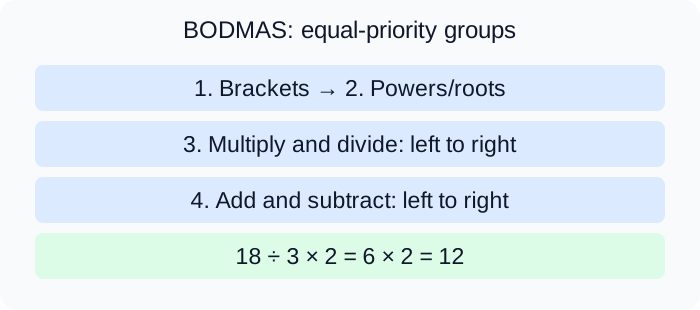
B means brackets, O means orders such as powers and roots, D/M means division and multiplication, and A/S means addition and subtraction. Division and multiplication have equal priority and are evaluated left to right. Addition and subtraction also have equal priority and are evaluated left to right.
| Priority | Operations | Rule |
|---|---|---|
| First | Bracketed groups | Work from innermost groups outward |
| Next | Powers and roots | Respect the grouping of the exponent/root |
| Next | Multiplication and division | Equal priority; left to right |
| Last | Addition and subtraction | Equal priority; left to right |
For 18 ÷ 3 × 2, compute 18 ÷ 3 = 6, then 6 × 2 = 12. Do not multiply 3 × 2 first. For 25 − 8 + 3, compute 17 + 3 = 20, not 25 − 11. The letters D before M and A before S are not instructions to give those operations separate precedence.
3. Brackets and grouping
Parentheses, square brackets and braces can all group arithmetic expressions. Their nesting determines which to evaluate first; the shape alone does not create a universal rule that round brackets always precede square brackets regardless of nesting.
Example: 9 − [6 − (4 − 1)]. First 4 − 1 = 3. Next 6 − 3 = 3. Finally 9 − 3 = 6. Keep a leading minus until the entire group is known. Removing brackets after a subtraction changes every sign inside: a − (b − c) = a − b + c.
A fraction bar groups its complete numerator and denominator. (18 + 6)/(7 − 3) is 24/4 = 6. It is not the ungrouped expression 18 + 6 ÷ 7 − 3. Write explicit brackets if the printed layout might be misunderstood.
4. Powers, roots and negative signs
This chapter uses ^ for exponentiation. Chained powers associate to the right: 2^3^2 means 2^(3²) = 2^9 = 512. By contrast, (2^3)^2 = 8² = 64. Follow explicit brackets if a question gives them.
A leading minus outside a power differs from a negative base inside brackets: −3² = −(3²) = −9, whereas (−3)² = 9. Thus −3² + 20 = 11, while (−3)² + 4 = 13.
The radical √16 denotes the principal, nonnegative square root 4. Solving x² = 16 gives two real solutions, +4 and −4; these are different tasks. Never divide by zero. If a proposed operator replacement produces a zero denominator, it is invalid for an ordinary numerical equality.
5. Fractions and decimals
Keep exact fractions when possible. For 20 ÷ 8 × 2, left-to-right evaluation gives (20/8) × 2 = 5. It does not give 20/(8×2). For (7 + 5)/8 + 3/4, the result is 12/8 + 6/8 = 18/8 = 9/4.
Do not round midway unless the question requests approximation. A displayed answer such as 9/4 is a reduced fraction, not a new instruction to change a coded sign. In these MCQs the code key applies to the given expression, while answer options are ordinary numerical values.
For decimal calculations, align place values in addition and subtraction and track decimal places in multiplication. Verify an estimate to catch a result that is ten or one hundred times too large.
6. Coded signs: decode once, then calculate
A question can assign a new meaning to a familiar sign. Its key controls the meaning; do not use ordinary arithmetic until you have rewritten the expression.
Example key: + means ×, × means −, and − means +. Evaluate 8 + 3 × 5 − 2. Simultaneous decoding gives 8 × 3 − 5 + 2, then 24 − 5 + 2 = 21.
Apply the key to the original displayed signs exactly once. Do not replace + by × and then replace that newly created × again by −. That repeated replacement corrupts a cyclic key. Keep numbers and brackets unchanged unless the instruction says otherwise. After decoding, standard precedence applies to the actual operations, not to the original symbols.
7. Interchanging two signs
An interchange is a two-way replacement: every chosen sign becomes the other, within the stated scope. Example: swap + and × on the left of 6 + 3 × 2 = 20. The left becomes 6 × 3 + 2, which is 18 + 2 = 20.
A reliable procedure is: copy the expression, replace both signs simultaneously, calculate afresh with BODMAS, compare with the fixed right side. Do not preserve intermediate results from the original expression because its priority structure may have changed.
If a sign occurs twice, change both occurrences when the instruction says everywhere. Do not alter the right side unless the question explicitly includes it. If several pairs appear to work, recheck the scope and precedence; the generated repair questions here were checked for a unique valid pair.
8. Fill missing operators in their stated order
An option “+, ×” means insert + into the first blank and × into the second. The reversed pair is a different answer. Example: 8 □ 3 □ 2 = 14 is solved by +, ×, because 8 + 3 × 2 = 14. ×, + gives 26.
Use the normal operation hierarchy after insertion. Do not evaluate strictly left to right across unequal priorities, and do not invent brackets to make a choice fit. If the instructions allow brackets, their placement becomes an additional variable and must be specified.
You can eliminate options with a quick size or sign check, but verify the surviving option with exact arithmetic. A rough estimate is not a proof of equality.
9. Interchanging whole numbers
For 8 − 3 × 2 = 2, swap the whole numbers 8 and 2 on the left: 2 − 3 × 8 = −22, not 2. This is a failed trial; reject it rather than changing another part of the equation. Testing an option requires calculation after the swap.
A successful example is 2 + 9 × 3 = 15: swapping 2 and 3 yields 3 + 9 × 2 = 21, so that pair fails; swapping 2 and 9 yields 9 + 2 × 3 = 15, so 2 ↔ 9 works. The fixed target 15 does not move.
When numbers have multiple digits, swap the entire values, not individual digits. If repeated values occur, the question should distinguish swapping all occurrences from swapping particular positions. Our number-swap questions use four distinct left-side numbers to avoid this ambiguity.
10. Custom operations are defined by their formulas
A special operation such as a ★ b = a² + 2b is a definition. Then 3 ★ 4 = 9 + 8 = 17. Do not assume ★ behaves like ordinary multiplication or that a ★ b = b ★ a. Here 4 ★ 3 = 16 + 6 = 22.
For nested operations, use brackets: (2 ★ 3) ★ 1 first gives 2 ★ 3 = 10, then 10 ★ 1 = 102. By contrast, 2 ★ (3 ★ 1) gives 3 ★ 1 = 11, then 2 ★ 11 = 26. Without an explicit convention, custom symbols do not automatically inherit the precedence of familiar arithmetic operators.
11. Equation repair checklist
- Mark the permitted change: meaning replacement, sign swap, missing signs or number swap.
- Mark its scope: left side, entire equation or specified positions.
- Copy the transformed expression completely.
- Check brackets, negative signs, exponents and any zero denominator.
- Apply precedence to the new expression.
- Compare its exact value with the unchanged target.
- Verify that the selected option is unique among the offered choices.
“=” asserts that both sides have the same value; it is not an instruction to continue calculating a different value. For example, do not write 18 ÷ 3 = 6 × 2 = 12, since 18 ÷ 3 is not 12. Write 18 ÷ 3 × 2 = 6 × 2 = 12, preserving equivalence on each step.
12. Common traps and efficient practice
- Giving division higher priority than multiplication, or addition higher priority than subtraction.
- Using the original signs’ priorities after decoding them.
- Replacing generated signs again in a cyclic code key.
- Swapping only one of the two selected signs.
- Adding brackets that the question did not allow.
- Moving the fixed right-hand target during a left-side repair.
- Confusing a negative base with a minus outside a power.
- Rounding a fraction too early or overlooking division by zero.
Practise accuracy first. Record each error as instruction, substitution, precedence or arithmetic. For a difficult expression, write one transformed line and one intermediate line before selecting an answer. The bank includes BODMAS, sign decoding, global sign swaps, ordered missing signs and whole-number swaps; exact rational arithmetic is used for its answer checks.
Practice set: 30 questions
Practice 01
Evaluate using standard order of operations. The symbol ^ means exponentiation; chained powers associate to the right: 18 ÷ 3 × 2 = ?
- A. 12
- B. 11
- C. 13
- D. 15
Practice 02
Evaluate using standard order of operations. The symbol ^ means exponentiation; chained powers associate to the right: 36 ÷ 6 ÷ 2 = ?
- A. 2
- B. 4
- C. 6
- D. 3
Practice 03
Evaluate using standard order of operations. The symbol ^ means exponentiation; chained powers associate to the right: 25 − 8 + 3 = ?
- A. 20
- B. 19
- C. 21
- D. 23
Practice 04
Evaluate using standard order of operations. The symbol ^ means exponentiation; chained powers associate to the right: 3 ^ 2 + 4 × 5 = ?
- A. 28
- B. 30
- C. 32
- D. 29
Practice 05
Evaluate using standard order of operations. The symbol ^ means exponentiation; chained powers associate to the right: 2 ^ 3 ^ 2 = ?
- A. 512
- B. 511
- C. 513
- D. 515
Practice 06
Evaluate using standard order of operations. The symbol ^ means exponentiation; chained powers associate to the right: −3 ^ 2 + 20 = ?
- A. 10
- B. 11
- C. 12
- D. 14
Practice 07
Evaluate using standard order of operations. The symbol ^ means exponentiation; chained powers associate to the right: (−3) ^ 2 + 4 = ?
- A. 12
- B. 14
- C. 13
- D. 16
Practice 08
Evaluate using standard order of operations. The symbol ^ means exponentiation; chained powers associate to the right: 20 ÷ 8 × 2 = ?
- A. 4
- B. 6
- C. 8
- D. 5
Practice 09
Evaluate using standard order of operations. The symbol ^ means exponentiation; chained powers associate to the right: (7 + 5) ÷ 8 + 3 ÷ 4 = ?
- A. 5/4
- B. 9/4
- C. 13/4
- D. 21/4
Practice 10
Evaluate using standard order of operations. The symbol ^ means exponentiation; chained powers associate to the right: 100 − 60 ÷ 5 × 2 + 3 ^ 2 = ?
- A. 84
- B. 86
- C. 88
- D. 85
Practice 11
Code key: + means ÷; − means −; × means ×; ÷ means +. Replace each displayed sign once and simultaneously, then use BODMAS: 5 × 5 + 14 ÷ 11 = ?
- A. 179/14
- B. 165/14
- C. 193/14
- D. 221/14
Practice 12
Code key: + means ×; − means ÷; × means +; ÷ means −. Replace each displayed sign once and simultaneously, then use BODMAS: 5 − 14 × 13 + 7 = ?
- A. 1265/14
- B. 1293/14
- C. 1321/14
- D. 1279/14
Practice 13
Code key: + means +; − means −; × means ÷; ÷ means ×. Replace each displayed sign once and simultaneously, then use BODMAS: 2 − 12 × 14 ÷ 8 = ?
- A. -41/7
- B. -27/7
- C. -34/7
- D. -13/7
Practice 14
Code key: + means −; − means ×; × means +; ÷ means ÷. Replace each displayed sign once and simultaneously, then use BODMAS: 11 − 4 ÷ 12 × 7 = ?
- A. 29/3
- B. 32/3
- C. 35/3
- D. 41/3
Practice 15
Code key: + means −; − means ×; × means +; ÷ means ÷. Replace each displayed sign once and simultaneously, then use BODMAS: 6 × 12 + 4 ÷ 6 = ?
- A. 52/3
- B. 49/3
- C. 55/3
- D. 61/3
Practice 16
Code key: + means ÷; − means ×; × means −; ÷ means +. Replace each displayed sign once and simultaneously, then use BODMAS: 3 × 12 − 9 ÷ 6 = ?
- A. -100
- B. -98
- C. -96
- D. -99
Practice 17
Code key: + means +; − means ÷; × means −; ÷ means ×. Replace each displayed sign once and simultaneously, then use BODMAS: 3 ÷ 6 + 10 × 6 = ?
- A. 21
- B. 23
- C. 22
- D. 25
Practice 18
Code key: + means ×; − means ÷; × means −; ÷ means +. Replace each displayed sign once and simultaneously, then use BODMAS: 3 × 2 − 13 ÷ 14 = ?
- A. 206/13
- B. 232/13
- C. 258/13
- D. 219/13
Practice 19
Which pair of signs must be interchanged everywhere on the LEFT side only to make the equation true? Keep the numbers, right side and standard precedence unchanged: 13 ÷ 21 + 19 − 12 = 280
- A. × ↔ ÷
- B. − ↔ ÷
- C. + ↔ −
- D. + ↔ ÷
Practice 20
Which pair of signs must be interchanged everywhere on the LEFT side only to make the equation true? Keep the numbers, right side and standard precedence unchanged: 3 − 16 × 8 + 6 = 35
- A. + ↔ ÷
- B. × ↔ ÷
- C. − ↔ ÷
- D. + ↔ ×
Practice 21
Which pair of signs must be interchanged everywhere on the LEFT side only to make the equation true? Keep the numbers, right side and standard precedence unchanged: 9 ÷ 7 − 16 + 21 = 68
- A. + ↔ ×
- B. + ↔ ÷
- C. × ↔ ÷
- D. + ↔ −
Practice 22
Which pair of signs must be interchanged everywhere on the LEFT side only to make the equation true? Keep the numbers, right side and standard precedence unchanged: 2 ÷ 10 × 5 + 13 = -35
- A. + ↔ ×
- B. − ↔ ÷
- C. − ↔ ×
- D. × ↔ ÷
Practice 23
Which pair of signs must be interchanged everywhere on the LEFT side only to make the equation true? Keep the numbers, right side and standard precedence unchanged: 11 × 6 + 20 − 15 = 116
- A. + ↔ ×
- B. × ↔ ÷
- C. + ↔ −
- D. + ↔ ÷
Practice 24
Which pair of signs must be interchanged everywhere on the LEFT side only to make the equation true? Keep the numbers, right side and standard precedence unchanged: 15 ÷ 17 × 5 + 14 = -56
- A. × ↔ ÷
- B. + ↔ ×
- C. − ↔ ×
- D. − ↔ ÷
Practice 25
Which pair of signs must be interchanged everywhere on the LEFT side only to make the equation true? Keep the numbers, right side and standard precedence unchanged: 15 × 13 − 10 ÷ 11 = 196
- A. × ↔ ÷
- B. + ↔ ×
- C. + ↔ ÷
- D. − ↔ ×
Practice 26
Which pair of signs must be interchanged everywhere on the LEFT side only to make the equation true? Keep the numbers, right side and standard precedence unchanged: 20 − 11 × 5 ÷ 6 = -29
- A. + ↔ −
- B. − ↔ ÷
- C. × ↔ ÷
- D. + ↔ ÷
Practice 27
Choose the ordered pair of signs for the first and second blanks. Use BODMAS; do not add brackets: 14 □ 16 □ 8 = 28
- A. ×, ÷
- B. ÷, ÷
- C. ÷, −
- D. +, +
Practice 28
Choose the ordered pair of signs for the first and second blanks. Use BODMAS; do not add brackets: 6 □ 8 □ 17 = -3
- A. ÷, +
- B. +, −
- C. ×, −
- D. −, ×
Practice 29
Interchange two WHOLE NUMBERS on the LEFT side only to make the equation true. Do not swap individual digits, operators or the right side: 2 + 7 × 3 ÷ 9 = 23
- A. 2 ↔ 7
- B. 2 ↔ 3
- C. 3 ↔ 9
- D. 7 ↔ 9
Practice 30
Interchange two WHOLE NUMBERS on the LEFT side only to make the equation true. Do not swap individual digits, operators or the right side: 8 − 2 + 3 × 10 = 24
- A. 2 ↔ 3
- B. 3 ↔ 10
- C. 2 ↔ 10
- D. 8 ↔ 2
Answers and explanations
Answer 01
A. 12
Evaluate brackets and powers, then multiplication/division left to right, then addition/subtraction left to right. 18 ÷ 3 = 6; 18 ÷ 3 × 2 = 12.
Answer 02
D. 3
Evaluate brackets and powers, then multiplication/division left to right, then addition/subtraction left to right. 36 ÷ 6 = 6; 36 ÷ 6 ÷ 2 = 3.
Answer 03
A. 20
Evaluate brackets and powers, then multiplication/division left to right, then addition/subtraction left to right. 25 − 8 = 17; 25 − 8 + 3 = 20.
Answer 04
D. 29
Evaluate brackets and powers, then multiplication/division left to right, then addition/subtraction left to right. 3 ^ 2 = 9; 4 × 5 = 20; 3 ^ 2 + 4 × 5 = 29.
Answer 05
A. 512
Evaluate brackets and powers, then multiplication/division left to right, then addition/subtraction left to right. 3 ^ 2 = 9; 2 ^ 3 ^ 2 = 512.
Answer 06
B. 11
Evaluate brackets and powers, then multiplication/division left to right, then addition/subtraction left to right. 3 ^ 2 = 9; −3 ^ 2 + 20 = 11.
Answer 07
C. 13
Evaluate brackets and powers, then multiplication/division left to right, then addition/subtraction left to right. (−3) ^ 2 = 9; (−3) ^ 2 + 4 = 13.
Answer 08
D. 5
Evaluate brackets and powers, then multiplication/division left to right, then addition/subtraction left to right. 20 ÷ 8 = 5/2; 20 ÷ 8 × 2 = 5.
Answer 09
B. 9/4
Evaluate brackets and powers, then multiplication/division left to right, then addition/subtraction left to right. 7 + 5 = 12; (7 + 5) ÷ 8 = 3/2; 3 ÷ 4 = 3/4; (7 + 5) ÷ 8 + 3 ÷ 4 = 9/4.
Answer 10
D. 85
Evaluate brackets and powers, then multiplication/division left to right, then addition/subtraction left to right. 60 ÷ 5 = 12; 60 ÷ 5 × 2 = 24; 100 − 60 ÷ 5 × 2 = 76; 3 ^ 2 = 9; 100 − 60 ÷ 5 × 2 + 3 ^ 2 = 85.
Answer 11
A. 179/14
Decoded expression: 5 × 5 ÷ 14 + 11. 5 × 5 = 25; 5 × 5 ÷ 14 = 25/14; 5 × 5 ÷ 14 + 11 = 179/14.
Answer 12
D. 1279/14
Decoded expression: 5 ÷ 14 + 13 × 7. 5 ÷ 14 = 5/14; 13 × 7 = 91; 5 ÷ 14 + 13 × 7 = 1279/14.
Answer 13
C. -34/7
Decoded expression: 2 − 12 ÷ 14 × 8. 12 ÷ 14 = 6/7; 12 ÷ 14 × 8 = 48/7; 2 − 12 ÷ 14 × 8 = -34/7.
Answer 14
B. 32/3
Decoded expression: 11 × 4 ÷ 12 + 7. 11 × 4 = 44; 11 × 4 ÷ 12 = 11/3; 11 × 4 ÷ 12 + 7 = 32/3.
Answer 15
A. 52/3
Decoded expression: 6 + 12 − 4 ÷ 6. 6 + 12 = 18; 4 ÷ 6 = 2/3; 6 + 12 − 4 ÷ 6 = 52/3.
Answer 16
D. -99
Decoded expression: 3 − 12 × 9 + 6. 12 × 9 = 108; 3 − 12 × 9 = -105; 3 − 12 × 9 + 6 = -99.
Answer 17
C. 22
Decoded expression: 3 × 6 + 10 − 6. 3 × 6 = 18; 3 × 6 + 10 = 28; 3 × 6 + 10 − 6 = 22.
Answer 18
D. 219/13
Decoded expression: 3 − 2 ÷ 13 + 14. 2 ÷ 13 = 2/13; 3 − 2 ÷ 13 = 37/13; 3 − 2 ÷ 13 + 14 = 219/13.
Answer 19
A. × ↔ ÷
After the simultaneous interchange: 13 × 21 + 19 − 12 = 280. 13 × 21 = 273; 13 × 21 + 19 = 292; 13 × 21 + 19 − 12 = 280.
Answer 20
D. + ↔ ×
After the simultaneous interchange: 3 − 16 + 8 × 6 = 35. 3 − 16 = -13; 8 × 6 = 48; 3 − 16 + 8 × 6 = 35.
Answer 21
C. × ↔ ÷
After the simultaneous interchange: 9 × 7 − 16 + 21 = 68. 9 × 7 = 63; 9 × 7 − 16 = 47; 9 × 7 − 16 + 21 = 68.
Answer 22
B. − ↔ ÷
After the simultaneous interchange: 2 − 10 × 5 + 13 = -35. 10 × 5 = 50; 2 − 10 × 5 = -48; 2 − 10 × 5 + 13 = -35.
Answer 23
A. + ↔ ×
After the simultaneous interchange: 11 + 6 × 20 − 15 = 116. 6 × 20 = 120; 11 + 6 × 20 = 131; 11 + 6 × 20 − 15 = 116.
Answer 24
D. − ↔ ÷
After the simultaneous interchange: 15 − 17 × 5 + 14 = -56. 17 × 5 = 85; 15 − 17 × 5 = -70; 15 − 17 × 5 + 14 = -56.
Answer 25
C. + ↔ ÷
After the simultaneous interchange: 15 × 13 − 10 + 11 = 196. 15 × 13 = 195; 15 × 13 − 10 = 185; 15 × 13 − 10 + 11 = 196.
Answer 26
D. + ↔ ÷
After the simultaneous interchange: 20 − 11 × 5 + 6 = -29. 11 × 5 = 55; 20 − 11 × 5 = -35; 20 − 11 × 5 + 6 = -29.
Answer 27
A. ×, ÷
Insert signs in their stated order: 14 × 16 ÷ 8 = 28. 14 × 16 = 224; 14 × 16 ÷ 8 = 28.
Answer 28
B. +, −
Insert signs in their stated order: 6 + 8 − 17 = -3. 6 + 8 = 14; 6 + 8 − 17 = -3.
Answer 29
C. 3 ↔ 9
After interchanging the whole numbers: 2 + 7 × 9 ÷ 3 = 23. 7 × 9 = 63; 7 × 9 ÷ 3 = 21; 2 + 7 × 9 ÷ 3 = 23.
Answer 30
D. 8 ↔ 2
After interchanging the whole numbers: 2 − 8 + 3 × 10 = 24. 2 − 8 = -6; 3 × 10 = 30; 2 − 8 + 3 × 10 = 24.
Online exams
Four tests contain 20 questions each: BODMAS, coded operations, sign interchange and equation repair. The complete test contains all 80 questions. Each repair question has exactly one correct option.
This is AI-generated information.