1. What a water image means in reasoning
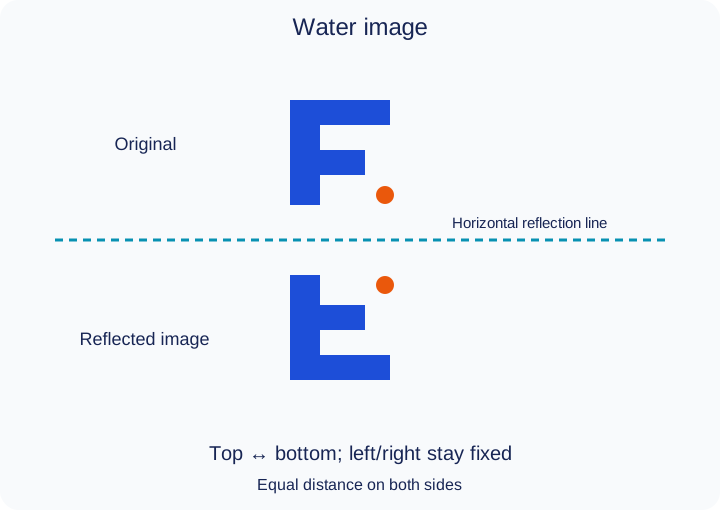
A water image is the top–bottom reflection of a printed figure across a horizontal line. Imagine still water below the object, or a horizontal mirror below the drawing. The top moves to the bottom and the bottom moves to the top; left and right remain unchanged.
These questions use an ideal two-dimensional reflection. Surface ripples, perspective and optical distortion are outside this convention. The image has the same size, shape dimensions, colours and number of parts as the original. Each point lies the same perpendicular distance on the opposite side of the water line. Points on the line do not move.
2. Direction and corner chart
| Original feature | Water image |
|---|---|
| Top / bottom | Bottom / top |
| Left / right | Left / right |
| Top-left corner | Bottom-left corner |
| Top-right corner | Bottom-right corner |
| Arrow ↑ / ↓ | ↓ / ↑ |
| Arrow → / ← | → / ← |
| Arrow ↗ / ↖ | ↘ / ↙ |
| Slash / | Backslash \ |
A dot at the top-left moves to the bottom-left. An arrow pointing right still points right, although its position may move from the upper half to the lower half. A mirror placed above the object gives the same top–bottom orientation change, with the whole image on the other side of that upper mirror line.
Equal distance from the water line
If a point is 3 cm above the water line, its image is 3 cm below it. The point and its image are 6 cm apart. In an upright figure above the water, the lower part is closer to the water line; its image is also closer to the line. The higher part produces the deeper part of the reflection.
3. Capital letters and horizontal symmetry
The conventional exam list of 8 unchanged block capitals is:
C, D, E, H, I, K, O, X
The other 18 capitals change under that conventional drawing style:
A, B, F, G, J, L, M, N, P, Q, R, S, T, U, V, W, Y, Z
These lists assume upright, ideal letter forms. They are not universal typography facts. For example, a B drawn with exactly equal upper and lower bowls and a centred join can have horizontal symmetry, although B is excluded from the usual eight-letter exam list. Serifs, unequal curves and italic lettering can alter the answer. When a drawing is supplied, its actual outline takes priority.
| Letter group in the conventional lists | Mirror image | Water image |
|---|---|---|
| H, I, O, X | Unchanged | Unchanged |
| A, M, T, U, V, W, Y | Unchanged | Changed |
| C, D, E, K | Changed | Unchanged |
| B, F, G, J, L, N, P, Q, R, S, Z | Changed | Changed |
Reflection and rotation are different. An ideal N or Z may match after a half-turn while changing under a horizontal reflection. Do not decide using a rotation test.
4. Digits: use the actual drawing
Many exam summaries list 0, 3 and 8 as unchanged or approximately unchanged water images. This requires symmetric outlines: a vertically centred 0, a 3 with matching upper and lower curves, and an 8 with matching upper and lower loops. Real fonts often draw a smaller upper loop, so exact symmetry may fail.
A plain vertical-stroke 1 also has horizontal symmetry; a 1 with an asymmetric hook and base need not. Slashed zeroes and decorative digits must be inspected individually. The digits 2, 4, 5, 6, 7 and 9 generally change in ordinary exam lettering, but the drawing remains the deciding evidence.
An upside-down 6 is not automatically a normal 9: that shortcut usually describes a 180-degree rotation, which also changes left and right. A water image changes top and bottom only.
5. A horizontal word keeps its position order
For a word written in one horizontal row, a water image keeps the left-to-right order of the character positions. Every character is flipped vertically in its own place.
For ABC, the positions remain A, B, C, but each printed shape must be reflected top-to-bottom. Writing the normal word ABC does not show those shape changes. Writing CBA would also reverse the order and would be wrong for this operation.
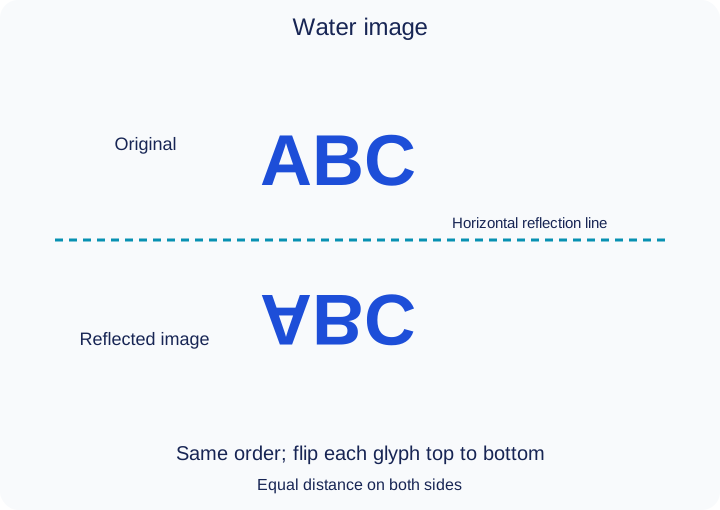
If every glyph has horizontal symmetry, the entire horizontal word can remain unchanged. With the conventional symmetric block forms, CODE, CHECK and HIDE are examples. A palindrome is not required because the horizontal order is preserved. MOM is a palindrome but changes as a water image because its M letters lack horizontal symmetry under the usual convention.
6. Multiple rows, vertical stacks and grids
For a rectangular arrangement, reverse the top-to-bottom order of the rows, keeping the left-to-right order within each row. Also reflect every glyph's shape. Symmetric circle markers make the positional change easy to see:
Original        Water image
● ○ ○           ○ ● ●
○ ● ●           ● ○ ○
For a vertical stack, the bottom item becomes the top item and the top item becomes the bottom item. If the stack is H, O, X from top to bottom, the water image is X, O, H with horizontally symmetric block glyphs.
For an R-row, C-column grid, numbered from the top-left, the reflected layout sends (row r, column c) → (R + 1 − r, c). A mark at (2, 4) in a 6-row grid goes to (5, 4). The column does not change. This specifies the position within the image grid; the whole image is across the water line.
7. Coordinates and distance checks
On Cartesian axes, x increases rightward and y increases upward.
| Horizontal reflecting line | Transformation |
|---|---|
| x-axis, y = 0 | (x, y) → (x, −y) |
| Horizontal line y = b | (x, y) → (x, 2b − y) |
Example: reflect (4, 7) in y = 2. The original is 5 units above the line, so the image is 5 units below it at (4, −3). The x-coordinate stays 4, and the average of the two y-coordinates is 2.
Computer-screen row numbers usually increase downward. Do not mix that convention with Cartesian y-coordinates, which increase upward. The grid formula and the coordinate formula use different descriptions of the same reflection.
8. Water images compared with mirror images and rotation
| Feature | Vertical mirror | Water image | 180-degree rotation |
|---|---|---|---|
| Left/right | Swapped | Preserved | Swapped |
| Top/bottom | Preserved | Swapped | Swapped |
| Top-left marker | Top-right | Bottom-left | Bottom-right |
| Arrow ↗ | ↖ | ↘ | ↙ |
| Grid rows | Preserved | Reversed | Reversed |
| Grid columns | Reversed | Preserved | Reversed |
Two reflections in the same horizontal line restore the original. An odd number in that same line has the effect of one reflection; an even number has no net effect.
A vertical and a horizontal reflection about perpendicular lines through the same centre together equal a half-turn about their intersection. Two different parallel horizontal lines give a translation: first y = a, then y = b sends y to y + 2(b − a).
9. Clocks and other misleading shortcuts
For a water image of a clock, reflect the drawn hands and dial across the horizontal line. Do not use the vertical-mirror formula 11:60 − time.
There is no single ordinary time-subtraction rule that always turns both horizontally reflected hands into a valid time on a normally numbered clock. At 3:00 the minute hand points up and the hour hand right. After a horizontal reflection, the minute hand points down and the hour hand still points exactly right. A real clock at 3:30 has its hour hand halfway between 3 and 4, so that reflected picture is not an exact 3:30 reading. Some exam diagrams simplify hand positions; follow the actual diagram and stated convention.
Likewise, water images of digital times are questions about glyph shapes and positions, not arithmetic with the time value. Reflect the display as a picture.
10. How to eliminate wrong options
- Mark the horizontal reflection line.
- Find a feature that distinguishes top from bottom: a dot, opening, arrowhead or shaded corner.
- Move it to the opposite vertical position while preserving left/right.
- If there are several rows, reverse their order.
- Check that every asymmetric symbol has been flipped.
- Reject horizontal reversal, a half-turn, a changed number of parts or unequal distances from the line.
If two choices differ only by a small mark, follow that mark through the transformation. An otherwise symmetric square with a dot is not the same as an unmarked square.
11. Worked examples
Example 1 — a corner dot
A square has a dot at the top-right. Its water image has the dot at the bottom-right. Moving it to bottom-left would add an unwanted horizontal reversal.
Example 2 — an arrow
An arrow points ↗. After a water reflection it points ↘. Its rightward component stays rightward; its upward component becomes downward.
Example 3 — unchanged word
With ideal horizontally symmetric C, O, D and E, the water image of CODE is CODE. Their order stays the same and each glyph matches its own reflection.
Example 4 — two rows
Top row: ● ○ ●. Bottom row: ○ ● ○. The image has ○ ● ○ on top and ● ○ ● below. No individual row is reversed left-to-right.
Example 5 — a grid
A dot is at (2, 3) in a 7-row, 5-column grid. Its image is (6, 3) because 7 + 1 − 2 = 6. The number of columns does not enter the new-row formula.
Example 6 — a coordinate
Reflect (−2, 8) in y = 3. Compute 2 × 3 − 8 = −2. The image is (−2, −2); the original x-coordinate remains −2.
Example 7 — two types of reflection
A top-left dot undergoes a water reflection, then a vertical reflection about axes through the box centre. It first goes bottom-left, then bottom-right. This equals a half-turn of the original box.
Example 8 — parallel horizontal lines
Reflect (3, 1) first in y = 2 and then in y = 5. The intermediate point is (3, 3); the final point is (3, 7). The net shift is 2(5 − 2) = 6 units upward.
12. Quick revision
- Water image: top/bottom swap; left/right stay the same.
- A horizontal mirror above or below a drawing gives this orientation change.
- Conventional unchanged capitals: C, D, E, H, I, K, O, X.
- Lists for 0, 3, 8 and 1 depend on the exact digit outline.
- A single horizontal word keeps its character positions in the same order; its glyphs flip.
- Multiple rows reverse top-to-bottom; columns stay in place.
- A water image is not a 180-degree rotation.
- Preserve perpendicular distance and verify the whole composite figure.
- Reflect clock diagrams geometrically; do not assume a universal time shortcut.
Practice set: 30 questions
Try these before reading the answer explanations. The online tests contain 80 questions, including these practice items.
Practice 01
Which pair is exchanged in a water image?
- A. Top and bottom
- B. Left and right
- C. Colour and size
- D. Every row with a column
Practice 02
A dot lies at the top-left of a box. Where is it in the water image?
- A. Top-left
- B. Bottom-left
- C. Top-right
- D. Bottom-right
Practice 03
A point is 5 cm above the water line. Where is its image?
- A. 5 cm to the right
- B. On the line
- C. 5 cm below the line
- D. 10 cm below the line
Practice 04
A point is 8 cm above a horizontal mirror. What is the point-to-image separation?
- A. 8 cm
- B. 4 cm
- C. 24 cm
- D. 16 cm
Practice 05
What happens to a point on the water line?
- A. It remains fixed
- B. It moves one row down
- C. It moves one column right
- D. It disappears
Practice 06
Which conventional block capital is unchanged in a water image but changes in a vertical mirror?
- A. M
- B. T
- C. E
- D. A
Practice 07
A 3 has unequal upper and lower curves. Must its water image be exactly unchanged?
- A. No; the actual outline must be checked
- B. Yes, for every printed 3
- C. It must become 8
- D. It must become 0
Practice 08
What happens to character positions in a single horizontal row under water reflection?
- A. They become a vertical stack
- B. They move to random columns
- C. Their left-to-right order stays the same
- D. Their left-to-right order always reverses
Practice 09
With ideal horizontally symmetric glyphs, which word stays unchanged in a water image?
- A. MOM
- B. TAX
- C. WAY
- D. CODE
Practice 10
A vertical stack reads H, O, X from top to bottom. Using symmetric block glyphs, what is its water-image order?
- A. H, X, O
- B. X, O, H
- C. H, O, X
- D. O, H, X
Practice 11
A horizontal mirror is placed above a figure instead of below it. Which orientation change still occurs?
- A. Top and bottom exchange
- B. Only left and right exchange
- C. The figure always turns 90 degrees
- D. No feature can change
Practice 12
Why should a water-image clock be solved from the diagram rather than 11:60 minus time?
- A. Clocks have no horizontal axis
- B. Every water-image clock is 6:00
- C. That subtraction describes a vertical reflection
- D. Water reflection changes the size of hands
Practice 13
An arrow points ↑. Which direction results after water reflection across a horizontal line?
- A. ↓
- B. ↑
- C. ↗
- D. →
Practice 14
An arrow points →. Which direction results after water reflection across a horizontal line?
- A. ↗
- B. ↘
- C. →
- D. ↑
Practice 15
An arrow points ↙. Which direction results after water reflection across a horizontal line?
- A. →
- B. ↖
- C. ↑
- D. ↗
Practice 16
A grid has 4 rows and 5 columns, numbered from the top-left. A dot is at (row, column) = (1, 2). Find its position within the reflected grid after water reflection across a horizontal line.
- A. (4, 2)
- B. (1, 2)
- C. (1, 4)
- D. (4, 4)
Practice 17
A grid has 6 rows and 7 columns, numbered from the top-left. A dot is at (row, column) = (5, 3). Find its position within the reflected grid after water reflection across a horizontal line.
- A. (5, 5)
- B. (2, 5)
- C. (2, 3)
- D. (5, 3)
Practice 18
A grid has 9 rows and 10 columns, numbered from the top-left. A dot is at (row, column) = (4, 8). Find its position within the reflected grid after water reflection across a horizontal line.
- A. (6, 3)
- B. (6, 8)
- C. (4, 8)
- D. (4, 3)
Practice 19
Using Cartesian coordinates (y increases upward), reflect (2, 5) across y = 7. Which image point is correct?
- A. (2, 9)
- B. (2, 5)
- C. (12, 5)
- D. (12, 9)
Practice 20
Using Cartesian coordinates (y increases upward), reflect (6, -2) across y = -1. Which image point is correct?
- A. (-8, -2)
- B. (-8, 0)
- C. (6, 0)
- D. (6, -2)
Practice 21
Using Cartesian coordinates (y increases upward), reflect (9, 3) across y = -2. Which image point is correct?
- A. (-13, -7)
- B. (9, -7)
- C. (9, 3)
- D. (-13, 3)
Practice 22
The circle pattern is ● ○ ○ / ○ ● ● / ○ ● ○. Slashes separate rows from top to bottom. Which pattern is its water reflection across a horizontal line?
- A. ○ ● ○ / ○ ● ● / ● ○ ○
- B. ● ○ ○ / ○ ● ● / ○ ● ○
- C. ○ ○ ● / ● ● ○ / ○ ● ○
- D. ○ ● ○ / ● ● ○ / ○ ○ ●
Practice 23
The circle pattern is ● ○ ○ ● / ● ○ ● ○. Slashes separate rows from top to bottom. Which pattern is its water reflection across a horizontal line?
- A. ● ○ ○ ● / ● ○ ● ○
- B. ● ○ ○ ● / ○ ● ○ ●
- C. ○ ● ○ ● / ● ○ ○ ●
- D. ● ○ ● ○ / ● ○ ○ ●
Practice 24
The circle pattern is ○ ● ○ / ● ○ ○ / ● ● ●. Slashes separate rows from top to bottom. Which pattern is its water reflection across a horizontal line?
- A. ○ ● ○ / ○ ○ ● / ● ● ●
- B. ● ● ● / ○ ○ ● / ○ ● ○
- C. ● ● ● / ● ○ ○ / ○ ● ○
- D. ○ ● ○ / ● ○ ○ / ● ● ●
Practice 25
Every printed glyph in CHECK is symmetric about its own horizontal centre line. The word is in one horizontal row. Which ordinary-letter string correctly represents its water reflection across a horizontal line?
- A. HCECK
- B. CHECK
- C. KCEHC
- D. HECKC
Practice 26
A square has a dot at top-left and an arrow ↑. After water reflection across a horizontal line, choose the correct dot corner AND arrow direction.
- A. bottom-left; arrow ↓
- B. top-left; arrow ↑
- C. top-right; arrow ↑
- D. bottom-right; arrow ↓
Practice 27
A square has a dot at bottom-right and an arrow ↖. After water reflection across a horizontal line, choose the correct dot corner AND arrow direction.
- A. bottom-right; arrow ↖
- B. bottom-left; arrow ↗
- C. top-left; arrow ↘
- D. top-right; arrow ↙
Practice 28
Point (6, -4) is reflected 14 times in the same x-axis (y = 0). What is the final point?
- A. (-6, 4)
- B. (-6, -4)
- C. (6, -4)
- D. (6, 4)
Practice 29
Reflect (-2, 5) first in y = -1, then in y = 2. What is the final point?
- A. (-2, 5)
- B. (-2, -7)
- C. (-2, -1)
- D. (-2, 11)
Practice 30
A horizontal reflection sends (5, -2) to (5, -8). Which line is the water line?
- A. y = -6
- B. x = -5
- C. y = -5
- D. y = -4
Answer explanations
Answer 01
A. Top and bottom — A water image is a reflection in a horizontal line, reversing vertical position.
Answer 02
B. Bottom-left — Top becomes bottom; the left side remains left.
Answer 03
C. 5 cm below the line — Reflection preserves perpendicular distance from the horizontal line.
Answer 04
D. 16 cm — The image is 8 cm below, so the total separation is 16 cm.
Answer 05
A. It remains fixed — A point at zero distance from the reflecting line maps to itself.
Answer 06
C. E — E has horizontal symmetry in the conventional outline; A, M and T instead have vertical symmetry.
Answer 07
A. No; the actual outline must be checked — Horizontal symmetry requires matching upper and lower parts; an approximate list is not an exact font guarantee.
Answer 08
C. Their left-to-right order stays the same — Horizontal position is preserved, while each glyph flips top-to-bottom.
Answer 09
D. CODE — C, O, D and E each have horizontal symmetry, and their order is preserved.
Answer 10
B. X, O, H — The stack order reverses top-to-bottom, and these three glyphs themselves stay unchanged.
Answer 11
A. Top and bottom exchange — Both positions use a horizontal reflecting line; only the overall image placement differs.
Answer 12
C. That subtraction describes a vertical reflection — A horizontal line transforms hand directions differently; reflect both drawn hands geometrically.
Answer 13
A. ↓ — ↑ becomes ↓: reverse the vertical component and preserve the horizontal component.
Answer 14
C. → — → becomes →: reverse the vertical component and preserve the horizontal component.
Answer 15
B. ↖ — ↙ becomes ↖: reverse the vertical component and preserve the horizontal component.
Answer 16
A. (4, 2) — Use (R + 1 − r, c) = (4 + 1 − 1, 2) = (4, 2).
Answer 17
C. (2, 3) — Use (R + 1 − r, c) = (6 + 1 − 5, 3) = (2, 3).
Answer 18
B. (6, 8) — Use (R + 1 − r, c) = (9 + 1 − 4, 8) = (6, 8).
Answer 19
A. (2, 9) — The y-coordinate becomes 2 × (7) − (5); the other coordinate stays fixed. The result is (2, 9).
Answer 20
C. (6, 0) — The y-coordinate becomes 2 × (-1) − (-2); the other coordinate stays fixed. The result is (6, 0).
Answer 21
B. (9, -7) — The y-coordinate becomes 2 × (-2) − (3); the other coordinate stays fixed. The result is (9, -7).
Answer 22
A. ○ ● ○ / ○ ● ● / ● ○ ○ — Reverse the row order; preserve the circle order in each row. Result: ○ ● ○ / ○ ● ● / ● ○ ○.
Answer 23
D. ● ○ ● ○ / ● ○ ○ ● — Reverse the row order; preserve the circle order in each row. Result: ● ○ ● ○ / ● ○ ○ ●.
Answer 24
C. ● ● ● / ● ○ ○ / ○ ● ○ — Reverse the row order; preserve the circle order in each row. Result: ● ● ● / ● ○ ○ / ○ ● ○.
Answer 25
B. CHECK — Keep the left-to-right order. Each glyph is horizontally symmetric by the question condition. The result is CHECK.
Answer 26
A. bottom-left; arrow ↓ — Apply the reflection separately to the dot position and the arrow direction: bottom-left; arrow ↓.
Answer 27
D. top-right; arrow ↙ — Apply the reflection separately to the dot position and the arrow direction: top-right; arrow ↙.
Answer 28
C. (6, -4) — 14 is even, so all reflections cancel in pairs. Result: (6, -4).
Answer 29
D. (-2, 11) — The first image is (-2, -7). Reflect it in the second line to obtain (-2, 11); the net shift in y is 2 × (2 − (-1)).
Answer 30
C. y = -5 — The horizontal line passes through the midpoint: y = (-2 + (-8))/2 = -5.
This is AI-generated information.