Blood Relations
1. Learning goals and explicit assumptions
Blood-relation reasoning translates family statements into a diagram and asks for one person’s relationship to another. Learn direct relationships, generations, family trees, pointing-to-a-person questions, coded relationships and information sufficiency. Separate biological, adoptive, step and marriage relationships when the question distinguishes them. In the practice below, named people are distinct unless identity is explicitly stated; relationships have their ordinary meaning and no additional links are assumed. Where sharing both parents is needed, the question says full siblings. Never infer gender from a name, occupation or letter.
2. Read the direction of the question
“How is A related to B?” asks for A’s role with B as the reference person. If A is B’s mother, the answer is mother; reversing the question asks about B and requires B’s gender to choose son or daughter. If B’s gender is unknown, answer child. Draw an arrow from the person being described toward the reference, or write A → B above your answer. Example: P is the father of Q; Q is the mother of R. P is R’s maternal grandfather. R is P’s grandchild; R’s gender is not supplied.
3. Relation dictionary: direct family
Parent is gender-neutral; father and mother are gender-specific. Child is neutral; son and daughter identify gender. Sibling is neutral; brother and sister identify the sibling’s gender, not the other person’s. Spouse is neutral; husband and wife specify a marriage relation. “A is the sister of B” establishes A as female but does not establish B as male. “A is the husband of B” states A’s role; use explicit details when more family structure is needed. Do not automatically identify a child’s other parent from a spouse link unless the question states the couple are the child’s parents.
4. Paternal, maternal and marriage relationships
English often combines relationships that Hindi distinguishes. Father’s father = paternal grandfather; mother’s father = maternal grandfather. A parent’s brother is an uncle; a parent’s sister is an aunt. A sibling’s son is a nephew and a sibling’s daughter a niece. Children of siblings are first cousins. In-law terms can describe several paths: brother-in-law may mean a spouse’s brother or a sibling’s husband. State the exact path when the broad English label is insufficient. Do not decide whether a father’s brother is older or younger without age information.
| Relationship path | Answer |
|---|---|
| Father’s father | Paternal grandfather |
| Mother’s father | Maternal grandfather |
| Father’s mother | Paternal grandmother |
| Mother’s mother | Maternal grandmother |
| Mother’s brother | Maternal uncle |
| Father’s sister | Paternal aunt |
| Brother’s daughter | Niece |
| Sister’s son | Nephew |
5. Generations and diagram symbols
Choose the reference person as generation 0. Parents are +1, grandparents +2, children −1 and grandchildren −2. Siblings and spouses occupy the same displayed generation. These levels help check a relation but do not determine it alone: an uncle and a father are both one generation above. Use a square or M for a stated male, a circle or F for a stated female and ? for unknown gender. Join spouses horizontally, draw parent-to-child links downward and place siblings on the same row under their shared parents. Record only stated links; leave unknown parents unnamed.
6. Worked family tree
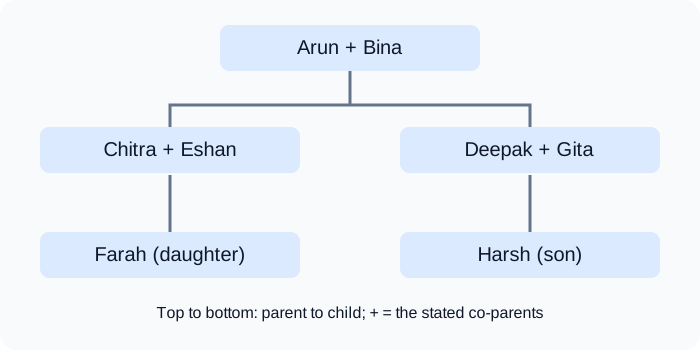
Use this explicitly defined family: Arun (father) and Bina (mother) are the parents of Chitra (daughter) and Deepak (son), who are full siblings. Chitra and Eshan are the parents of Farah (daughter). Deepak and Gita are the parents of Harsh (son). Thus Arun is Farah’s maternal grandfather and Harsh’s paternal grandfather. Deepak is Farah’s maternal uncle; Chitra is Harsh’s paternal aunt. Farah and Harsh are first cousins. Farah is Deepak’s niece through his sister; Harsh is Chitra’s nephew through her brother. The same person may have different relational labels depending on the reference branch.
7. Pointing and photograph questions
Work from the innermost relationship outward. Example: a woman says, “The boy is the son of my mother’s only daughter.” Her mother’s only daughter is the speaker herself, so the boy is her son. If a man says the same words and his mother has exactly one daughter, that daughter is his sister and the boy is his nephew. “My father’s only son” may mean the male speaker himself; for a female speaker it means her brother. Keep the speaker’s gender and the scope of “only” visible throughout.
8. Only son, only daughter and only child
Only son means no other sons, but daughters may exist. Only daughter means no other daughters, but sons may exist. Only child excludes all siblings who are children of that stated parent. Example: A is B’s only son and C is B’s daughter. A and C can coexist; there is no contradiction. But A is B’s only child and C is a different child of B is inconsistent. Do not replace “only son of X” with “only child of X”. If a statement is inconsistent, do not manufacture a family tree that silently changes it.
9. Coded blood relations
Write each code in words before combining it. Suppose X + Y means X is the father of Y, X − Y means X is the mother of Y, X × Y means X is the brother of Y, and X ÷ Y means X is the sister of Y. P + Q − R means P is Q’s father and Q is R’s mother; therefore P is R’s maternal grandfather. P × Q − R means P is Q’s brother and Q is R’s mother; P is R’s maternal uncle. These are adjacent relationship statements, not arithmetic: BODMAS does not apply. Redefine the symbols afresh for each question.
10. Reverse questions and missing gender
Knowing that A is B’s father does not tell whether B is a son or daughter. Knowing A is B’s sister does not tell whether B is a brother or sister. Likewise, “A’s brother’s child” is a nephew or niece of A, but the child’s gender is needed to choose one. Example: A is the mother of B; B is the parent of C. A is C’s grandmother, but whether she is maternal or paternal is undetermined. A name does not supply the missing gender. Use “cannot be determined” only for the precise missing attribute; a broad relation may still be certain.
11. Family counts and information sufficiency
Count distinct people, not relationship words. A grandfather, his son and his grandson are three people, including two fathers and two sons. This does not require four people. For sufficiency, test each statement alone and then together. Asked “Is P the maternal uncle of R?” I: P is the brother of Q. II: Q is the mother of R. Neither alone fixes the requested relation; together they do. Do not use statement II while evaluating I alone. If only a maximum or minimum is asked, construct a valid arrangement attaining it and explain why a smaller or larger value cannot work.
12. Common traps and revision routine
Use this order: identify the target and reference; mark known genders; split each chain into single links; draw generations; trace from reference to target; check uniqueness. Cousins are not siblings. A spouse link is not automatically a parent link. “Brother of the mother” is maternal uncle, while “brother of the father” is paternal uncle. Do not assume age order, number of children, marriage or a second parent from an incomplete tree. Answer the exact relationship requested, including gender and maternal/paternal side only when established.
Practice set: 30 questions
Draw a family tree before selecting one correct answer using only the given links.
Practice 01
A is the father of B. B is the father of C. How is A related to C?
- A. Paternal grandfather
- B. Father
- C. Mother
- D. Brother
Practice 02
A is the father of B. B is the mother of C. How is A related to C?
- A. Mother
- B. Brother
- C. Maternal grandfather
- D. Father
Practice 03
A is the brother of B. B is the mother of C. How is A related to C?
- A. Maternal uncle
- B. Father
- C. Mother
- D. Brother
Practice 04
A is the sister of B. B is the father of C. How is A related to C?
- A. Father
- B. Mother
- C. Brother
- D. Paternal aunt
Practice 05
A is the son of B. B is the brother of C. How is A related to C?
- A. Nephew through a brother
- B. Father
- C. Mother
- D. Brother
Practice 06
A is the daughter of B. B is the sister of C. How is A related to C?
- A. Father
- B. Mother
- C. Brother
- D. Niece through a sister
Practice 07
A is the son of B. B is the daughter of C. How is A related to C?
- A. Mother
- B. Brother
- C. Grandson through a daughter
- D. Father
Practice 08
A is the wife of B. B is the son of C. How is A related to C?
- A. Mother
- B. Brother
- C. Daughter-in-law
- D. Father
Practice 09
Arun and Bina are the parents of full siblings Chitra (female) and Deepak (male). Chitra and Eshan are Farah’s parents (Farah is female); Deepak and Gita are Harsh’s parents (Harsh is male). Arun and Eshan are male; Bina and Gita are female. How is Arun related to Farah?
- A. Maternal grandfather
- B. Father
- C. Mother
- D. Brother
Practice 10
Arun and Bina are the parents of full siblings Chitra (female) and Deepak (male). Chitra and Eshan are Farah’s parents (Farah is female); Deepak and Gita are Harsh’s parents (Harsh is male). Arun and Eshan are male; Bina and Gita are female. How is Deepak related to Farah?
- A. Maternal uncle
- B. Father
- C. Mother
- D. Brother
Practice 11
Arun and Bina are the parents of full siblings Chitra (female) and Deepak (male). Chitra and Eshan are Farah’s parents (Farah is female); Deepak and Gita are Harsh’s parents (Harsh is male). Arun and Eshan are male; Bina and Gita are female. How is Chitra related to Harsh?
- A. Brother
- B. Paternal aunt
- C. Father
- D. Mother
Practice 12
Arun and Bina are the parents of full siblings Chitra (female) and Deepak (male). Chitra and Eshan are Farah’s parents (Farah is female); Deepak and Gita are Harsh’s parents (Harsh is male). Arun and Eshan are male; Bina and Gita are female. How is Farah related to Deepak?
- A. Mother
- B. Brother
- C. Niece through a sister
- D. Father
Practice 13
Arun and Bina are the parents of full siblings Chitra (female) and Deepak (male). Chitra and Eshan are Farah’s parents (Farah is female); Deepak and Gita are Harsh’s parents (Harsh is male). Arun and Eshan are male; Bina and Gita are female. How is Harsh related to Chitra?
- A. Father
- B. Mother
- C. Brother
- D. Nephew through a brother
Practice 14
Arun and Bina are the parents of full siblings Chitra (female) and Deepak (male). Chitra and Eshan are Farah’s parents (Farah is female); Deepak and Gita are Harsh’s parents (Harsh is male). Arun and Eshan are male; Bina and Gita are female. How is Farah related to Harsh?
- A. Mother
- B. Brother
- C. Female first cousin
- D. Father
Practice 15
Arun and Bina are the parents of full siblings Chitra (female) and Deepak (male). Chitra and Eshan are Farah’s parents (Farah is female); Deepak and Gita are Harsh’s parents (Harsh is male). Arun and Eshan are male; Bina and Gita are female. How is Harsh related to Farah?
- A. Father
- B. Mother
- C. Brother
- D. Male first cousin
Practice 16
X @ Y means X is Y’s father; X # Y means X is Y’s father. In P @ Q # R, how is P related to R?
- A. Paternal grandfather
- B. Father
- C. Mother
- D. Brother
Practice 17
X @ Y means X is Y’s brother; X # Y means X is Y’s mother. In P @ Q # R, how is P related to R?
- A. Maternal uncle
- B. Father
- C. Mother
- D. Brother
Practice 18
X @ Y means X is Y’s daughter; X # Y means X is Y’s brother. In P @ Q # R, how is P related to R?
- A. Brother
- B. Niece through a brother
- C. Father
- D. Mother
Practice 19
X @ Y means X is Y’s daughter; X # Y means X is Y’s daughter. In P @ Q # R, how is P related to R?
- A. Father
- B. Mother
- C. Brother
- D. Granddaughter through a daughter
Practice 20
A woman says, “This boy is the son of my mother’s only daughter.” How is the boy related to her?
- A. Son
- B. Brother
- C. Father
- D. Nephew
Practice 21
A man says, “This boy is the son of my mother’s only daughter.” How is the boy related to him?
- A. Father
- B. Nephew through a sister
- C. Son
- D. Brother
Practice 22
A man says, “This girl is the daughter of my father’s only son.” How is she related to him?
- A. Mother
- B. Niece
- C. Daughter
- D. Sister
Practice 23
A woman says, “This girl is the daughter of my father’s only son.” How is she related to her?
- A. Daughter
- B. Sister
- C. Mother
- D. Niece through a brother
Practice 24
A is the father of B. B’s gender is not stated. How is B related to A?
- A. Child; gender undetermined
- B. Definitely son
- C. Definitely daughter
- D. Spouse
Practice 25
A is B’s mother; B is C’s parent, with gender unstated. Which relation is certain for A to C?
- A. Definitely paternal grandmother
- B. Aunt
- C. Grandmother, side unknown
- D. Definitely maternal grandmother
Practice 26
A is B’s only son; C is B’s daughter. A and C are distinct. Are these statements consistent?
- A. No children are allowed
- B. No; only son means only child
- C. C must equal A
- D. Yes; only son does not exclude daughters
Practice 27
A is B’s only child. C is a different child of B. What is the correct assessment?
- A. Contradictory statements
- B. A and C must be twins
- C. Both statements always hold
- D. C must be female
Practice 28
What is the minimum number of distinct people needed for two fathers and two sons in a direct three-generation chain?
- A. 5
- B. 2
- C. 3
- D. 4
Practice 29
To determine whether P is R’s maternal uncle: I. P is Q’s brother. II. Q is R’s mother. Which statements suffice?
- A. I alone
- B. II alone
- C. Neither even together
- D. Both together, neither alone
Practice 30
A is the spouse of B, and B is C’s parent. Without further information, must A be C’s parent?
- A. A must be C’s child
- B. No; that parent link is not established
- C. Yes, always
- D. A must be C’s sibling
Answers and explanations
Answer 01
A. Paternal grandfather
From C go to C’s father B, then to B’s father A: paternal grandfather.
Answer 02
C. Maternal grandfather
From C go to C’s mother B, then to B’s father A: maternal grandfather.
Answer 03
A. Maternal uncle
From C go to C’s mother B, then to B’s brother A: maternal uncle.
Answer 04
D. Paternal aunt
From C go to C’s father B, then to B’s sister A: paternal aunt.
Answer 05
A. Nephew through a brother
From C go to C’s brother B, then to B’s son A: nephew through a brother.
Answer 06
D. Niece through a sister
From C go to C’s sister B, then to B’s daughter A: niece through a sister.
Answer 07
C. Grandson through a daughter
From C go to C’s daughter B, then to B’s son A: grandson through a daughter.
Answer 08
C. Daughter-in-law
From C go to C’s son B, then to B’s wife A: daughter-in-law.
Answer 09
A. Maternal grandfather
Arun → Chitra → Farah.
Answer 10
A. Maternal uncle
Deepak is the brother of Farah’s mother Chitra.
Answer 11
B. Paternal aunt
Chitra is the sister of Harsh’s father Deepak.
Answer 12
C. Niece through a sister
Farah is the daughter of Deepak’s sister Chitra.
Answer 13
D. Nephew through a brother
Harsh is the son of Chitra’s brother Deepak.
Answer 14
C. Female first cousin
Farah’s mother and Harsh’s father are siblings.
Answer 15
D. Male first cousin
Harsh’s father is the brother of Farah’s mother.
Answer 16
A. Paternal grandfather
Decode adjacent pairs: P is Q’s father; Q is R’s father. Hence P is R’s paternal grandfather; symbols are not arithmetic operators.
Answer 17
A. Maternal uncle
Decode adjacent pairs: P is Q’s brother; Q is R’s mother. Hence P is R’s maternal uncle; symbols are not arithmetic operators.
Answer 18
B. Niece through a brother
Decode adjacent pairs: P is Q’s daughter; Q is R’s brother. Hence P is R’s niece through a brother; symbols are not arithmetic operators.
Answer 19
D. Granddaughter through a daughter
Decode adjacent pairs: P is Q’s daughter; Q is R’s daughter. Hence P is R’s granddaughter through a daughter; symbols are not arithmetic operators.
Answer 20
A. Son
The woman is her mother’s only daughter; the boy is her son.
Answer 21
B. Nephew through a sister
The only daughter is the man’s sister; her son is his nephew.
Answer 22
C. Daughter
The only son is the speaker himself.
Answer 23
D. Niece through a brother
Her father’s only son is her brother; his daughter is her niece.
Answer 24
A. Child; gender undetermined
Fatherhood does not establish the child’s gender.
Answer 25
C. Grandmother, side unknown
There are two parent links, but the middle person’s gender is missing.
Answer 26
D. Yes; only son does not exclude daughters
Only restricts the number of sons here.
Answer 27
A. Contradictory statements
Only child excludes another distinct child of that parent.
Answer 28
C. 3
Grandfather, father and son fulfil the roles; two people cannot form three generations.
Answer 29
D. Both together, neither alone
I supplies the sibling link; II connects it to R through R’s mother.
Answer 30
B. No; that parent link is not established
A marriage link alone does not prove a shared child.
Online practice
Four level tests contain 20 questions each; the complete test contains all 80. Review whether each mistake came from reversing the relationship, assuming gender, miscounting generations or adding an unstated link.
This is AI-generated information.