Direction Sense and Distance
1. Learning plan and assumptions
Direction questions ask where a person or place lies, which way someone faces, or how far apart two points are. These are three different answers: final position, final facing and distance. Work on a flat map with north at the top unless stated otherwise. Distances use a common unit. A turn changes facing but does not itself change position. A move changes position. Read whether a turn is followed by movement and whether the question asks about the start or another person.
2. Eight directions and opposites
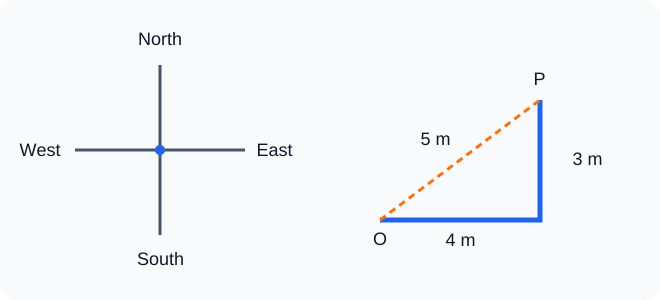
The clockwise order is North (N), North-East (NE), East (E), South-East (SE), South (S), South-West (SW), West (W), North-West (NW). Adjacent directions on this eight-point compass differ by 45°. Opposites are N/S, E/W, NE/SW and NW/SE. Facing north is not the same as being north of the start. A person may finish east of the start while facing south. For qualitative position questions, positive east and north components mean the north-east region; the exact NE bearing is 45° only when the components are equal.
3. Left and right depend on the person
For a 90° turn use this table. Facing N: right E, left W. Facing E: right S, left N. Facing S: right W, left E. Facing W: right N, left S. A right turn is clockwise on the plan-view compass; a left turn is anticlockwise. A U-turn reverses facing by 180°. Example: start facing west, turn right, right, left. The sequence is W→N→E→N, so finish facing north. Do not take the reader’s right side of the page as the walker’s right side.
| Facing | Right 90° | Left 90° |
|---|---|---|
| North | East | West |
| East | South | North |
| South | West | East |
| West | North | South |
4. Coordinate method: the safest general solution
Put the start at O=(0,0). East adds to x; west subtracts from x. North adds to y; south subtracts from y. Record every endpoint, and maintain a separate facing column when turns are given. Example: go 8 m east, 6 m north and 3 m west. Endpoints are (8,0), (8,6), (5,6). Final position is north-east of O, with net movement 5 m east and 6 m north. The last movement is westward, so the final facing is west if there is no additional turn. Opposite movements cancel component by component, even if separated by other steps.
5. Travelled distance, displacement and road distance
Total travelled distance is the sum of all legs. Straight-line distance from start is √(x²+y²). If travel is restricted to an unobstructed east-west/north-south street grid, the minimum route length is |x|+|y|. Do not use that street formula if obstacles or specific roads are supplied. Example: 8 m east, 6 m north, 3 m west gives travelled distance 17 m, straight distance √61 m, and shortest grid route 11 m. A 3 m east then 4 m north path has length 7 m but displacement 5 m. Familiar triples are 3–4–5, 5–12–13, 8–15–17 and 7–24–25, including scaled versions.
6. Complete worked example with turns
A walker faces north, goes 10 m, turns right and goes 8 m, turns right and goes 4 m, then turns left and goes 2 m. Track (position; facing): (0,10; N), (8,10; E), (8,6; S), (10,6; E). Therefore final facing E; final region NE; travelled distance 10+8+4+2=24 m; shortest distance √(10²+6²)=√136=2√34 m. To return directly, the vector is (−10,−6), in the south-west region. Returning along the same path would be 24 m, not 2√34 m. A direct return requires no obstacle restriction.
7. Relative positions and two walkers
To find B relative to A, calculate B−A, not A−B. If A=(−3,4) and B=(5,−2), then B−A=(8,−6): B is south-east of A and 10 units away. A is north-west of B. Example with two walkers: from one start P goes 6 m east and 8 m north; Q goes 6 m west and 8 m north. Their y-values match and their x-values differ by 12, so they are 12 m apart. Never add their distances from the origin unless their endpoints lie on opposite rays of one straight line.
8. Diagonal movement and rotation
An exact NE movement of length d has components (d/√2,d/√2); it does not add d to both axes. Thus 10√2 m NE means 10 m east and 10 m north. If a location is merely described as north-east without distance or bearing, exact components are unknown. For rotations use N=0°, E=90°, S=180°, W=270°; add clockwise angles and subtract anticlockwise angles, then reduce modulo 360°. Example: facing SW (225°), rotate 135° clockwise: 360° becomes N. A rotated map changes how compass directions appear on paper; retain the marked north arrow as the reference.
9. Coded directions and relationship chains
Decode each symbol exactly as defined. Suppose A @ B means A is 4 m east of B, and A # B means A is 3 m north of B. In P @ Q and Q # R, set R=(0,0), Q=(0,3), P=(4,3). P is 5 m from R in the north-east region. The first named point is being located relative to the second; reversing the order reverses the displacement. Codes need not mean the same thing in another question. Do not turn a positional statement into a walking instruction unless the definition says so.
10. Shadows: use the stated sun direction
For the simplified horizontal reasoning model, the shadow extends away from the sun. If the sun is stated to be exactly east, the shadow points west; if the sun is exactly west, it points east. Example: sun east and shadow on the person’s right means their right is west, so they face south. Shadow on their left means they face north. Real sunrise direction varies by location and season; “morning” alone is not a precise astronomical bearing. Use the east/west convention only when the question establishes that simplification. Noon alone does not determine a universal shadow direction or guarantee zero shadow.
11. Data sufficiency, zero displacement and missing steps
Ask whether the requested answer is unique. Statement I: P is east of O. Statement II: P is 5 m from O. I alone fixes direction but not distance; II alone fixes distance but not direction; together they locate P=(5,0). If a walk ends at the start, displacement is zero and there is no direction from start to finish; facing may still be known. To solve a missing movement, set the final x and y to the required values. Example: 7 m east, 5 m north, x m west and 5 m south returns to the start only if x=7. A diagram shows relationships, not a scale drawing unless scale is specified.
12. Revision table and solving routine
Use five steps: (1) mark north and the origin; (2) decode movements and turns; (3) update coordinates and facing separately; (4) answer exactly what is asked; (5) substitute back to check. East/west affect x; north/south affect y. Position of B from A is (xB−xA,yB−yA). Direct distance is √(Δx²+Δy²). Journey length is the sum of legs. Opposite direction is a 180° reversal. At the origin say “same point”, not north or south. Do not assume that north-east implies equal legs unless an exact diagonal bearing is stated.
Practice set: 30 questions
Draw your own diagram before choosing one correct option.
Practice 01
A right turn from north points toward which direction?
- A. East
- B. South
- C. West
- D. North
Practice 02
A left turn from south points toward which direction?
- A. North
- B. East
- C. South
- D. West
Practice 03
A point has coordinates (5, −3). In which region is it relative to (0,0)?
- A. South-east
- B. South-west
- C. North-west
- D. North-east
Practice 04
What changes during a turn in place without walking?
- A. Both position and journey length
- B. Neither facing nor position
- C. Facing only
- D. Position only
Practice 05
A walker returns to the starting point. What is the displacement magnitude?
- A. 1
- B. Total route length
- C. Always unknown
- D. 0
Practice 06
For net movement 3 m east and 4 m north, what is the direct distance in metres?
- A. 5
- B. 7
- C. 1
- D. 12
Practice 07
Facing North, turn 90° clockwise, then 90° clockwise, then 90° anticlockwise. What is the final facing?
- A. West
- B. North
- C. East
- D. South
Practice 08
Facing South, turn 90° clockwise, then 90° anticlockwise, then 90° anticlockwise. What is the final facing?
- A. East
- B. South
- C. West
- D. North
Practice 09
Facing South-east, turn 45° anticlockwise, then 90° anticlockwise. What is the final facing?
- A. East
- B. South
- C. West
- D. North
Practice 10
Facing East, turn 180° anticlockwise, then 90° clockwise. What is the final facing?
- A. East
- B. South
- C. West
- D. North
Practice 11
Walk 5 m east, 4 m north, then 2 m west. Find the straight-line distance from the start in metres.
- A. 5
- B. 6
- C. 4
- D. 7
Practice 12
Walk 12 m east, 8 m north, then 6 m west. Find the straight-line distance from the start in metres.
- A. 10
- B. 11
- C. 9
- D. 12
Practice 13
Walk 31 m east, 21 m north, then 11 m west. Find the straight-line distance from the start in metres.
- A. 31
- B. 29
- C. 30
- D. 28
Practice 14
Walk 9 m north, 5 m east and 3 m south. What is the total distance walked in metres?
- A. 16
- B. 19
- C. 17
- D. 18
Practice 15
Walk 14 m north, 10 m east and 8 m south. What is the total distance walked in metres?
- A. 33
- B. 31
- C. 34
- D. 32
Practice 16
Walk 18 m north, 14 m east and 12 m south. What is the total distance walked in metres?
- A. 45
- B. 43
- C. 46
- D. 44
Practice 17
A=(-4,3) and B=(2,11) on a metre grid. How far apart are A and B in metres?
- A. 10
- B. 11
- C. 9
- D. 12
Practice 18
A=(0,-1) and B=(5,11) on a metre grid. How far apart are A and B in metres?
- A. 13
- B. 14
- C. 12
- D. 15
Practice 19
A=(5,-6) and B=(-3,-21) on a metre grid. How far apart are A and B in metres?
- A. 19
- B. 17
- C. 18
- D. 16
Practice 20
From O, P walks 4 m east and 6 m north; Q walks 7 m west and 6 m north. What is PQ in metres?
- A. 10
- B. 13
- C. 11
- D. 12
Practice 21
From O, P walks 9 m east and 11 m north; Q walks 12 m west and 11 m north. What is PQ in metres?
- A. 22
- B. 20
- C. 23
- D. 21
Practice 22
From O, P walks 13 m east and 15 m north; Q walks 16 m west and 15 m north. What is PQ in metres?
- A. 30
- B. 28
- C. 31
- D. 29
Practice 23
Walk exactly 3√2 m north-east (45°), then 12 m east, then 3 m south. What is the direct distance from the start in metres?
- A. 15
- B. 16
- C. 14
- D. 17
Practice 24
Walk exactly 7√2 m north-east (45°), then 28 m east, then 7 m south. What is the direct distance from the start in metres?
- A. 35
- B. 36
- C. 34
- D. 37
Practice 25
X @ Y means X is 3 m east of Y; X # Y means X is 4 m north of Y. If P @ Q and Q # R, what is PR in metres?
- A. 7
- B. 5
- C. 6
- D. 4
Practice 26
X @ Y means X is 9 m east of Y; X # Y means X is 12 m north of Y. If P @ Q and Q # R, what is PR in metres?
- A. 17
- B. 15
- C. 16
- D. 14
Practice 27
The sun is stated to be exactly east. In the simplified shadow model, a person’s shadow lies to their right. Which way do they face?
- A. North
- B. East
- C. South
- D. West
Practice 28
P is somewhere east of O, with no distance given. Can OP be uniquely calculated?
- A. Yes: 5 m
- B. Yes: 0 m
- C. No
- D. Yes: 1 m
Practice 29
To find the exact position of P relative to O: I. P is due east of O. II. OP is 5 m. Which information is sufficient?
- A. I alone
- B. II alone
- C. Even both are insufficient
- D. Both together, neither alone
Practice 30
A person walks 4 m north, 3 m east, 4 m south and 3 m west. What is the direction of the final position from the start?
- A. Same point; no displacement direction
- B. North
- C. South
- D. West
Answers and explanations
Answer 01
A. East
A 90° clockwise turn sends north to east.
Answer 02
B. East
When facing south, the left hand points east.
Answer 03
A. South-east
Positive x is east; negative y is south: south-east.
Answer 04
C. Facing only
Turning changes orientation, while coordinates remain the same.
Answer 05
D. 0
The initial and final coordinates coincide.
Answer 06
A. 5
√(3²+4²)=5, while the two-leg route length is 7.
Answer 07
C. East
Initial angle 0°; net turn 90°. Reduce modulo 360° to 90°: East.
Answer 08
A. East
Initial angle 180°; net turn -90°. Reduce modulo 360° to 90°: East.
Answer 09
D. North
Initial angle 135°; net turn -135°. Reduce modulo 360° to 0°: North.
Answer 10
D. North
Initial angle 90°; net turn -90°. Reduce modulo 360° to 0°: North.
Answer 11
A. 5
Net east = 5−2=3; north=4. Distance=√(3²+4²)=5.
Answer 12
A. 10
Net east = 12−6=6; north=8. Distance=√(6²+8²)=10.
Answer 13
B. 29
Net east = 31−11=20; north=21. Distance=√(20²+21²)=29.
Answer 14
C. 17
Add the legs: 9+5+3=17; do not cancel opposite directions when finding journey length.
Answer 15
D. 32
Add the legs: 14+10+8=32; do not cancel opposite directions when finding journey length.
Answer 16
D. 44
Add the legs: 18+14+12=44; do not cancel opposite directions when finding journey length.
Answer 17
A. 10
B−A=(6,8); distance=√((6)²+(8)²)=10.
Answer 18
A. 13
B−A=(5,12); distance=√((5)²+(12)²)=13.
Answer 19
B. 17
B−A=(-8,-15); distance=√((-8)²+(-15)²)=17.
Answer 20
C. 11
P=(4,6), Q=(-7,6). Same north coordinate, so separation=4+7=11.
Answer 21
D. 21
P=(9,11), Q=(-12,11). Same north coordinate, so separation=9+12=21.
Answer 22
D. 29
P=(13,15), Q=(-16,15). Same north coordinate, so separation=13+16=29.
Answer 23
A. 15
The diagonal contributes (3,3); final position=(15,0), so distance=15.
Answer 24
A. 35
The diagonal contributes (7,7); final position=(35,0), so distance=35.
Answer 25
B. 5
R=(0,0), Q=(0,4), P=(3,4); PR=√(3²+4²)=5.
Answer 26
B. 15
R=(0,0), Q=(0,12), P=(9,12); PR=√(9²+12²)=15.
Answer 27
C. South
The shadow points opposite the sun. Match that direction to the person’s right: facing South.
Answer 28
C. No
Direction fixes a ray, not a unique distance.
Answer 29
D. Both together, neither alone
I fixes direction, II fixes distance; together P=(5,0).
Answer 30
A. Same point; no displacement direction
Net x and net y are both zero. West is the last movement, not the displacement direction.
Continue practising
Four level tests contain 20 questions each; the complete test contains all 80. For every mistake, identify whether you confused facing, position, distance or reference point. Verify answers with a diagram and coordinates.
This is AI-generated information.