Seating Arrangement
1. What a seating puzzle asks
A seating puzzle gives people, seats, facing directions and constraints. You must find an arrangement satisfying every clue, then answer relative-position questions. The final answer may be a neighbour, a seat, a pair, a number of people between two people or a direction. Unless stated otherwise, one person occupies each seat and each person is seated once. Do not assume everybody faces north, the centre or the same direction. A diagram is useful only after its orientation is labelled.
2. The language of clues
Immediately left/right means the next seat on that side. Second to the left means two seat steps, with one seat between; third means three steps, with two seats between. “Somewhere to the left” gives order but not a fixed gap. “Next to” and “adjacent” mean neighbouring seats. “Not adjacent” excludes both neighbours. “Between” alone may describe a wider interval; “immediately between” means a person has the two specified neighbours. Keep the reference person clear: in “A is to B’s left”, use B’s facing direction.
3. Linear rows: north and south facing
Number a row from the reader’s left as 1 to n. For a north-facing reference, personal left is the reader’s left and personal right is the reader’s right. For a south-facing reference the meanings reverse. Example: A, B, C, D, E sit from reader-left to reader-right and all face south. The person second to C’s right is A; immediately to C’s left is D. The reader’s leftmost person is still A. Questions using “left end” should establish whether this is the reader’s view; in this chapter it is stated explicitly.
4. Mixed facing and a position table
Write the facing direction beside every name, not just beside the whole row. With A north-facing, B south-facing and C north-facing in reader order A–B–C, A is immediately to B’s right and C is immediately to B’s left. But B is immediately to A’s right. Thus relative-left relations do not reverse symmetrically when people face different directions. Maintain columns for seat, person, facing and excluded possibilities. A clue about A’s position relative to B uses B’s facing, even if A faces the opposite direction.
| Reference facing | Personal left | Personal right |
|---|---|---|
| North | Reader-left | Reader-right |
| South | Reader-right | Reader-left |
| Centre | Clockwise | Anticlockwise |
| Outward | Anticlockwise | Clockwise |
5. Solve a linear example step by step
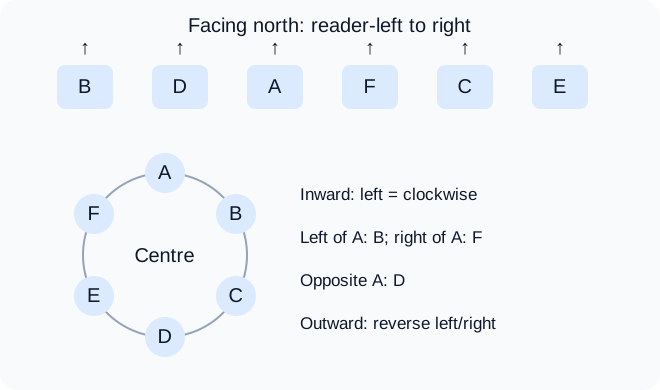
Six people A–F face north. B occupies the reader’s left end. D is immediately right of B. A is immediately right of D. F is immediately right of A. C is immediately right of F. First fix B in seat 1; then place D, A, F and C in seats 2–5. The unused person E takes seat 6. Solution: B–D–A–F–C–E. A’s immediate neighbours are D and F; two people lie between D and C; E is at the right end. Check all clues after filling the last seat; never place an unused person before checking whether multiple empty seats remain.
6. Circular arrangement: inward and outward
Draw seats around a circle and label clockwise order. Facing the centre: left is clockwise and right is anticlockwise. Facing outward: left is anticlockwise and right is clockwise. Check this at the top seat: an inward-facing person looks south, so their left points east toward the next clockwise seat. Six people in clockwise order A–B–C–D–E–F, all inward, give B immediately left of A, F immediately right of A and D opposite A. Fixing A at the top removes rotational duplicates; it is an anchor for drawing, not an extra relative-position clue.
7. Opposite seats and counting around a circle
With n equally spaced seats and even n, the opposite seat is n/2 steps away. An odd number of equally spaced seats has no exact diametrically opposite seat. If the clockwise step distance from A to B is d, there are d−1 people strictly between them clockwise and n−d−1 on the other arc. Example: eight seats, clockwise distance 3 gives 2 people on that arc and 4 on the other. The phrase “between” is ambiguous on a circle unless a direction or shorter arc is specified. For opposite seats the two arcs contain equal numbers.
8. Parallel rows facing each other
Draw the upper row facing south and the lower row facing north. Number columns from the reader’s left identically in both rows. Opposite people occupy the same column; they do not share the same personal-left orientation. Example: upper row A–B–C–D, lower row P–Q–R–S. A faces P, B faces Q. The person immediately right of C is B, and B faces Q. The person immediately left of R is Q, and Q faces B. Resolve a chain such as “the person facing the one to X’s right” one step at a time.
9. Square and rectangular tables
Label the permitted seats first: four corners, four side midpoints, or another stated layout. In an eight-seat square, use clockwise positions 1–8: top-left corner, top midpoint, top-right corner, right midpoint, bottom-right corner, bottom midpoint, bottom-left corner, left midpoint. Opposite positions differ by four. Corner and midpoint seats alternate. For all inward-facing people, personal left follows the clockwise seat order; outward-facing reverses it. If corners face inward and midpoints outward, use the reference person’s seat type. Do not silently add midpoint seats when only four corners are mentioned.
10. Blocks, cases and negative clues
Treat consecutive people as a block: “A immediately left of B” in an all-north row makes AB. A distance of two seat steps means A _ B, not AB. Place strong anchors first, such as an endpoint, a fixed seat or an opposite pair. Then branch only when necessary, label Case 1 and Case 2 and eliminate a case as soon as it violates any clue. Record “not at an end” and “not next to” immediately. Avoid merging different cases into one picture. If a puzzle includes attributes such as colour or profession, keep one column per attribute and apply each uniqueness rule explicitly.
11. Uniqueness and data sufficiency
A full arrangement need not be unique for a particular answer to be definite. Example: A is at the left end and B immediately right of A in a four-person north-facing row. C and D can swap, but A’s right neighbour is definitely B. To claim a complete solution, all valid arrangements must agree after removing rotations in an unanchored circle. A mirror reversal is not automatically equivalent when left/right clues are present. For data sufficiency, test statements separately, then together; do not import information from statement II into the trial of I alone. If several valid arrangements give different answers, report insufficient information.
12. Revision and a timed solving routine
First identify shape, number of seats, facing directions and reference viewpoint. Draw and number the seats. Place anchors, build blocks, branch if needed, then test every clue. For a question, circle its reference person and apply that person’s left/right. In a row the number strictly between seats p and q is |p−q|−1. In a circle specify the arc. Answer the requested fact without rebuilding the whole puzzle. The complete online practice bank contains sixteen five-question sets; all complete layouts are checked by enumerating possible seat assignments. Solve each set once, then use its diagram for all five questions.
Practice set: 30 questions
Draw each set before choosing one correct option. The full online bank contains five questions per set.
Practice 01
Set 1: Six people A–F sit in one row. All face north. Seats 1–6 run from the reader’s left to right. Exactly 4 people sit between D and A in their row. B is 3 seat step(s) to C’s right. A is 2 seat step(s) to E’s right. Who occupies the reader’s left end?
- A. D
- B. C
- C. F
- D. E
Practice 02
Set 1: Six people A–F sit in one row. All face north. Seats 1–6 run from the reader’s left to right. Exactly 4 people sit between D and A in their row. B is 3 seat step(s) to C’s right. A is 2 seat step(s) to E’s right. Who is second to E’s left?
- A. C
- B. D
- C. F
- D. E
Practice 03
Set 2: Six people A–F sit in one row. All face south. Seats 1–6 run from the reader’s left to right. Exactly 4 people sit between C and B in their row. A is 3 seat step(s) to F’s right. D is 3 seat step(s) to B’s right. Who occupies the reader’s left end?
- A. E
- B. C
- C. A
- D. D
Practice 04
Set 2: Six people A–F sit in one row. All face south. Seats 1–6 run from the reader’s left to right. Exactly 4 people sit between C and B in their row. A is 3 seat step(s) to F’s right. D is 3 seat step(s) to B’s right. Who is second to E’s left?
- A. D
- B. B
- C. C
- D. A
Practice 05
Set 3: Six people A–F sit in one row. All face north. Seats 1–6 run from the reader’s left to right. Exactly 4 people sit between D and F in their row. B is 3 seat step(s) to E’s left. A is 2 seat step(s) to F’s right. Who occupies the reader’s left end?
- A. A
- B. C
- C. F
- D. B
Practice 06
Set 3: Six people A–F sit in one row. All face north. Seats 1–6 run from the reader’s left to right. Exactly 4 people sit between D and F in their row. B is 3 seat step(s) to E’s left. A is 2 seat step(s) to F’s right. Who is second to C’s left?
- A. A
- B. C
- C. B
- D. F
Practice 07
Set 4: Six people A–F sit in one row. All face south. Seats 1–6 run from the reader’s left to right. Exactly 4 people sit between E and F in their row. C is 3 seat step(s) to D’s right. B is 2 seat step(s) to F’s right. Who occupies the reader’s left end?
- A. C
- B. A
- C. B
- D. E
Practice 08
Set 4: Six people A–F sit in one row. All face south. Seats 1–6 run from the reader’s left to right. Exactly 4 people sit between E and F in their row. C is 3 seat step(s) to D’s right. B is 2 seat step(s) to F’s right. Who is second to B’s left?
- A. E
- B. C
- C. A
- D. F
Practice 09
Set 5: Six people A–F occupy equally spaced circular seats, all facing the centre. Draw A at the top in seat 1 and number seats clockwise 1–6. F is 2 seat steps clockwise from B. E is 3 seat steps clockwise from A. D is 2 seat steps clockwise from A. Who sits immediately to F’s left?
- A. D
- B. A
- C. F
- D. E
Practice 10
Set 5: Six people A–F occupy equally spaced circular seats, all facing the centre. Draw A at the top in seat 1 and number seats clockwise 1–6. F is 2 seat steps clockwise from B. E is 3 seat steps clockwise from A. D is 2 seat steps clockwise from A. Who occupies seat 5 in the stated clockwise numbering?
- A. C
- B. A
- C. F
- D. D
Practice 11
Set 6: Six people A–F occupy equally spaced circular seats, all facing outward. Draw A at the top in seat 1 and number seats clockwise 1–6. D is 2 seat steps clockwise from F. E is 3 seat steps clockwise from B. B is 2 seat steps clockwise from C. Who sits immediately to E’s left?
- A. F
- B. A
- C. E
- D. C
Practice 12
Set 6: Six people A–F occupy equally spaced circular seats, all facing outward. Draw A at the top in seat 1 and number seats clockwise 1–6. D is 2 seat steps clockwise from F. E is 3 seat steps clockwise from B. B is 2 seat steps clockwise from C. Who occupies seat 5 in the stated clockwise numbering?
- A. C
- B. B
- C. A
- D. E
Practice 13
Set 7: Six people A–F occupy equally spaced circular seats, all facing the centre. Draw A at the top in seat 1 and number seats clockwise 1–6. D is 1 seat steps clockwise from A. E is 3 seat steps clockwise from C. C is 2 seat steps clockwise from F. Who sits immediately to D’s left?
- A. D
- B. F
- C. E
- D. A
Practice 14
Set 7: Six people A–F occupy equally spaced circular seats, all facing the centre. Draw A at the top in seat 1 and number seats clockwise 1–6. D is 1 seat steps clockwise from A. E is 3 seat steps clockwise from C. C is 2 seat steps clockwise from F. Who occupies seat 5 in the stated clockwise numbering?
- A. D
- B. E
- C. B
- D. A
Practice 15
Set 8: Six people A–F occupy equally spaced circular seats, all facing outward. Draw A at the top in seat 1 and number seats clockwise 1–6. F is 3 seat steps clockwise from D. C is 2 seat steps clockwise from B. A is 2 seat steps clockwise from F. Who sits immediately to D’s left?
- A. D
- B. E
- C. B
- D. A
Practice 16
Set 8: Six people A–F occupy equally spaced circular seats, all facing outward. Draw A at the top in seat 1 and number seats clockwise 1–6. F is 3 seat steps clockwise from D. C is 2 seat steps clockwise from B. A is 2 seat steps clockwise from F. Who occupies seat 5 in the stated clockwise numbering?
- A. A
- B. D
- C. E
- D. F
Practice 17
Set 9: A–D sit in the upper row facing south; E–H sit in the lower row facing north. Each row has four seats in columns 1–4 from the reader’s left. People in the same column face each other. H is 3 seat step(s) to F’s right. C is 3 seat step(s) to A’s right. H is 1 seat step(s) to G’s right. D is 1 seat step(s) to C’s left. Who faces D?
- A. E
- B. C
- C. D
- D. B
Practice 18
Set 9: A–D sit in the upper row facing south; E–H sit in the lower row facing north. Each row has four seats in columns 1–4 from the reader’s left. People in the same column face each other. H is 3 seat step(s) to F’s right. C is 3 seat step(s) to A’s right. H is 1 seat step(s) to G’s right. D is 1 seat step(s) to C’s left. Who faces the person immediately to B’s right?
- A. E
- B. C
- C. D
- D. B
Practice 19
Set 10: A–D sit in the upper row facing south; E–H sit in the lower row facing north. Each row has four seats in columns 1–4 from the reader’s left. People in the same column face each other. C is 3 seat step(s) to A’s right. G is 3 seat step(s) to H’s right. D sits directly opposite E. Exactly 1 people sit between G and E in their row. Who faces D?
- A. B
- B. E
- C. C
- D. D
Practice 20
Set 10: A–D sit in the upper row facing south; E–H sit in the lower row facing north. Each row has four seats in columns 1–4 from the reader’s left. People in the same column face each other. C is 3 seat step(s) to A’s right. G is 3 seat step(s) to H’s right. D sits directly opposite E. Exactly 1 people sit between G and E in their row. Who faces the person immediately to B’s right?
- A. B
- B. E
- C. C
- D. D
Practice 21
Set 11: A–D sit in the upper row facing south; E–H sit in the lower row facing north. Each row has four seats in columns 1–4 from the reader’s left. People in the same column face each other. C is 3 seat step(s) to D’s left. F is 3 seat step(s) to H’s right. D is 1 seat step(s) to B’s right. G sits directly opposite A. Who faces B?
- A. B
- B. A
- C. E
- D. D
Practice 22
Set 11: A–D sit in the upper row facing south; E–H sit in the lower row facing north. Each row has four seats in columns 1–4 from the reader’s left. People in the same column face each other. C is 3 seat step(s) to D’s left. F is 3 seat step(s) to H’s right. D is 1 seat step(s) to B’s right. G sits directly opposite A. Who faces the person immediately to A’s right?
- A. B
- B. A
- C. E
- D. D
Practice 23
Set 12: A–D sit in the upper row facing south; E–H sit in the lower row facing north. Each row has four seats in columns 1–4 from the reader’s left. People in the same column face each other. D is 3 seat step(s) to C’s right. F is 3 seat step(s) to G’s left. E is 2 seat step(s) to G’s left. B is 2 seat step(s) to C’s right. Who faces B?
- A. D
- B. B
- C. A
- D. E
Practice 24
Set 12: A–D sit in the upper row facing south; E–H sit in the lower row facing north. Each row has four seats in columns 1–4 from the reader’s left. People in the same column face each other. D is 3 seat step(s) to C’s right. F is 3 seat step(s) to G’s left. E is 2 seat step(s) to G’s left. B is 2 seat step(s) to C’s right. Who faces the person immediately to A’s right?
- A. D
- B. B
- C. A
- D. E
Practice 25
Set 13: Eight people A–H sit at the four corners and four side midpoints of a square. Seat 1 is the top-left corner, seat 2 the top midpoint, and the remaining seats follow clockwise to 8. A is in seat 1. All face the centre. E is 4 seat steps clockwise from C. A is 1 seat steps clockwise from B. D is 3 seat steps clockwise from G. E is 3 seat steps clockwise from B. H is 4 seat steps clockwise from B. Who sits immediately to G’s left?
- A. E
- B. A
- C. G
- D. H
Practice 26
Set 13: Eight people A–H sit at the four corners and four side midpoints of a square. Seat 1 is the top-left corner, seat 2 the top midpoint, and the remaining seats follow clockwise to 8. A is in seat 1. All face the centre. E is 4 seat steps clockwise from C. A is 1 seat steps clockwise from B. D is 3 seat steps clockwise from G. E is 3 seat steps clockwise from B. H is 4 seat steps clockwise from B. Who occupies seat 5 in the stated clockwise numbering?
- A. D
- B. A
- C. G
- D. E
Practice 27
Set 14: Eight people A–H sit at the four corners and four side midpoints of a square. Seat 1 is the top-left corner, seat 2 the top midpoint, and the remaining seats follow clockwise to 8. A is in seat 1. All face outward. G is 4 seat steps clockwise from E. F is 1 seat steps clockwise from H. B is 3 seat steps clockwise from A. D is 3 seat steps clockwise from E. B is 1 seat steps clockwise from G. Who sits immediately to D’s left?
- A. B
- B. A
- C. D
- D. G
Practice 28
Set 14: Eight people A–H sit at the four corners and four side midpoints of a square. Seat 1 is the top-left corner, seat 2 the top midpoint, and the remaining seats follow clockwise to 8. A is in seat 1. All face outward. G is 4 seat steps clockwise from E. F is 1 seat steps clockwise from H. B is 3 seat steps clockwise from A. D is 3 seat steps clockwise from E. B is 1 seat steps clockwise from G. Who occupies seat 5 in the stated clockwise numbering?
- A. G
- B. H
- C. A
- D. D
Practice 29
Set 15: Eight people A–H sit at the four corners and four side midpoints of a square. Seat 1 is the top-left corner, seat 2 the top midpoint, and the remaining seats follow clockwise to 8. A is in seat 1. Corner occupants face the centre; midpoint occupants face outward. G is 1 seat steps clockwise from F. C is 4 seat steps clockwise from E. H is 3 seat steps clockwise from B. D is 1 seat steps clockwise from B. E is 3 seat steps clockwise from A. Who occupies seat 5 in the stated clockwise numbering?
- A. B
- B. D
- C. H
- D. A
Practice 30
Set 16: Eight people A–H sit at the four corners and four side midpoints of a square. Seat 1 is the top-left corner, seat 2 the top midpoint, and the remaining seats follow clockwise to 8. A is in seat 1. Corner occupants face the centre; midpoint occupants face outward. C is 2 seat steps clockwise from D. B is 1 seat steps clockwise from A. A is 3 seat steps clockwise from G. B is 3 seat steps clockwise from H. B is 2 seat steps clockwise from E. Who occupies seat 5 in the stated clockwise numbering?
- A. A
- B. B
- C. D
- D. C
Answers and explanations
Answer 01
A. D
Reader-left to right: D – C – F – E – B – A. Seat 1 is the left endpoint.
Answer 02
A. C
Reader-left to right: D – C – F – E – B – A. Count two seat steps using the facing direction, leaving one person between.
Answer 03
B. C
Reader-left to right: C – A – D – E – F – B. Seat 1 is the left endpoint.
Answer 04
B. B
Reader-left to right: C – A – D – E – F – B. Count two seat steps using the facing direction, leaving one person between.
Answer 05
C. F
Reader-left to right: F – B – A – C – E – D. Seat 1 is the left endpoint.
Answer 06
C. B
Reader-left to right: F – B – A – C – E – D. Count two seat steps using the facing direction, leaving one person between.
Answer 07
D. E
Reader-left to right: E – C – A – B – D – F. Seat 1 is the left endpoint.
Answer 08
D. F
Reader-left to right: E – C – A – B – D – F. Count two seat steps using the facing direction, leaving one person between.
Answer 09
A. D
Clockwise from A: A – F – D – E – C – B. Inward left is clockwise; outward left is anticlockwise.
Answer 10
A. C
Clockwise from A: A – F – D – E – C – B. Read the fifth clockwise seat from the anchor.
Answer 11
B. A
Clockwise from A: A – E – C – F – B – D. Inward left is clockwise; outward left is anticlockwise.
Answer 12
B. B
Clockwise from A: A – E – C – F – B – D. Read the fifth clockwise seat from the anchor.
Answer 13
C. E
Clockwise from A: A – D – E – F – B – C. Inward left is clockwise; outward left is anticlockwise.
Answer 14
C. B
Clockwise from A: A – D – E – F – B – C. Read the fifth clockwise seat from the anchor.
Answer 15
D. A
Clockwise from A: A – D – E – B – F – C. Inward left is clockwise; outward left is anticlockwise.
Answer 16
D. F
Clockwise from A: A – D – E – B – F – C. Read the fifth clockwise seat from the anchor.
Answer 17
A. E
Upper row: C – D – B – A. Lower row: F – E – G – H. Opposite people share column 2.
Answer 18
A. E
Upper row: C – D – B – A. Lower row: F – E – G – H. B’s right neighbour is D, whose opposite is E.
Answer 19
B. E
Upper row: C – D – B – A. Lower row: H – E – F – G. Opposite people share column 2.
Answer 20
B. E
Upper row: C – D – B – A. Lower row: H – E – F – G. B’s right neighbour is D, whose opposite is E.
Answer 21
C. E
Upper row: D – B – A – C. Lower row: H – E – G – F. Opposite people share column 2.
Answer 22
C. E
Upper row: D – B – A – C. Lower row: H – E – G – F. A’s right neighbour is B, whose opposite is E.
Answer 23
D. E
Upper row: D – B – A – C. Lower row: F – E – H – G. Opposite people share column 2.
Answer 24
D. E
Upper row: D – B – A – C. Lower row: F – E – H – G. A’s right neighbour is B, whose opposite is E.
Answer 25
A. E
Clockwise from A: A – G – E – H – D – F – C – B. Inward left is clockwise; outward left is anticlockwise.
Answer 26
A. D
Clockwise from A: A – G – E – H – D – F – C – B. Read the fifth clockwise seat from the anchor.
Answer 27
B. A
Clockwise from A: A – D – G – B – H – F – E – C. Inward left is clockwise; outward left is anticlockwise.
Answer 28
B. H
Clockwise from A: A – D – G – B – H – F – E – C. Read the fifth clockwise seat from the anchor.
Answer 29
C. H
Clockwise from A: A – B – D – E – H – F – G – C. Read the fifth clockwise seat from the anchor.
Answer 30
D. C
Clockwise from A: A – B – D – F – C – G – H – E. Read the fifth clockwise seat from the anchor.
Online exams
Four tests contain 20 questions each; the complete test contains all 80. Work through rows, circles, parallel rows and square tables in that order. Recheck the reference person and facing after every mistake.
This is AI-generated information.