Clock
Learning goals
Understand the rules, draw a row or timeline, reproduce worked examples and attempt practice before checking answers. Identify the assumptions in every question first.
1. Reading an analogue clock
Assume an ideal 12-hour analogue clock with continuously moving hands unless the question specifies otherwise. There are 360 degrees around the dial, 30 degrees between consecutive hour marks and 6 degrees between minute marks. The hour hand moves even between hour numbers. At 3:30 it is halfway between 3 and 4, not exactly at 3. For formulas set H to the hour modulo 12, so 12 becomes 0; M is minutes past that hour.
2. Hand speeds and positions
Minute hand: 360/60 = 6 degrees per minute. Hour hand: 360/720 = 0.5 degrees per minute. Minute hand gains on the hour hand at 5.5 degrees per minute. Measured clockwise from 12, hour position = 30H + 0.5M and minute position = 6M. A second hand moves 6 degrees per second. When seconds S matter, replace M by M+S/60 for the hour/minute pair. Never mix degrees per second and degrees per minute without converting.
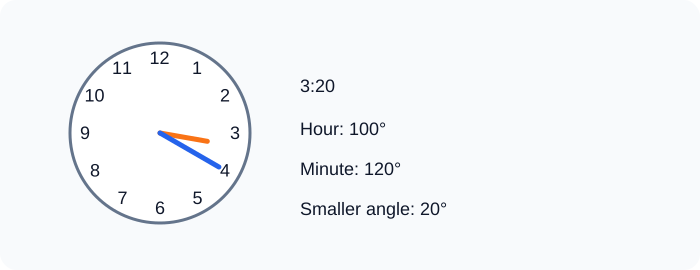
3. Smaller and reflex angles
Compute d = |30H − 5.5M|. The smaller angle is min(d,360−d) for valid H and M; the reflex angle is 360 minus the smaller angle. Example: at 3:20, d=|90−110|=20 degrees. At 8:10, d=|240−55|=185 degrees, so the smaller angle is 175 degrees. At 12:30, d=165 degrees, not 180: the hour hand has moved 15 degrees. At 6:00 the angle is 180; at 9:00 it is 90. “Angle between hands” usually means the smaller angle, but obey an explicit request for a reflex angle.
4. Overlap and opposite directions
Use the signed relative position 5.5M−30H. Overlap means it equals 360k for an integer k. Opposite directions mean 180+360k. Solve and keep only 0≤M<60 for the stated hour. Example: between 4 and 5, overlap gives M=120/5.5=240/11 = 21 9/11 minutes after 4. Between 2 and 3, opposite hands give 5.5M−60=180, so M=480/11 = 43 7/11 minutes. The fractional minute must be multiplied by 60 to convert to seconds; 9/11 minute is 49 1/11 seconds.
5. Right angles and any target angle
For a smaller angle α between 0 and 180, solve 5.5M−30H = +α+360k and −α+360k, then filter by the requested interval and remove duplicates. Between 2 and 3, a right angle gives M=300/11 = 27 3/11 minutes; the other immediate candidate is negative, so there is only one solution in that hour. Between 3 and 4, the solutions are 3:00 and 3:32 8/11; if the endpoints are excluded, omit 3:00. Do not assume there are two right angles inside every named hour.
6. Frequency and endpoint conventions
The interval between consecutive overlaps is 360/5.5 = 720/11 minutes = 65 5/11 minutes. In a half-open 12-hour interval, such as 00:00 inclusive to 12:00 exclusive, there are 11 overlaps, 11 opposite positions and 22 right angles. In 24 hours these counts are 22,22,44. Straight-line positions include both overlap and opposite directions: 22 in 12 hours. Counting both 00:00 and 12:00 gives an extra overlap at the endpoint. When seconds are present, minute/second relative speed is 6−0.1=5.9 degrees per second; hour/second relative speed is 6−1/120 degrees per second.
7. Fast and slow clocks
If a clock gains g minutes per 60 real minutes, displayed elapsed time = real elapsed time ×(60+g)/60. If it loses l minutes, use (60−l)/60. To recover real elapsed time, divide the displayed interval by that factor. Example: gaining 5 minutes per real hour, set correctly at noon, after six real hours it shows 18:30. If its displayed elapsed interval is 130 minutes, the real interval is 130×60/65 = 120 minutes. A loss per displayed hour is a different rate: a clock losing five minutes during 60 indicated minutes takes 65 real minutes for that interval. Always identify the rate’s reference.
8. When clocks agree again
A constantly fast or slow 12-hour display next agrees with the correct dial reading after accumulating 720 minutes of error; for a 24-hour display use 1440. Example: gaining 2 minutes per real hour requires 720/2 = 360 hours = 15 days. A stopped 12-hour clock displays the correct time twice in a 24-hour cycle. Two clocks gaining 3 and losing 2 minutes per real hour separate at five minutes per hour; a displayed separation of 30 minutes first occurs after six real hours. Distinguish “both correct” from “show the same reading”; identical errors can agree while both are wrong.
9. Mirror and water images of clocks
For a conventional vertical-mirror clock question, complement the reading to 12:00: image = (720 − time in minutes) mod 720. The borrowed form 11:60 is convenient: 3:25 becomes 8:35; 12:00 remains 12:00. Reflect both hands, not the written digits. A water image reverses top and bottom while preserving left and right. Shortcuts such as subtracting from 17:90 (18:30) are quoted for simplified exam drawings, but are not a universal exact normal-clock time rule. At 3:00, horizontal reflection puts the minute hand down and the hour hand exactly right; a real 3:30 hour hand lies between 3 and 4. Thus the reflected hands need not describe a valid ordinary clock reading. Use the supplied diagram and its stated simplified convention; do not apply a subtraction formula blindly.
10. Exam method and common mistakes
Classify the question: known-time angle, target angle, rate error or reflection. Draw the hour hand between marks when minutes are nonzero. Compute the smaller angle after the absolute difference. Solve all signed branches for target angles, enforce the hour interval and state endpoint inclusion. Keep fractions exact until converting to seconds. In faulty clocks separate real time, displayed time and accumulated error. For reflections check the geometry. A striking clock sounding six strokes has five gaps; if six strokes take ten seconds, twelve strokes take eleven gaps, or 22 seconds, assuming uniform gaps and negligible stroke duration.
Practice set: 30 questions
Choose one correct option. Minutes written as fractions are exact rather than decimal approximations.
Practice 01
What is the smaller angle in degrees at 1:20 on an ideal clock?
- A. 80
- B. 81
- C. 79
- D. 82
Practice 02
What is the smaller angle in degrees at 4:40 on an ideal clock?
- A. 101
- B. 99
- C. 102
- D. 100
Practice 03
What is the smaller angle in degrees at 11:50 on an ideal clock?
- A. 56
- B. 54
- C. 57
- D. 55
Practice 04
How many degrees does the hour hand move in 7 real minutes on an ideal clock?
- A. 7/2
- B. 9/2
- C. 5/2
- D. 11/2
Practice 05
How many degrees does the hour hand move in 19 real minutes on an ideal clock?
- A. 21/2
- B. 17/2
- C. 23/2
- D. 19/2
Practice 06
How many degrees does the hour hand move in 35 real minutes on an ideal clock?
- A. 37/2
- B. 33/2
- C. 39/2
- D. 35/2
Practice 07
Between 1:00 and 2:00, how many minutes after 1:00 do the hands overlap? Give an exact fraction.
- A. 60/11
- B. 71/11
- C. 49/11
- D. 82/11
Practice 08
Between 4:00 and 5:00, how many minutes after 4:00 do the hands overlap? Give an exact fraction.
- A. 251/11
- B. 229/11
- C. 262/11
- D. 240/11
Practice 09
Between 8:00 and 9:00, how many minutes after 8:00 do the hands overlap? Give an exact fraction.
- A. 491/11
- B. 469/11
- C. 502/11
- D. 480/11
Practice 10
Strictly between 1:00 and 2:00, how many minutes after 1:00 are the hands opposite? Give an exact fraction.
- A. 420/11
- B. 431/11
- C. 409/11
- D. 442/11
Practice 11
Strictly between 4:00 and 5:00, how many minutes after 4:00 are the hands opposite? Give an exact fraction.
- A. 611/11
- B. 589/11
- C. 622/11
- D. 600/11
Practice 12
Strictly between 10:00 and 11:00, how many minutes after 10:00 are the hands opposite? Give an exact fraction.
- A. 251/11
- B. 229/11
- C. 262/11
- D. 240/11
Practice 13
What is the first right angle strictly after 1:00 and before 2:00, in minutes after 1:00? Give an exact fraction.
- A. 240/11
- B. 251/11
- C. 229/11
- D. 262/11
Practice 14
What is the first right angle strictly after 4:00 and before 5:00, in minutes after 4:00? Give an exact fraction.
- A. 71/11
- B. 49/11
- C. 82/11
- D. 60/11
Practice 15
What is the first right angle strictly after 8:00 and before 9:00, in minutes after 8:00? Give an exact fraction.
- A. 311/11
- B. 289/11
- C. 322/11
- D. 300/11
Practice 16
A clock is set correctly and gains 2 minutes per real hour. After 3 real hours, how many minutes have elapsed on its display?
- A. 186
- B. 187
- C. 185
- D. 188
Practice 17
A clock is set correctly and gains 5 minutes per real hour. After 6 real hours, how many minutes have elapsed on its display?
- A. 391
- B. 389
- C. 392
- D. 390
Practice 18
A clock is set correctly and gains 9 minutes per real hour. After 10 real hours, how many minutes have elapsed on its display?
- A. 691
- B. 689
- C. 692
- D. 690
Practice 19
A clock loses 2 minutes per real hour. It shows an elapsed interval of 116 minutes. What was the real elapsed interval in minutes?
- A. 120
- B. 121
- C. 119
- D. 122
Practice 20
A clock loses 5 minutes per real hour. It shows an elapsed interval of 275 minutes. What was the real elapsed interval in minutes?
- A. 301
- B. 299
- C. 302
- D. 300
Practice 21
A clock loses 9 minutes per real hour. It shows an elapsed interval of 459 minutes. What was the real elapsed interval in minutes?
- A. 541
- B. 539
- C. 542
- D. 540
Practice 22
What reading is obtained in the conventional vertical-mirror clock question for 1:10?
- A. 10:50
- B. 10:55
- C. 11:20
- D. 11:50
Practice 23
What reading is obtained in the conventional vertical-mirror clock question for 4:25?
- A. 7:40
- B. 8:05
- C. 8:35
- D. 7:35
Practice 24
What reading is obtained in the conventional vertical-mirror clock question for 8:45?
- A. 3:20
- B. 3:45
- C. 4:15
- D. 3:15
Practice 25
A 12-hour clock gains 2 minutes per real hour after being set correctly. After how many real hours does its dial next agree with the correct time?
- A. 360
- B. 361
- C. 359
- D. 362
Practice 26
A 12-hour clock gains 5 minutes per real hour after being set correctly. After how many real hours does its dial next agree with the correct time?
- A. 145
- B. 143
- C. 146
- D. 144
Practice 27
A 12-hour clock gains 9 minutes per real hour after being set correctly. After how many real hours does its dial next agree with the correct time?
- A. 81
- B. 79
- C. 82
- D. 80
Practice 28
How many overlaps occur from 00:00 inclusive to 12:00 exclusive?
- A. 11
- B. 12
- C. 22
- D. 24
Practice 29
Six strikes span ten seconds from the first to the last. With uniform gaps and negligible strike duration, how long do twelve strikes span?
- A. 20
- B. 24
- C. 12
- D. 22
Practice 30
A clock loses five minutes during each 60 indicated minutes. How many real minutes correspond to 120 indicated minutes?
- A. 110
- B. 125
- C. 120
- D. 130
Answers and explanations
Answer 01
A. 80
d = |30×1−5.5×20| = 80; smaller angle = 80 degrees.
Answer 02
D. 100
d = |30×4−5.5×40| = 100; smaller angle = 100 degrees.
Answer 03
D. 55
d = |30×11−5.5×50| = 55; smaller angle = 55 degrees.
Answer 04
A. 7/2
Hour hand speed = 0.5 degrees/minute; displacement = 7/2 = 7/2 degrees.
Answer 05
D. 19/2
Hour hand speed = 0.5 degrees/minute; displacement = 19/2 = 19/2 degrees.
Answer 06
D. 35/2
Hour hand speed = 0.5 degrees/minute; displacement = 35/2 = 35/2 degrees.
Answer 07
A. 60/11
5.5M = 30×1; M = 60/11 minutes. This lies within the stated hour.
Answer 08
D. 240/11
5.5M = 30×4; M = 240/11 minutes. This lies within the stated hour.
Answer 09
D. 480/11
5.5M = 30×8; M = 480/11 minutes. This lies within the stated hour.
Answer 10
A. 420/11
Solve 5.5M−30 = 180+360k and keep 0<M<60. M = 420/11.
Answer 11
D. 600/11
Solve 5.5M−120 = 180+360k and keep 0<M<60. M = 600/11.
Answer 12
D. 240/11
Solve 5.5M−300 = 180+360k and keep 0<M<60. M = 240/11.
Answer 13
A. 240/11
Solve 5.5M−30 = ±90+360k. Valid positive minutes: 240/11, 600/11; choose 240/11.
Answer 14
D. 60/11
Solve 5.5M−120 = ±90+360k. Valid positive minutes: 60/11, 420/11; choose 60/11.
Answer 15
D. 300/11
Solve 5.5M−240 = ±90+360k. Valid positive minutes: 300/11; choose 300/11.
Answer 16
A. 186
Displayed interval = 3×(60+2) = 186 minutes.
Answer 17
D. 390
Displayed interval = 6×(60+5) = 390 minutes.
Answer 18
D. 690
Displayed interval = 10×(60+9) = 690 minutes.
Answer 19
A. 120
Real interval = 116×60/(60−2) = 120 minutes.
Answer 20
D. 300
Real interval = 275×60/(60−5) = 300 minutes.
Answer 21
D. 540
Real interval = 459×60/(60−9) = 540 minutes.
Answer 22
A. 10:50
Complement to 12:00: 720−70 = 650 minutes, or 10:50.
Answer 23
D. 7:35
Complement to 12:00: 720−265 = 455 minutes, or 7:35.
Answer 24
D. 3:15
Complement to 12:00: 720−525 = 195 minutes, or 3:15.
Answer 25
A. 360
Accumulate 720 minutes of error: 720/2 = 360 hours.
Answer 26
D. 144
Accumulate 720 minutes of error: 720/5 = 144 hours.
Answer 27
D. 80
Accumulate 720 minutes of error: 720/9 = 80 hours.
Answer 28
A. 11
The relative hand motion makes 11 full cycles in 12 hours; the last endpoint is excluded.
Answer 29
D. 22
Six strikes have five gaps: each is two seconds. Twelve strikes have eleven gaps: 22 seconds.
Answer 30
D. 130
Each 60 indicated minutes require 65 real minutes, so two intervals require 130.
Online exam practice
This chapter links to four tests of 20 questions each and a complete 80-question test. After each attempt, review explanations for mistakes and revise the relevant rule.
This is AI-generated information.