Time Sequence Test
Learning goals
Understand the rules, draw a row or timeline, reproduce worked examples and attempt practice before checking answers. Identify the assumptions in every question first.
1. What time-sequence questions test
These questions combine a reference day or time with offsets, calendar lengths, remembered windows and repeated events. They differ from clock-hand angle questions. Use one consistent unit and one reference point. Treat today as offset 0, tomorrow as +1 and yesterday as −1. Unless stated otherwise, schedules use one time zone and have no daylight-saving change.
2. Weekdays and modular arithmetic
Number Monday through Sunday as 0 through 6. For n days later add n; for earlier subtract n, then reduce modulo 7. A multiple of seven changes no weekday. Example: 100 days after Tuesday gives 100 mod 7 = 2, hence Thursday. For negative results add seven until the number is between 0 and 6. Three days after today is Sunday: today is Thursday. Four days before tomorrow is then Monday because tomorrow is Friday and Friday−4 = Monday.
3. Nested statements: translate before solving
“Two days after the day before yesterday” has offset −2+2=0. “Three days before the day after tomorrow” has offset +2−3=−1. If a statement identifies offset a as a known weekday, the weekday at offset b is (b−a) days from it. Example: five days before tomorrow is Tuesday. That is offset −4. Two days after yesterday is offset +1, so move five days from Tuesday to Sunday. Do not repeatedly guess the current weekday when direct offset subtraction is simpler.
4. Calendar foundations and leap years
In the Gregorian calendar, a year divisible by 4 is a leap year except century years, which must also be divisible by 400. Thus 2000 is leap, 1900 and 2100 are not, and 2024 is leap. February has 28 or 29 days. April, June, September and November have 30; other months have 31. An ordinary year has 365 days = 52 weeks + 1 day; a leap year has 366 = 52 weeks + 2. A 400-year cycle has 146097 days, exactly divisible by seven. When shifting the same date to next year, use the actual interval: add two weekdays only if February 29 lies in that interval. Never transfer a February 29 birthday to an invalid date without an explicit convention.
5. Date intervals and inclusive counting
Elapsed days from the start of March 3 to the start of March 10 are 10−3=7; counting both named dates gives eight dates. For cross-month intervals, count remaining days and then the next month’s dates. Example: from January 28 to February 3 is 3+3=6 days. From February 27 to March 2 is four days in an ordinary year and five in a leap year. Distinguish the nth day, which uses n−1 elapsed days, from n days later. A five-day course beginning Monday ends Friday if Monday is day one.
6. Remembered time or date windows
Find the intersection, not the union. Rakesh says after 2 pm but before 5 pm: (14:00,17:00). Sunil says after 3 pm but before 6 pm: (15:00,18:00). The common continuous window is (15:00,17:00), which contains many times. Only if the meeting starts at an exact whole hour can 4 pm be the unique answer. “At least” and “not earlier than” include the boundary; “after” does not. For dates strictly after the 12th and before the 17th, candidates are 13,14,15,16. Intersect with strictly after the 14th and before the 18th to get 15,16: the answer is still not unique.
7. Bus and train schedules
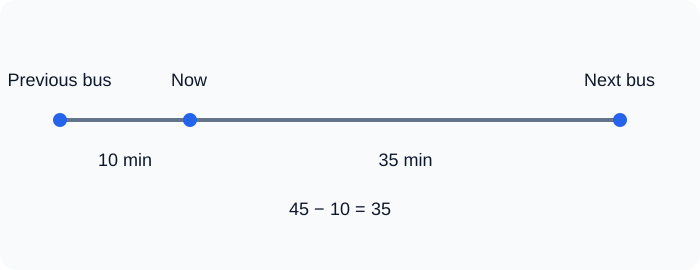
For services every p minutes, if the last one left e minutes ago with 0<e<p, wait p−e minutes. Every 45 minutes with the last bus ten minutes ago gives 35 minutes. If you can board a service departing exactly when you arrive, waiting at a scheduled departure is zero. With first departure t0 and arrival t, the next usable departure is t0 + p×ceil((t−t0)/p), for t≥t0. Example: first bus 08:00, interval 35 minutes, arrival 09:20. Departures are 08:00,08:35,09:10,09:45; waiting is 25 minutes. Respect the final departure and any excluded service days.
8. Repeating events and counting departures
Events starting together with periods a and b next coincide after LCM(a,b). Buses every 18 and 24 minutes leaving together at 09:00 next coincide after 72 minutes, at 10:12. With different start offsets, LCM alone is not enough: list departures or solve t≡a mod p and t≡b mod q. Periodic schedules have a common time only if the offset difference is divisible by gcd(p,q). A bus every 20 minutes from 08:00 through 10:00 inclusive makes 120/20+1=7 departures. Excluding the first or last endpoint changes that count.
9. Midnight, duration and working days
Convert to minutes after midnight: 14:35 is 875 minutes. Across midnight add 1440 to the next day’s endpoint. From 22:45 to 01:20 next day, duration is 155 minutes, or 2 h 35 min. 12 am is 00:00; 12 pm is noon. For working days explicitly exclude the stated weekends and holidays; calendar days and working days are not interchangeable. A three-working-day deadline after Friday with Saturday/Sunday off falls on Wednesday when Friday is excluded and no holidays occur.
10. Fast revision checklist
Write the reference, the signed offset and the unit. Reduce weekday shifts modulo seven. Verify leap rules before crossing February. Decide whether endpoints are included. Intersect remembered ranges and report insufficient information if more than one answer remains. Use LCM only with compatible schedule starts. Distinguish duration from inclusive date count and exact hours from arbitrary times. Recheck the result by building a short timeline.
Practice set: 30 questions
Choose one correct option. Minutes written as fractions are exact rather than decimal approximations.
Practice 01
Today is Monday. What day will it be 17 days later?
- A. Thursday
- B. Friday
- C. Saturday
- D. Sunday
Practice 02
Today is Thursday. What day will it be 44 days later?
- A. Sunday
- B. Monday
- C. Tuesday
- D. Saturday
Practice 03
Today is Monday. What day will it be 80 days later?
- A. Friday
- B. Saturday
- C. Sunday
- D. Thursday
Practice 04
3 days after today is Monday. What weekday was 2 days before tomorrow?
- A. Thursday
- B. Friday
- C. Saturday
- D. Sunday
Practice 05
6 days after today is Thursday. What weekday was 5 days before tomorrow?
- A. Tuesday
- B. Wednesday
- C. Thursday
- D. Monday
Practice 06
10 days after today is Monday. What weekday was 9 days before tomorrow?
- A. Friday
- B. Saturday
- C. Sunday
- D. Thursday
Practice 07
How many days elapse from the start of 27 February 2020 to the start of 3 March 2020, using the Gregorian calendar?
- A. 5
- B. 6
- C. 4
- D. 7
Practice 08
How many days elapse from the start of 27 February 2023 to the start of 3 March 2023, using the Gregorian calendar?
- A. 5
- B. 3
- C. 6
- D. 4
Practice 09
How many days elapse from the start of 27 February 2027 to the start of 3 March 2027, using the Gregorian calendar?
- A. 5
- B. 3
- C. 6
- D. 4
Practice 10
A date is strictly after the 9th and before the 14th, and strictly after the 12th and before the 14th. Which date fits both?
- A. 13
- B. 14
- C. 12
- D. 15
Practice 11
A date is strictly after the 12th and before the 17th, and strictly after the 15th and before the 17th. Which date fits both?
- A. 17
- B. 15
- C. 18
- D. 16
Practice 12
A date is strictly after the 16th and before the 21th, and strictly after the 19th and before the 21th. Which date fits both?
- A. 21
- B. 19
- C. 22
- D. 20
Practice 13
Buses depart every 30 minutes. The last departed 7 minutes ago. How many minutes until the next?
- A. 23
- B. 24
- C. 22
- D. 25
Practice 14
Buses depart every 45 minutes. The last departed 10 minutes ago. How many minutes until the next?
- A. 36
- B. 34
- C. 37
- D. 35
Practice 15
Buses depart every 65 minutes. The last departed 14 minutes ago. How many minutes until the next?
- A. 52
- B. 50
- C. 53
- D. 51
Practice 16
The first bus leaves at 08:00, then every 20 minutes. You arrive 77 minutes after 08:00 and may board a bus departing at that instant. What is the wait in minutes?
- A. 3
- B. 4
- C. 2
- D. 5
Practice 17
The first bus leaves at 08:00, then every 29 minutes. You arrive 89 minutes after 08:00 and may board a bus departing at that instant. What is the wait in minutes?
- A. 28
- B. 26
- C. 29
- D. 27
Practice 18
The first bus leaves at 08:00, then every 41 minutes. You arrive 105 minutes after 08:00 and may board a bus departing at that instant. What is the wait in minutes?
- A. 19
- B. 17
- C. 20
- D. 18
Practice 19
Two services start together and repeat every 12 and 18 minutes. After how many minutes do they next start together?
- A. 36
- B. 37
- C. 35
- D. 38
Practice 20
Two services start together and repeat every 15 and 21 minutes. After how many minutes do they next start together?
- A. 106
- B. 104
- C. 107
- D. 105
Practice 21
Two services start together and repeat every 19 and 25 minutes. After how many minutes do they next start together?
- A. 476
- B. 474
- C. 477
- D. 475
Practice 22
How many minutes pass from 22:15 to 01:10 the next day?
- A. 175
- B. 176
- C. 174
- D. 177
Practice 23
How many minutes pass from 22:24 to 01:22 the next day?
- A. 179
- B. 177
- C. 180
- D. 178
Practice 24
How many minutes pass from 22:36 to 01:38 the next day?
- A. 183
- B. 181
- C. 184
- D. 182
Practice 25
A service runs every 10 minutes from its first departure through a departure 50 minutes later. Counting both endpoints, how many departures occur?
- A. 6
- B. 7
- C. 5
- D. 8
Practice 26
A service runs every 25 minutes from its first departure through a departure 200 minutes later. Counting both endpoints, how many departures occur?
- A. 10
- B. 8
- C. 11
- D. 9
Practice 27
A service runs every 45 minutes from its first departure through a departure 540 minutes later. Counting both endpoints, how many departures occur?
- A. 14
- B. 12
- C. 15
- D. 13
Practice 28
A meeting is after 10:00 but before 13:00, and after 11:00 but before 14:00. Starts can be at any minute. Is a unique time determined?
- A. No; multiple times fit
- B. 12:00
- C. 11:00
- D. No time fits
Practice 29
A meeting is after 13:00 but before 16:00, and after 14:00 but before 17:00. Starts can be at any minute. Is a unique time determined?
- A. 15:00
- B. 14:00
- C. No time fits
- D. No; multiple times fit
Practice 30
A meeting is after 17:00 but before 20:00, and after 18:00 but before 21:00. Starts can be at any minute. Is a unique time determined?
- A. 19:00
- B. 18:00
- C. No time fits
- D. No; multiple times fit
Answers and explanations
Answer 01
A. Thursday
17 mod 7 = 3; move 3 days forward to Thursday.
Answer 02
D. Saturday
44 mod 7 = 2; move 2 days forward to Saturday.
Answer 03
D. Thursday
80 mod 7 = 3; move 3 days forward to Thursday.
Answer 04
A. Thursday
Known offset is +3; target offset is 1−2. Shift by -4 days to Thursday.
Answer 05
D. Monday
Known offset is +6; target offset is 1−5. Shift by -10 days to Monday.
Answer 06
D. Thursday
Known offset is +10; target offset is 1−9. Shift by -18 days to Thursday.
Answer 07
A. 5
February has 29 days; the elapsed interval is 5 days. Do not add an inclusive endpoint.
Answer 08
D. 4
February has 28 days; the elapsed interval is 4 days. Do not add an inclusive endpoint.
Answer 09
D. 4
February has 28 days; the elapsed interval is 4 days. Do not add an inclusive endpoint.
Answer 10
A. 13
The second range allows only 13, which also lies inside the first range.
Answer 11
D. 16
The second range allows only 16, which also lies inside the first range.
Answer 12
D. 20
The second range allows only 20, which also lies inside the first range.
Answer 13
A. 23
Wait = interval − elapsed = 30−7 = 23 minutes.
Answer 14
D. 35
Wait = interval − elapsed = 45−10 = 35 minutes.
Answer 15
D. 51
Wait = interval − elapsed = 65−14 = 51 minutes.
Answer 16
A. 3
The next departure offset is 80; waiting = 80−77 = 3.
Answer 17
D. 27
The next departure offset is 116; waiting = 116−89 = 27.
Answer 18
D. 18
The next departure offset is 123; waiting = 123−105 = 18.
Answer 19
A. 36
LCM(12,18) = 12×18/gcd(12,18) = 36.
Answer 20
D. 105
LCM(15,21) = 15×21/gcd(15,21) = 105.
Answer 21
D. 475
LCM(19,25) = 19×25/gcd(19,25) = 475.
Answer 22
A. 175
Add a day to the endpoint: 1440+70−1335 = 175 minutes.
Answer 23
D. 178
Add a day to the endpoint: 1440+82−1344 = 178 minutes.
Answer 24
D. 182
Add a day to the endpoint: 1440+98−1356 = 182 minutes.
Answer 25
A. 6
50/10 = 5 gaps, so 6 departures.
Answer 26
D. 9
200/25 = 8 gaps, so 9 departures.
Answer 27
D. 13
540/45 = 12 gaps, so 13 departures.
Answer 28
A. No; multiple times fit
The common open interval is (11:00,13:00), containing many minute values; whole-hour starts were not specified.
Answer 29
D. No; multiple times fit
The common open interval is (14:00,16:00), containing many minute values; whole-hour starts were not specified.
Answer 30
D. No; multiple times fit
The common open interval is (18:00,20:00), containing many minute values; whole-hour starts were not specified.
Online exam practice
This chapter links to four tests of 20 questions each and a complete 80-question test. After each attempt, review explanations for mistakes and revise the relevant rule.
This is AI-generated information.