Cubes and Dice: Opposite Faces, Rotations, Nets and Painted Cubes
1. Basic structure of a cube
A cube has 6 square faces, 12 edges and 8 vertices. Three faces meet at each vertex. Every face has four adjacent faces and one opposite face. Opposite faces share neither an edge nor a vertex; adjacent faces share an edge.
A die is a labelled cube. Labels can be numbers, letters, symbols or colours. Their numerical values do not determine their positions unless a convention is explicitly supplied. Two visible faces meeting along an edge are adjacent and cannot be opposite.
This chapter uses U=top, D=bottom, F=front, B=back, R=right and L=left. The observer’s directions remain fixed during roll questions. Keep a six-position table rather than relying on an unlabelled mental picture.
2. Opposite faces: use adjacency first
If a face is seen next to four distinct faces across valid views of the same die, the sixth label is its opposite. Example: face 1 is seen adjacent to 2, 3, 4 and 5. With six distinct labels 1–6, its opposite must be 6.
A single corner view shows three mutually adjacent faces. It does not identify which of the three unseen labels is opposite each visible one. You need additional information. The same printed triple in a different order can imply a different orientation; record positions as well as labels.
Do not automatically apply “opposite numbers add to 7”. Use that rule only when the question explicitly specifies that numbering convention. The questions here allow arbitrary arrangements of labels 1–6.
3. Compare views without creating a mirror image
Every ordered view in the MCQs is (top, front, right). If two views share two faces, align those common faces by a valid rotation before comparing the remaining positions. Do not simply place common labels wherever convenient: this can create a reflected arrangement that a physical die cannot reach by rotation.
Example views (1,2,3) and (1,5,4) show that 1 touches 2,3,5,4, so 6 is opposite 1. The example uses adjacency and does not require guessing the other opposite pairs.
When only one common face is visible, read the neighbouring faces around it in a consistent cyclic direction. A shortcut that ignores clockwise order can reverse the die. If the information still permits more than one opposite label, the correct conclusion is insufficient information—not an invented arrangement.
4. A die has 24 rigid orientations
Choose which face is on top in 6 ways. With that face fixed, choose which of its four neighbours is at the front. This gives 6 × 4 = 24 orientations. Once top and front are fixed, right is determined for that labelled die.
These 24 orientations preserve opposite pairs and the cyclic order of faces. A mirror reflection can preserve adjacency but reverse handedness; it is not an additional rotation. Six unique labels permit many different initial labellings, but one fixed die still has only 24 rigid orientations.
5. Rolling: track where the old faces move
A roll is a quarter-turn, 90°. “Roll right” here means the old top moves to the right. The table lists the cycle of old face positions; positions outside the cycle stay fixed.
| Roll toward | Old-position cycle |
|---|---|
| Front | U → F → D → B → U |
| Back | U → B → D → F → U |
| Right | U → R → D → L → U |
| Left | U → L → D → R → U |
Example start: U=1, D=6, F=2, B=5, R=3, L=4. After a right roll, U=4, D=3, F=2, B=5, R=1, L=6. After a further front roll, U=5, D=2, F=4, B=3, R=1, L=6. The final top is 5.
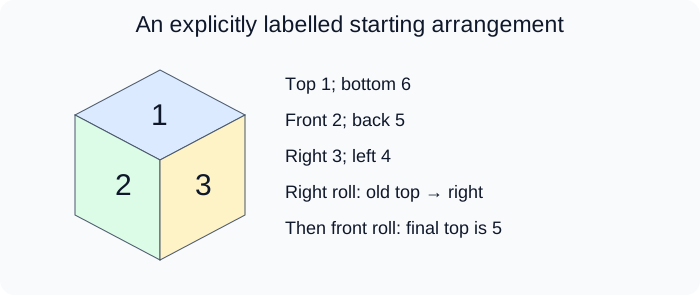
6. Multiple rolls and useful checks
Four rolls in the same direction restore the original orientation. A right roll followed by a left roll also restores it; front and back are inverse moves. Two rolls in one direction exchange top and bottom and exchange the relevant side pair.
Order matters: right then front generally differs from front then right. With the example in section 5, right then front gives top 5; front then right gives top 4. Do not combine movements as if they were ordinary addition.
After every step, all six labels must still appear once and the same opposite pairs must remain opposite. If a pair changes, the update was wrong. Update the positions simultaneously, using a fresh table rather than overwriting a value needed later in the same roll.
7. What is a cube net?
A net is a connected arrangement of six squares joined along full edges that folds into a cube without overlapping faces. Six connected squares are not automatically a valid net. A 2×3 rectangle, for example, does not fold into a cube without overlap or conflicting folds.
A square that touches another only at a corner does not provide a full-edge hinge. After folding, each of the six squares must occupy a different face direction. A valid net covers all six directions: top, bottom, front, back, left and right.
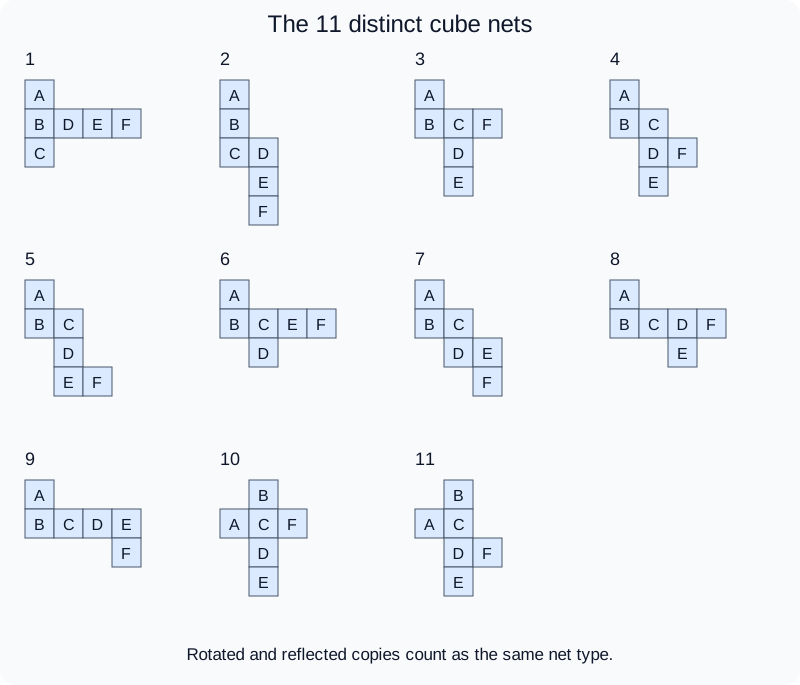
There are 11 distinct cube-net shapes when rotated and reflected flat copies count as the same shape. The gallery below is a shape reference; letter positions belong to each individual drawing and must not be transferred from one net to another.
8. Fold a net systematically
Choose one square as the base. Fold each edge-neighbour by 90°, then continue outward through the remaining squares. Keep each label attached to its own square. Squares opposite on the completed cube need not be farthest apart on the flat page.
Worked net, with blank spaces meaning no square:
    A
B   C   D
    E
    F
Take C as the front face. A and E fold to opposite sides; B and D also fold to opposite sides; F folds opposite C. Opposite pairs are A–E, B–D, C–F. The four-square strip A–C–E–F wraps around four sides, so positions two apart in this particular straight strip are opposite. Do not apply this strip rule to arbitrary non-straight arrangements.
9. Coordinate-based net questions
The MCQs describe net squares as (row, column). Rows increase downward and columns rightward; both start at 1. Thus A:(1,2), B:(2,1), C:(2,2), D:(2,3), E:(3,2), F:(4,2) gives exactly the worked net above.
Draw a small grid, place all six labels and mark shared full edges before folding. A coordinate difference of one in exactly one axis gives an edge neighbour. A diagonal displacement does not. The paper’s up/down directions are drawing coordinates, not fixed top/bottom faces after folding.
For letters or arrows printed on faces, identifying opposite faces is different from determining the final orientation of the printing. These questions ask about face labels only; do not add a symbol-rotation requirement that was not asked.
10. All six faces painted: the four categories
Paint the large cube before cutting. Divide every edge into n equal segments, producing n³ small cubes. For n ≥ 2, classify small cubes by their original outside faces:
| Exactly this many painted faces | Location | Number |
|---|---|---|
| 3 | Corners | 8 |
| 2 | Edges excluding corners | 12(n−2) |
| 1 | Face interiors excluding edges | 6(n−2)² |
| 0 | Completely inside | (n−2)³ |
Why subtract 2? Each edge has a corner cube at both ends. A face’s interior is therefore an (n−2)×(n−2) grid. Internal cubes form an (n−2)×(n−2)×(n−2) block.
The categories sum to n³. “At least one painted face” is n³−(n−2)³. “At least two” is 12(n−2)+8. Do not count corners again inside the exactly-two category.
11. Worked painted-cube examples and exceptions
For n=3: total 27; three painted faces 8; two painted faces 12; one painted face 6; no paint 1. The check is 8+12+6+1=27.
For n=5: total 125; three painted faces 8; two painted faces 36; one painted face 54; no paint 27. Their sum is 125. At least one painted face gives 125−27=98.
For n=2, all 8 small cubes are corner cubes with 3 painted faces; the other categories are zero. For n=1 there is no subdivision: the single cube has 6 painted faces. The n≥2 formulas are not valid for that case. New cut surfaces are unpainted unless repainting is explicitly stated.
12. Partial painting: use the stated faces only
The six-face formulas do not apply when fewer faces were painted. For n≥2:
- One face painted: n² cubes have exactly one painted face.
- Two opposite faces painted: 2n² cubes have exactly one; none has two.
- Two adjacent faces painted: n cubes on their shared edge have exactly two. Exactly one gives 2n²−2n; at least one gives 2n²−n.
- Three faces meeting at one corner: exactly three gives 1; exactly two gives 3(n−1); exactly one gives 3(n−1)²; unpainted gives (n−1)³.
For two adjacent painted faces with n=4, exactly two gives 4, exactly one gives 24 and at least one gives 28. Check overlaps once rather than adding face counts without adjustment.
13. Painted cuboids and cut counts
For a cuboid divided into a×b×c unit cubes, with all six outside faces painted and a,b,c≥2:
- Three painted faces: 8.
- Exactly two: 4[(a−2)+(b−2)+(c−2)].
- Exactly one: 2[(a−2)(b−2)+(b−2)(c−2)+(c−2)(a−2)].
- No paint: (a−2)(b−2)(c−2).
For 3×4×5, these counts are 8, 24, 22 and 6; their sum is 60. If a dimension is 1, the ordinary corner/edge classification changes; do not substitute blindly into these formulas.
Dividing each edge into n segments uses n−1 parallel cutting planes in each of three directions, or 3(n−1) cuts when one plane cuts the intact block at a time with no rearrangement. Questions allowing stacking or rearrangement need a different cutting analysis.
14. Final revision checklist
Keep top/front/right order consistent. Use four known neighbours to identify an opposite. Do not assume the sum-seven convention. A rigid rotation preserves all opposite pairs. Write each roll as a simultaneous position update. Draw net coordinates before folding, and reject overlapping face directions. In painting questions, identify which faces were painted, whether cutting happened before or after painting, the number of divisions, and whether the question asks exactly or at least.
The question bank checks ordered die views against rigid rotations, checks nets by folding their faces, and counts painted small cubes by their positions. Use these geometric ideas in your own solutions instead of memorising disconnected shortcuts.
Practice set: 30 questions
Practice 01
All views show the SAME die, with six distinct labels 1–6. Each ordered triple is (top, front, right): (6, 5, 2); (5, 2, 6); (1, 4, 5). Which label is opposite 4? Do not assume opposite labels sum to 7.
- A. 6
- B. 1
- C. 5
- D. 2
Practice 02
All views show the SAME die, with six distinct labels 1–6. Each ordered triple is (top, front, right): (1, 2, 3); (5, 6, 1). Which label is opposite 1? Do not assume opposite labels sum to 7.
- A. 3
- B. 6
- C. 5
- D. 4
Practice 03
All views show the SAME die, with six distinct labels 1–6. Each ordered triple is (top, front, right): (6, 1, 2); (5, 2, 4). Which label is opposite 6? Do not assume opposite labels sum to 7.
- A. 5
- B. 6
- C. 4
- D. 3
Practice 04
All views show the SAME die, with six distinct labels 1–6. Each ordered triple is (top, front, right): (1, 4, 3); (3, 2, 6). Which label is opposite 4? Do not assume opposite labels sum to 7.
- A. 2
- B. 6
- C. 4
- D. 5
Practice 05
All views show the SAME die, with six distinct labels 1–6. Each ordered triple is (top, front, right): (1, 4, 6); (5, 4, 2). Which label is opposite 4? Do not assume opposite labels sum to 7.
- A. 3
- B. 5
- C. 4
- D. 6
Practice 06
All views show the SAME die, with six distinct labels 1–6. Each ordered triple is (top, front, right): (6, 3, 5); (6, 1, 2). Which label is opposite 5? Do not assume opposite labels sum to 7.
- A. 5
- B. 3
- C. 1
- D. 2
Practice 07
All views show the SAME die, with six distinct labels 1–6. Each ordered triple is (top, front, right): (6, 4, 2); (3, 5, 2). Which label is opposite 4? Do not assume opposite labels sum to 7.
- A. 6
- B. 3
- C. 5
- D. 1
Practice 08
All views show the SAME die, with six distinct labels 1–6. Each ordered triple is (top, front, right): (2, 3, 6); (2, 1, 4). Which label is opposite 2? Do not assume opposite labels sum to 7.
- A. 2
- B. 6
- C. 4
- D. 5
Practice 09
Initial faces: top=6, bottom=5, front=3, back=4, right=1, left=2. Roll the die through 90° once for each instruction, keeping the observer’s directions fixed: front. A roll toward a direction moves the old top face to that side. Which label is now on the top?
- A. 4
- B. 2
- C. 1
- D. 5
Practice 10
Initial faces: top=6, bottom=2, front=4, back=5, right=1, left=3. Roll the die through 90° once for each instruction, keeping the observer’s directions fixed: right → back → right → front. A roll toward a direction moves the old top face to that side. Which label is now on the back?
- A. 2
- B. 4
- C. 3
- D. 6
Practice 11
Initial faces: top=6, bottom=4, front=5, back=2, right=3, left=1. Roll the die through 90° once for each instruction, keeping the observer’s directions fixed: right → right. A roll toward a direction moves the old top face to that side. Which label is now on the top?
- A. 5
- B. 6
- C. 4
- D. 3
Practice 12
Initial faces: top=3, bottom=4, front=5, back=1, right=2, left=6. Roll the die through 90° once for each instruction, keeping the observer’s directions fixed: right → right → back → back → left. A roll toward a direction moves the old top face to that side. Which label is now on the back?
- A. 3
- B. 5
- C. 6
- D. 4
Practice 13
Initial faces: top=2, bottom=6, front=5, back=1, right=3, left=4. Roll the die through 90° once for each instruction, keeping the observer’s directions fixed: front → left → back. A roll toward a direction moves the old top face to that side. Which label is now on the top?
- A. 2
- B. 3
- C. 4
- D. 5
Practice 14
Initial faces: top=4, bottom=1, front=3, back=2, right=5, left=6. Roll the die through 90° once for each instruction, keeping the observer’s directions fixed: right. A roll toward a direction moves the old top face to that side. Which label is now on the back?
- A. 1
- B. 5
- C. 6
- D. 2
Practice 15
Initial faces: top=2, bottom=1, front=5, back=4, right=3, left=6. Roll the die through 90° once for each instruction, keeping the observer’s directions fixed: right → front → right → back. A roll toward a direction moves the old top face to that side. Which label is now on the top?
- A. 1
- B. 5
- C. 6
- D. 2
Practice 16
Initial faces: top=5, bottom=6, front=3, back=1, right=2, left=4. Roll the die through 90° once for each instruction, keeping the observer’s directions fixed: left → left → right → back → front. A roll toward a direction moves the old top face to that side. Which label is now on the bottom?
- A. 6
- B. 5
- C. 3
- D. 4
Practice 17
The following unit squares form a cube net. Coordinates are (row, column), counted from 1; rows increase downward and columns rightward. Shared full edges are fold lines. B: (1, 1); A: (2, 1); D: (3, 1); C: (2, 2); F: (2, 3); E: (2, 4). Fold the net into a cube: which face is opposite F?
- A. A
- B. C
- C. F
- D. B
Practice 18
The following unit squares form a cube net. Coordinates are (row, column), counted from 1; rows increase downward and columns rightward. Shared full edges are fold lines. B: (1, 1); F: (2, 1); E: (2, 2); C: (3, 2); A: (4, 2); D: (3, 3). Fold the net into a cube: which face is opposite E?
- A. D
- B. B
- C. F
- D. A
Practice 19
The following unit squares form a cube net. Coordinates are (row, column), counted from 1; rows increase downward and columns rightward. Shared full edges are fold lines. A: (1, 1); C: (2, 1); E: (2, 2); D: (3, 2); B: (3, 3); F: (4, 3). Fold the net into a cube: which face is opposite A?
- A. C
- B. B
- C. D
- D. E
Practice 20
The following unit squares form a cube net. Coordinates are (row, column), counted from 1; rows increase downward and columns rightward. Shared full edges are fold lines. E: (2, 1); B: (1, 2); D: (2, 2); A: (3, 2); C: (4, 2); F: (2, 3). Fold the net into a cube: which face is opposite B?
- A. C
- B. A
- C. D
- D. B
Practice 21
The following unit squares form a cube net. Coordinates are (row, column), counted from 1; rows increase downward and columns rightward. Shared full edges are fold lines. A: (1, 1); F: (2, 1); C: (3, 1); E: (3, 2); D: (4, 2); B: (5, 2). Fold the net into a cube: which face is opposite D?
- A. F
- B. E
- C. A
- D. B
Practice 22
The following unit squares form a cube net. Coordinates are (row, column), counted from 1; rows increase downward and columns rightward. Shared full edges are fold lines. C: (1, 1); B: (2, 1); D: (2, 2); A: (3, 2); E: (4, 2); F: (4, 3). Fold the net into a cube: which face is opposite D?
- A. A
- B. D
- C. C
- D. E
Practice 23
The following unit squares form a cube net. Coordinates are (row, column), counted from 1; rows increase downward and columns rightward. Shared full edges are fold lines. C: (1, 1); F: (2, 1); A: (2, 2); B: (2, 3); E: (3, 3); D: (2, 4). Fold the net into a cube: which face is opposite F?
- A. F
- B. C
- C. B
- D. A
Practice 24
The following unit squares form a cube net. Coordinates are (row, column), counted from 1; rows increase downward and columns rightward. Shared full edges are fold lines. F: (1, 1); E: (2, 1); B: (2, 2); D: (2, 3); A: (2, 4); C: (3, 4). Fold the net into a cube: which face is opposite A?
- A. A
- B. E
- C. C
- D. B
Practice 25
All SIX outer faces of a cube are painted before cutting. Each edge is divided into 2 equal parts, making 8 equal small cubes. How many small cubes have EXACTLY 0 painted faces?
- A. 0
- B. 1
- C. 2
- D. 5
Practice 26
All SIX outer faces of a cube are painted before cutting. Each edge is divided into 3 equal parts, making 27 equal small cubes. How many small cubes have EXACTLY 1 painted faces?
- A. 7
- B. 6
- C. 8
- D. 11
Practice 27
All SIX outer faces of a cube are painted before cutting. Each edge is divided into 5 equal parts, making 125 equal small cubes. How many small cubes have EXACTLY 2 painted faces?
- A. 37
- B. 38
- C. 36
- D. 41
Practice 28
A cube has only two opposite outer faces painted before cutting. Divide each edge into 5 equal parts. How many small cubes have EXACTLY 1 painted faces?
- A. 51
- B. 50
- C. 52
- D. 55
Practice 29
All six faces of a 3 × 4 × 5 cuboid made of unit-length edges are painted. It is cut into 60 unit cubes. How many have EXACTLY 0 painted faces?
- A. 6
- B. 7
- C. 8
- D. 11
Practice 30
All six faces of a 3 × 4 × 5 cuboid made of unit-length edges are painted. It is cut into 60 unit cubes. How many have EXACTLY 3 painted faces?
- A. 9
- B. 10
- C. 13
- D. 8
Answers and explanations
Answer 01
A. 6
Faces appearing together in a view are adjacent. Preserve the ordered top/front/right orientation when matching views. Every rigid orientation consistent with all these views pairs 4 with 6; a reflection is not an allowed rotation.
Answer 02
D. 4
Faces appearing together in a view are adjacent. Preserve the ordered top/front/right orientation when matching views. Every rigid orientation consistent with all these views pairs 1 with 4; a reflection is not an allowed rotation.
Answer 03
C. 4
Faces appearing together in a view are adjacent. Preserve the ordered top/front/right orientation when matching views. Every rigid orientation consistent with all these views pairs 6 with 4; a reflection is not an allowed rotation.
Answer 04
B. 6
Faces appearing together in a view are adjacent. Preserve the ordered top/front/right orientation when matching views. Every rigid orientation consistent with all these views pairs 4 with 6; a reflection is not an allowed rotation.
Answer 05
A. 3
Faces appearing together in a view are adjacent. Preserve the ordered top/front/right orientation when matching views. Every rigid orientation consistent with all these views pairs 4 with 3; a reflection is not an allowed rotation.
Answer 06
D. 2
Faces appearing together in a view are adjacent. Preserve the ordered top/front/right orientation when matching views. Every rigid orientation consistent with all these views pairs 5 with 2; a reflection is not an allowed rotation.
Answer 07
C. 5
Faces appearing together in a view are adjacent. Preserve the ordered top/front/right orientation when matching views. Every rigid orientation consistent with all these views pairs 4 with 5; a reflection is not an allowed rotation.
Answer 08
D. 5
Faces appearing together in a view are adjacent. Preserve the ordered top/front/right orientation when matching views. Every rigid orientation consistent with all these views pairs 2 with 5; a reflection is not an allowed rotation.
Answer 09
A. 4
After each roll, (U=top, F=front, R=right): U=4, F=6, R=1. Final top = 4. Opposite pairs remain unchanged during a roll.
Answer 10
D. 6
After each roll, (U=top, F=front, R=right): U=3, F=4, R=6; U=4, F=1, R=6; U=2, F=1, R=4; U=3, F=2, R=4. Final back = 6. Opposite pairs remain unchanged during a roll.
Answer 11
C. 4
After each roll, (U=top, F=front, R=right): U=1, F=5, R=6; U=4, F=5, R=1. Final top = 4. Opposite pairs remain unchanged during a roll.
Answer 12
B. 5
After each roll, (U=top, F=front, R=right): U=6, F=5, R=3; U=4, F=5, R=6; U=5, F=3, R=6; U=3, F=1, R=6; U=6, F=1, R=4. Final back = 5. Opposite pairs remain unchanged during a roll.
Answer 13
A. 2
After each roll, (U=top, F=front, R=right): U=1, F=2, R=3; U=3, F=2, R=5; U=2, F=4, R=5. Final top = 2. Opposite pairs remain unchanged during a roll.
Answer 14
D. 2
After each roll, (U=top, F=front, R=right): U=6, F=3, R=4. Final back = 2. Opposite pairs remain unchanged during a roll.
Answer 15
C. 6
After each roll, (U=top, F=front, R=right): U=6, F=5, R=2; U=4, F=6, R=2; U=1, F=6, R=4; U=6, F=2, R=4. Final top = 6. Opposite pairs remain unchanged during a roll.
Answer 16
D. 4
After each roll, (U=top, F=front, R=right): U=2, F=3, R=6; U=6, F=3, R=4; U=2, F=3, R=6; U=3, F=4, R=6; U=2, F=3, R=6. Final bottom = 4. Opposite pairs remain unchanged during a roll.
Answer 17
A. A
Fold shared edges through 90°, keeping the labels on their own squares. F and A acquire opposite outward directions. Their squares need not be farthest apart on the flat page; flat distance is not the opposite-face rule.
Answer 18
D. A
Fold shared edges through 90°, keeping the labels on their own squares. E and A acquire opposite outward directions. Their squares need not be farthest apart on the flat page; flat distance is not the opposite-face rule.
Answer 19
C. D
Fold shared edges through 90°, keeping the labels on their own squares. A and D acquire opposite outward directions. Their squares need not be farthest apart on the flat page; flat distance is not the opposite-face rule.
Answer 20
B. A
Fold shared edges through 90°, keeping the labels on their own squares. B and A acquire opposite outward directions. Their squares need not be farthest apart on the flat page; flat distance is not the opposite-face rule.
Answer 21
A. F
Fold shared edges through 90°, keeping the labels on their own squares. D and F acquire opposite outward directions. Their squares need not be farthest apart on the flat page; flat distance is not the opposite-face rule.
Answer 22
D. E
Fold shared edges through 90°, keeping the labels on their own squares. D and E acquire opposite outward directions. Their squares need not be farthest apart on the flat page; flat distance is not the opposite-face rule.
Answer 23
C. B
Fold shared edges through 90°, keeping the labels on their own squares. F and B acquire opposite outward directions. Their squares need not be farthest apart on the flat page; flat distance is not the opposite-face rule.
Answer 24
D. B
Fold shared edges through 90°, keeping the labels on their own squares. A and B acquire opposite outward directions. Their squares need not be farthest apart on the flat page; flat distance is not the opposite-face rule.
Answer 25
A. 0
For n ≥ 2, the count with exactly 0 painted faces is (n − 2)³. With n=2, this gives 0. Count only original exterior paint, not newly cut surfaces.
Answer 26
B. 6
For n ≥ 2, the count with exactly 1 painted faces is 6(n − 2)². With n=3, this gives 6. Count only original exterior paint, not newly cut surfaces.
Answer 27
C. 36
For n ≥ 2, the count with exactly 2 painted faces is 12(n − 2). With n=5, this gives 36. Count only original exterior paint, not newly cut surfaces.
Answer 28
B. 50
Only the specified original faces carry paint. Count small cubes touching exactly 1 of those faces; the count is 50. Do not apply the six-face painting formula to this partial-painting case.
Answer 29
A. 6
For dimensions a,b,c ≥ 2, use (a−2)(b−2)(c−2). Substituting 3,4,5 gives 6.
Answer 30
D. 8
For dimensions a,b,c ≥ 2, use 8. Substituting 3,4,5 gives 8.
Online exams
Four tests contain 20 questions each: opposite faces, rotations, nets and painted cubes. The complete test contains all 80 questions. Draw coordinate-based nets and keep observer directions fixed while practising.
This is AI-generated information.