Paper Folding and Cutting: Unfolding, Punched Holes and Reflected Shapes
1. What changes when paper is folded?
A fold moves part of the paper across a crease by reflection. Points on the crease stay fixed. Points on the moving side go to the other side at equal perpendicular distance. The part that remains in place is not reflected again during that fold.
An unfolding question starts with the final folded stack. A punch through every layer creates corresponding marks in the original sheet. To recover them, undo the last fold first, reflecting the current pattern across each crease in reverse order. A cut shape must be reflected as a whole, not merely copied to another location with its orientation unchanged.
2. Read the diagram and the conventions
Identify the paper boundary, crease line, arrow direction, retained side and the location of the punch or cut. A dashed line normally marks a crease, but follow the legend given in the question. Never infer a fold from the shape of a shaded region alone.
Our coordinate questions use a 16×16 square: 0≤x≤16 and 0≤y≤16. The origin is at the top-left; x increases to the right and y increases downward. Coordinates stay attached to this fixed drawing, even after folding. Fractions such as 3/2 mean 1.5 units.
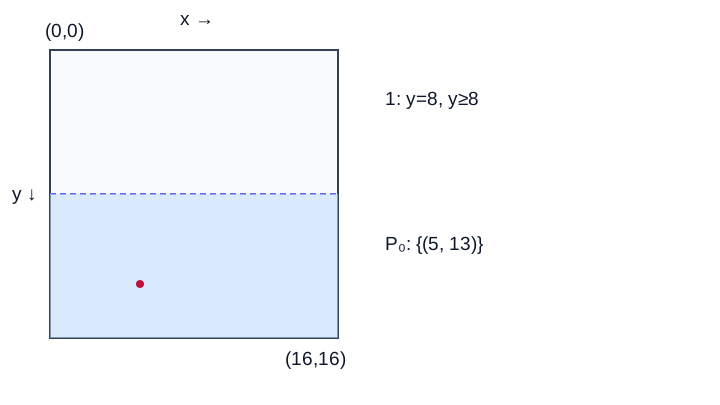
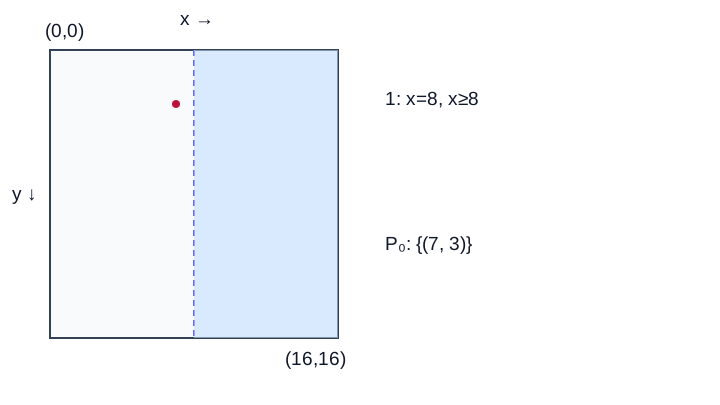
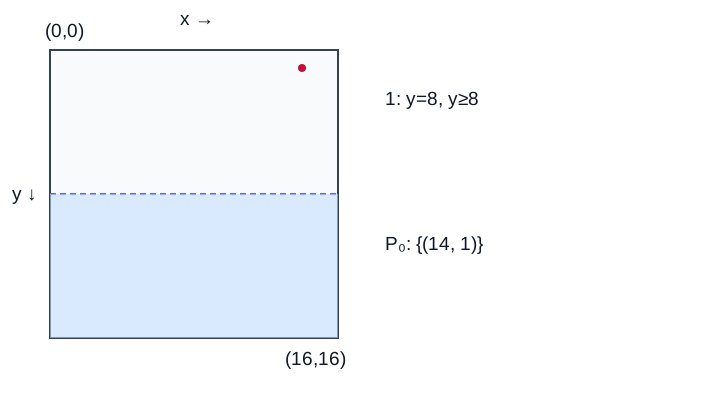
Question diagrams show the original boundary, numbered creases and the final retained region in blue. A red point is the initial point in tracking questions, or the punch position in hole questions. A red triangle is the proposed cut. The written coordinates define the exact geometry; do not estimate an answer from the image size.
3. Vertical and horizontal reflection rules
| Crease | Image of (x,y) | What stays unchanged |
|---|---|---|
| Vertical x=c | (2c−x, y) | y coordinate |
| Horizontal y=c | (x, 2c−y) | x coordinate |
| Diagonal y=x | (y,x) | Distance to the diagonal |
| Diagonal x+y=16 | (16−y,16−x) | Distance to that diagonal |
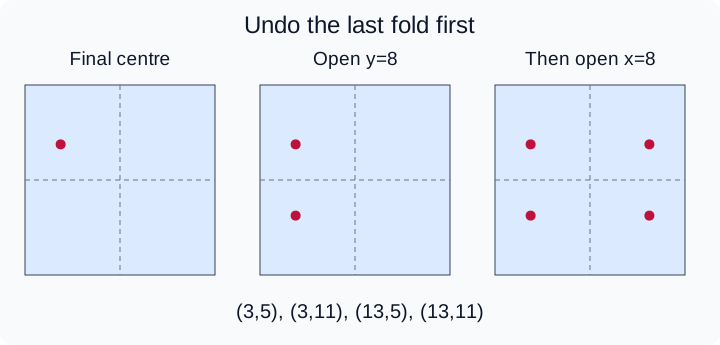
Example: across x=8, (3,5) becomes (13,5). Both points are 5 units from the crease. Across y=8, (3,5) becomes (3,11). Across y=x it becomes (5,3). These operations are reflections, not 90° rotations.
4. Tracking a point while folding
Apply folds in forward order and only reflect a point if it lies on the moving side. For a fold at x=8 retaining x≤8, an initial point (12,3) moves to (4,3). A point already at (4,3) stays there. A point at (8,3) remains on the crease.
If the next fold is y=8 retaining y≤8, (4,3) stays unchanged. But initial point (12,13) moves first to (4,13) and then to (4,3). Different original points can therefore overlap in the final stack.
Do not treat a fold as a translation by half the sheet width. The distance moved depends on the point’s distance from the crease: x=12 moves to 4, while x=9 moves to 7.
5. Unfolding a punched hole step by step
Start with a square from 0 to 16. Fold right onto left at x=8, then bottom onto top at y=8. Punch a small hole at (3,5) through all four layers, away from edges and creases.
- Undo the last fold, y=8: add (3,11).
- Undo x=8: reflect both existing points, adding (13,5) and (13,11).
- The four centres are (3,5), (3,11), (13,5), (13,11).
The hole’s distance from each relevant crease is preserved. After each unfolding, the pattern must be symmetric about the crease just opened. Do not reflect only the original hole at every stage; reflect the entire current set.
6. Reverse order matters
Successive folds may be on different parts of a progressively smaller stack. Suppose the first fold is x=8, retaining x≤8, and the next is x=4, retaining x≤4. A final punch at x=1 unfolds across x=4 to x=7, then across x=8 to x=15 and x=9. The original-sheet x coordinates are 1,7,9,15.
Opening x=8 first would place a copy outside the domain relevant to the still-folded stack. This is why the last crease is opened first. Perpendicular midline reflections can commute in some simple examples; do not turn that special case into a general rule.
7. Counting holes: when doubling works
If each fold exactly doubles a fully overlapping stack, a punch passes through all layers, the punch is away from every relevant crease/edge, and the unfolded copies do not overlap, then f folds give 2^f distinct holes per punch. Two independent punches give twice that number only if their unfolded copies remain distinct.
One such fold gives 2, two give 4 and three give 8. The number of folds alone is not enough when the paper is partially overlapped or the punch misses some layers. Read “through all layers” rather than assuming it.
For physical holes, finite radius and merging matter. For the ideal point-centre questions in this bank, count unique coordinates. This mathematical convention is stated explicitly so a centre exactly on a crease is not confused with two separate physical holes.
8. Punches on a fold line and at fold intersections
A point on its reflection line maps to itself. With one fold x=8, an ideal puncture centre (8,5) remains one distinct centre after opening. With folds x=8 and y=8, a centre (8,3) gives (8,3) and (8,13): two distinct centres, not four. At (8,8), both reflections leave it fixed.
This is a centre-count rule. A real circular punch centred on a folded edge removes only the part of the circle lying in the folded stack; unfolding may produce a full circle. Counting component holes requires considering their shapes and whether their boundaries join, not just multiplying by layers.
A puncture on the original outer boundary is an edge notch rather than an interior hole. The centre-count questions ask only about distinct marked centres and do not claim that each boundary point is an interior circular hole.
9. Multiple holes and duplicate positions
Keep a set of positions. Reflect every position at each reverse step, then remove duplicates. Example: after one fold at x=8, two punctures at (2,3) and (5,3) produce x coordinates 2,14 and 5,11: four distinct centres on y=3.
If a supplied pattern already contains a point and its mirror at the current unfolding stage, reflecting them again does not create additional distinct positions. In ordinary one-sided folded paper, two different interior points of the final stack usually have disjoint reflection sets; boundary/crease cases still need checking.
“Exactly how many centres?” and “which pattern?” require different checks. A wrong option can contain the right number of holes but the wrong distances or symmetry.
10. Cuts reflect in orientation as well as position
Reflect each vertex of a polygon and join the corresponding vertices. A triangle with vertices (2,3), (4,3), (3,5), reflected across x=8, has vertices (14,3), (12,3), (13,5). It is a mirror copy, not an unchanged triangle slid sideways.
An interior triangular cut through two fully overlapping layers produces two separate triangular openings when neither touches the crease. A cut touching the crease can join its mirror into one opening. Keep “number of copies” separate from “number of connected openings”.
For an arrow, asymmetric letter or irregular notch, a single reflection reverses handedness. Two reflections may restore orientation or produce a rotation/translation depending on the crease lines; the location still needs calculation.
11. V-shaped notches on the crease
Fold at x=8 and retain the left half. Cut the triangle with vertices (8,6), (8,10), (6,8). Its two crease vertices remain fixed; the off-crease apex reflects to (10,8). The opened boundary has four vertices: (8,6), (6,8), (8,10), (10,8). The two triangular removals join into one diamond-shaped opening.
Do not count the common crease segment as an interior boundary after opening. It lies inside the combined opening. For a symmetric V with unequal horizontal and vertical diagonals, the opening is a rhombus; when those diagonals are equal it is a square rotated relative to the page.
A rectangular notch meeting a fold can become a larger rectangle. A semicircular notch with its diameter on the fold can become a circle. These results depend on exact geometry; not every vaguely triangular cut creates the same final shape.
12. Diagonal folds
For the square in this chapter, reflection across y=x exchanges coordinates. A point (10,3) maps to (3,10). Reflection across the other diagonal x+y=16 maps it to (13,6). Do not use the x=8 rule for a diagonal crease.
Draw the diagonal and verify that each point and its image lie on opposite sides at equal perpendicular distances. Points on the diagonal remain fixed. In a triangle-cut problem, apply the rule to all three vertices; reflecting only the centroid loses orientation information.
A fold must move the cut’s actual layer region onto the retained region. The single-fold diagonal questions place the complete triangle inside the retained part so that its reflected copy is unambiguous.
13. Common traps
- Opening the first fold first instead of the last fold first.
- Reflecting only the original point instead of the current whole pattern.
- Moving a point already on the retained side during forward folding.
- Treating reflection as translation or rotation.
- Assuming every punch has 2^f distinct centres without checking creases.
- Counting joined cut regions as separate holes.
- Using a diagram’s pixel size instead of the stated coordinates.
- Adding missing layers or a fold that the question never specified.
For each step, write the crease, retained side and current pattern. A rough paper sketch is often faster and safer than keeping several folds only in memory.
14. Exam practice method
Begin with one vertical or horizontal fold. Move to two perpendicular folds, then repeated folds on the same axis, fold-line centres, multiple punches and diagonal shape reflections. Check symmetry and distances before comparing options.
The 80 questions include point tracking, full hole patterns, distinct-centre counting, reflected triangular cuts and joined V-notches. Every question has a diagram. The numerical coordinate model uses exact halves and quarters; the hole-count questions explicitly separate ideal centres from finite physical cut areas.
Practice set: 30 questions
Practice 01
The paper is the square 0≤x≤16, 0≤y≤16. The origin is at top-left; x increases rightward and y downward. 1. Fold at y=8, moving the side with smaller y over and retaining y≥8. A point initially at (5, 13) is carried with the paper. Where does it finish after these folds?
- A. (5, 13)
- B. (10, 11)
- C. (5, 11)
- D. (8, 8)
Practice 02
The paper is the square 0≤x≤16, 0≤y≤16. The origin is at top-left; x increases rightward and y downward. 1. Fold at x=8, moving the side with smaller x over and retaining x≥8. A point initially at (7, 3) is carried with the paper. Where does it finish after these folds?
- A. (8, 1)
- B. (9, 16)
- C. (9, 13)
- D. (9, 3)
Practice 03
The paper is the square 0≤x≤16, 0≤y≤16. The origin is at top-left; x increases rightward and y downward. 1. Fold at y=8, moving the side with smaller y over and retaining y≥8. A point initially at (14, 1) is carried with the paper. Where does it finish after these folds?
- A. (6, 16)
- B. (7, 12)
- C. (14, 15)
- D. (5, 13)
Practice 04
The paper is the square 0≤x≤16, 0≤y≤16. The origin is at top-left; x increases rightward and y downward. 1. Fold at x=8, moving the side with larger x over and retaining x≤8. A point initially at (8, 8) is carried with the paper. Where does it finish after these folds?
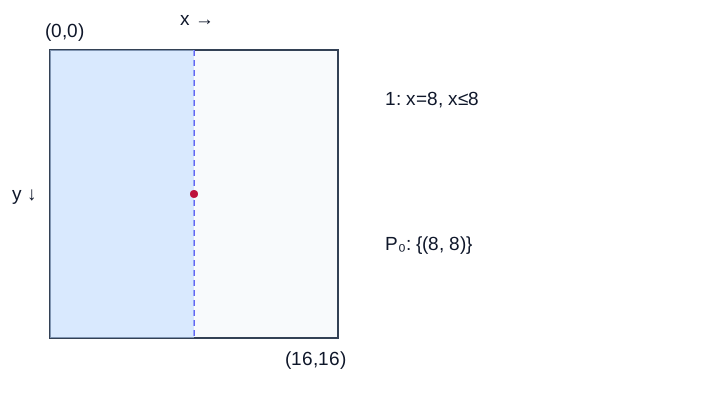
- A. (3, 13)
- B. (8, 8)
- C. (4, 8)
- D. (5, 9)
Practice 05
The paper is the square 0≤x≤16, 0≤y≤16. The origin is at top-left; x increases rightward and y downward. 1. Fold at y=8, moving the side with larger y over and retaining y≤8. A point initially at (6, 13) is carried with the paper. Where does it finish after these folds?
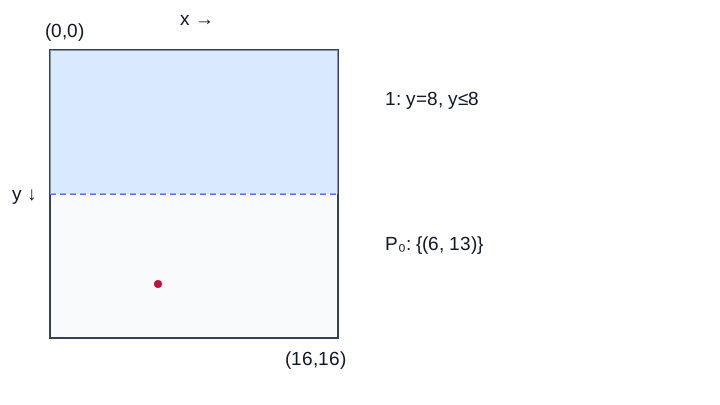
- A. (6, 3)
- B. (11, 0)
- C. (4, 3)
- D. (7, 7)
Practice 06
The paper is the square 0≤x≤16, 0≤y≤16. The origin is at top-left; x increases rightward and y downward. 1. Fold at x=8, moving the side with larger x over and retaining x≤8. A point initially at (15, 5) is carried with the paper. Where does it finish after these folds?
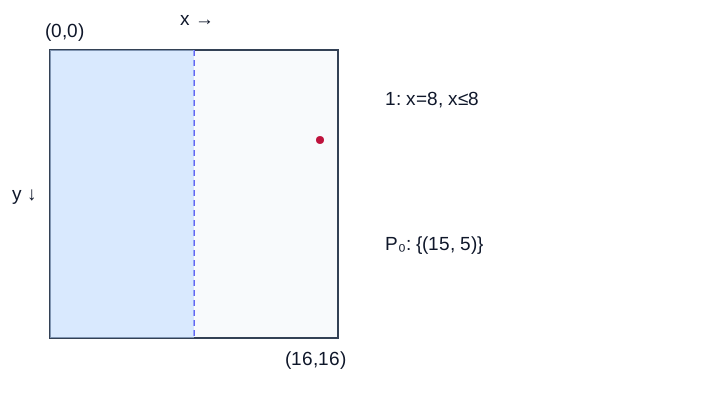
- A. (8, 4)
- B. (4, 2)
- C. (1, 10)
- D. (1, 5)
Practice 07
The paper is the square 0≤x≤16, 0≤y≤16. The origin is at top-left; x increases rightward and y downward. 1. Fold at x=8, moving the side with larger x over and retaining x≤8. A point initially at (13, 10) is carried with the paper. Where does it finish after these folds?
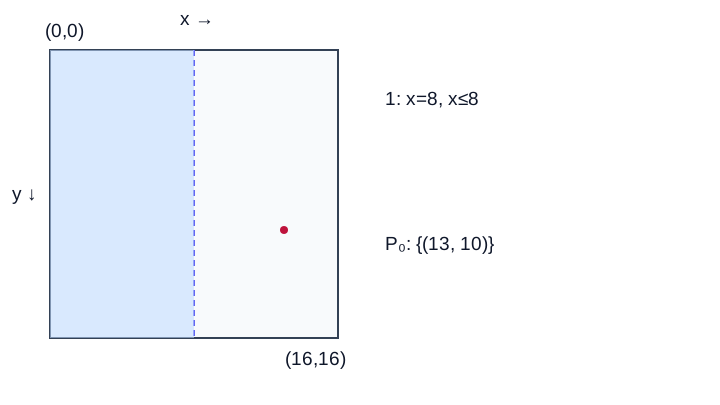
- A. (4, 10)
- B. (0, 4)
- C. (3, 10)
- D. (6, 12)
Practice 08
The paper is the square 0≤x≤16, 0≤y≤16. The origin is at top-left; x increases rightward and y downward. 1. Fold at x=8, moving the side with larger x over and retaining x≤8. 2. Fold at x=4, moving the side with larger x over and retaining x≤4. A point initially at (11, 6) is carried with the paper. Where does it finish after these folds?
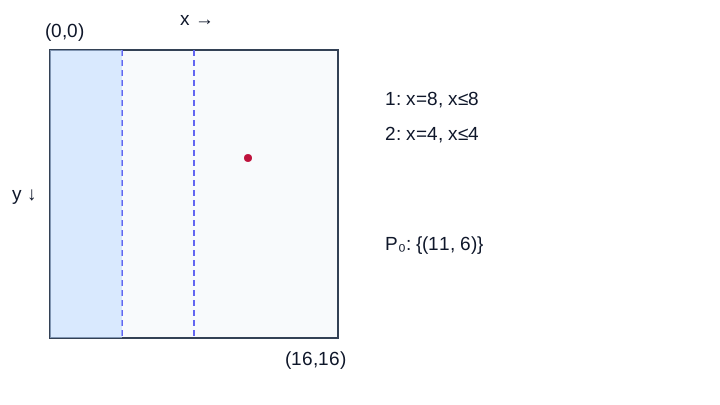
- A. (3, 2)
- B. (1, 0)
- C. (4, 15)
- D. (3, 6)
Practice 09
The paper is the square 0≤x≤16, 0≤y≤16. The origin is at top-left; x increases rightward and y downward. 1. Fold at y=8, moving the side with smaller y over and retaining y≥8. A tiny circular hole centred at (31/2, 19/2) is punched through ALL layers of the final stack, away from folds and edges. Which set gives all centres after full unfolding?
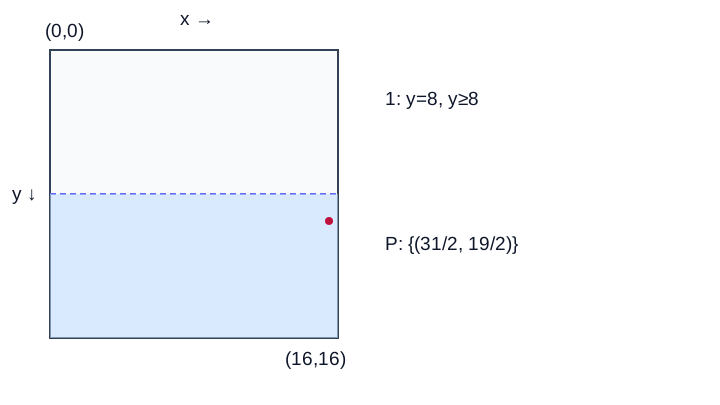
- A. {(31/2, 13/2), (31/2, 19/2)}
- B. {(5/2, 5), (5/2, 11)}
- C. {(3/2, 15/2), (3/2, 17/2)}
- D. {(17/2, 7), (17/2, 9)}
Practice 10
The paper is the square 0≤x≤16, 0≤y≤16. The origin is at top-left; x increases rightward and y downward. 1. Fold at y=8, moving the side with larger y over and retaining y≤8. A tiny circular hole centred at (1/2, 6) is punched through ALL layers of the final stack, away from folds and edges. Which set gives all centres after full unfolding?
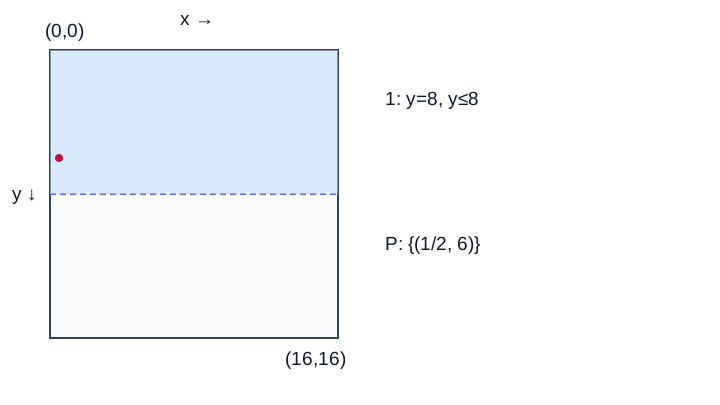
- A. {(27/2, 1/2), (27/2, 31/2)}
- B. {(19/2, 5), (19/2, 11)}
- C. {(5, 11/2), (5, 21/2)}
- D. {(1/2, 6), (1/2, 10)}
Practice 11
The paper is the square 0≤x≤16, 0≤y≤16. The origin is at top-left; x increases rightward and y downward. 1. Fold at x=8, moving the side with larger x over and retaining x≤8. A tiny circular hole centred at (5, 10) is punched through ALL layers of the final stack, away from folds and edges. Which set gives all centres after full unfolding?
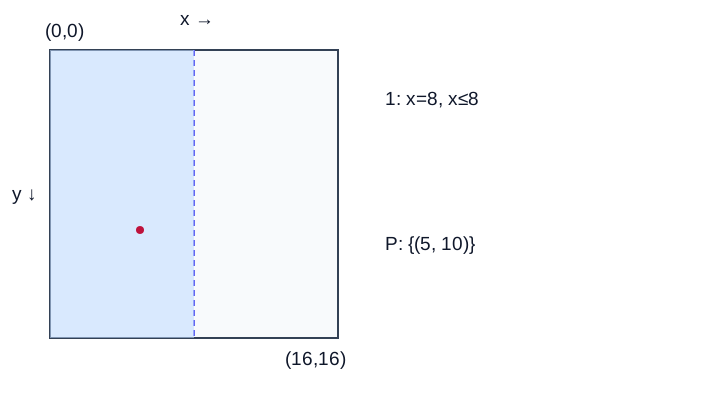
- A. {(2, 5/2), (14, 5/2)}
- B. {(1, 7/2), (15, 7/2)}
- C. {(5, 10), (11, 10)}
- D. {(6, 19/2), (10, 19/2)}
Practice 12
The paper is the square 0≤x≤16, 0≤y≤16. The origin is at top-left; x increases rightward and y downward. 1. Fold at x=8, moving the side with smaller x over and retaining x≥8. A tiny circular hole centred at (27/2, 15) is punched through ALL layers of the final stack, away from folds and edges. Which set gives all centres after full unfolding?
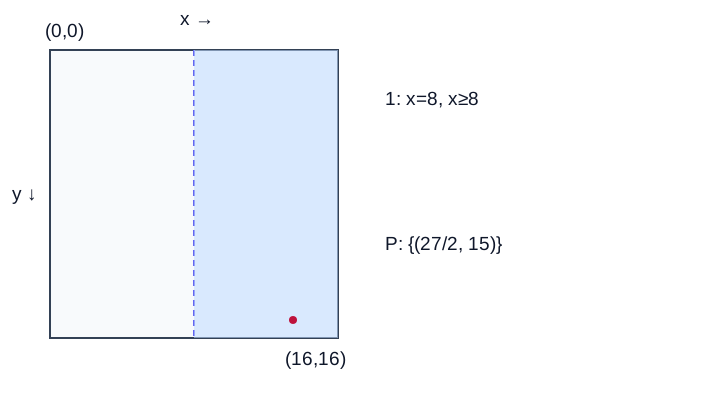
- A. {(9/2, 1), (23/2, 1)}
- B. {(5/2, 15), (27/2, 15)}
- C. {(7, 15/2), (9, 15/2)}
- D. {(11/2, 31/2), (21/2, 31/2)}
Practice 13
The paper is the square 0≤x≤16, 0≤y≤16. The origin is at top-left; x increases rightward and y downward. 1. Fold at y=8, moving the side with smaller y over and retaining y≥8. A tiny circular hole centred at (19/2, 15) is punched through ALL layers of the final stack, away from folds and edges. Which set gives all centres after full unfolding?
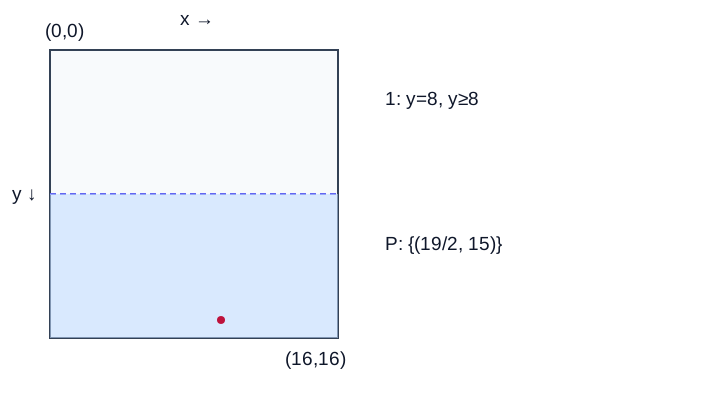
- A. {(19/2, 1), (19/2, 15)}
- B. {(19/2, 3/2), (19/2, 29/2)}
- C. {(12, 1/2), (12, 31/2)}
- D. {(7/2, 2), (7/2, 14)}
Practice 14
The paper is the square 0≤x≤16, 0≤y≤16. The origin is at top-left; x increases rightward and y downward. 1. Fold at y=8, moving the side with larger y over and retaining y≤8. A tiny circular hole centred at (8, 1) is punched through ALL layers of the final stack, away from folds and edges. Which set gives all centres after full unfolding?
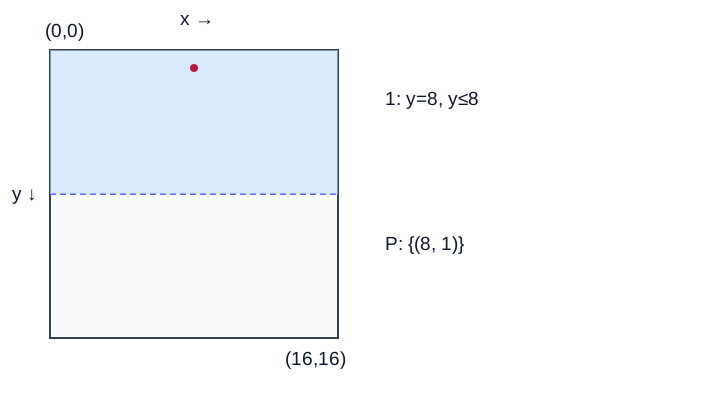
- A. {(7/2, 3/2), (7/2, 29/2)}
- B. {(11, 7/2), (11, 25/2)}
- C. {(2, 9/2), (2, 23/2)}
- D. {(8, 1), (8, 15)}
Practice 15
The paper is the square 0≤x≤16, 0≤y≤16. The origin is at top-left; x increases rightward and y downward. 1. Fold at y=8, moving the side with larger y over and retaining y≤8. A tiny circular hole centred at (1/2, 1) is punched through ALL layers of the final stack, away from folds and edges. Which set gives all centres after full unfolding?
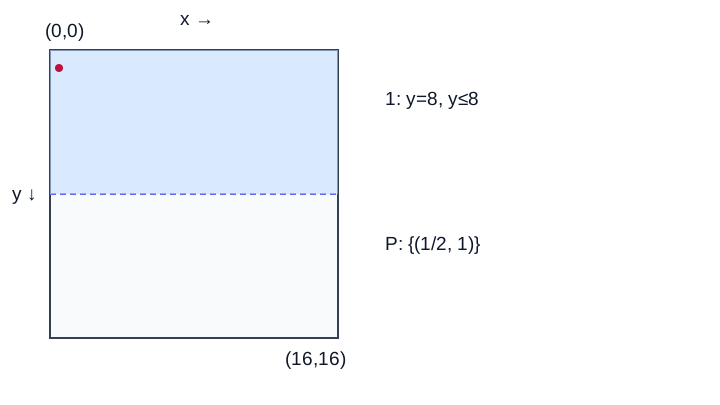
- A. {(17/2, 2), (17/2, 14)}
- B. {(3/2, 1/2), (3/2, 31/2)}
- C. {(1/2, 1), (1/2, 15)}
- D. {(4, 3), (4, 13)}
Practice 16
The paper is the square 0≤x≤16, 0≤y≤16. The origin is at top-left; x increases rightward and y downward. 1. Fold at x=8, moving the side with larger x over and retaining x≤8. 2. Fold at x=4, moving the side with smaller x over and retaining x≥4. A tiny circular hole centred at (6, 8) is punched through ALL layers of the final stack, away from folds and edges. Which set gives all centres after full unfolding?
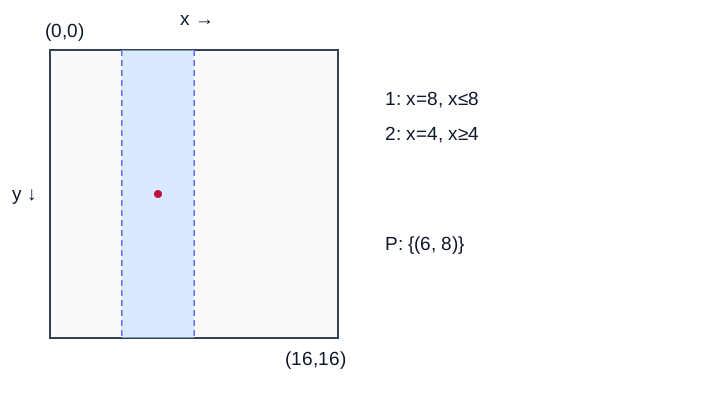
- A. {(5/2, 4), (11/2, 4), (21/2, 4), (27/2, 4)}
- B. {(2, 7/2), (6, 7/2), (10, 7/2), (14, 7/2)}
- C. {(1, 10), (7, 10), (9, 10), (15, 10)}
- D. {(2, 8), (6, 8), (10, 8), (14, 8)}
Practice 17
The paper is the square 0≤x≤16, 0≤y≤16. The origin is at top-left; x increases rightward and y downward. 1. Fold at y=8, moving the side with smaller y over and retaining y≥8. Ideal point punctures are made through all layers at {(8, 12)}. Count DISTINCT puncture centres after full unfolding. Coincident centres on a crease count once; do not count finite hole areas or merged shapes.
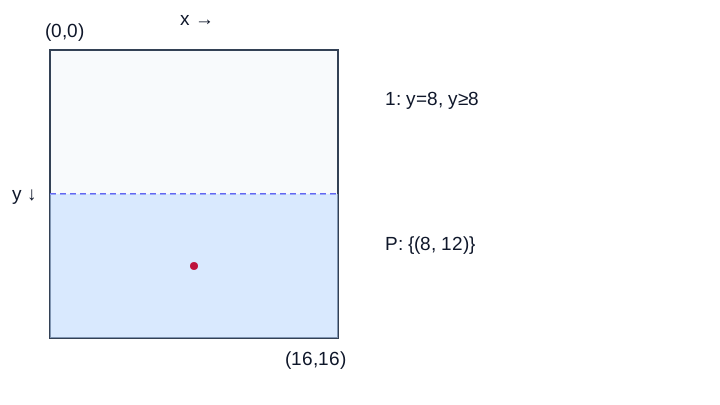
- A. 2
- B. 3
- C. 4
- D. 6
Practice 18
The paper is the square 0≤x≤16, 0≤y≤16. The origin is at top-left; x increases rightward and y downward. 1. Fold at x=8, moving the side with smaller x over and retaining x≥8. Ideal point punctures are made through all layers at {(8, 8)}. Count DISTINCT puncture centres after full unfolding. Coincident centres on a crease count once; do not count finite hole areas or merged shapes.
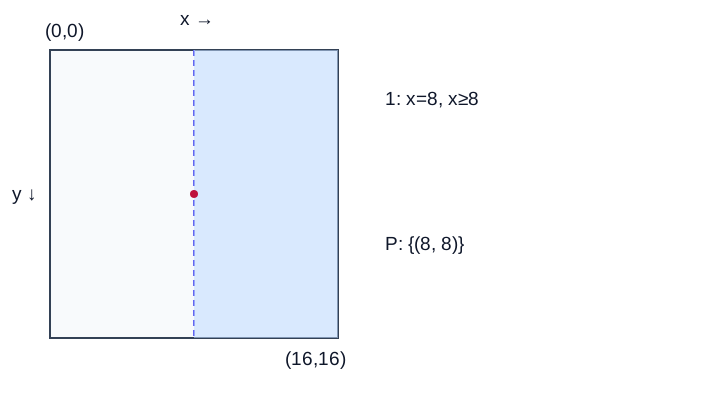
- A. 2
- B. 3
- C. 5
- D. 1
Practice 19
The paper is the square 0≤x≤16, 0≤y≤16. The origin is at top-left; x increases rightward and y downward. 1. Fold at y=8, moving the side with larger y over and retaining y≤8. Ideal point punctures are made through all layers at {(4, 2), (8, 4)}. Count DISTINCT puncture centres after full unfolding. Coincident centres on a crease count once; do not count finite hole areas or merged shapes.
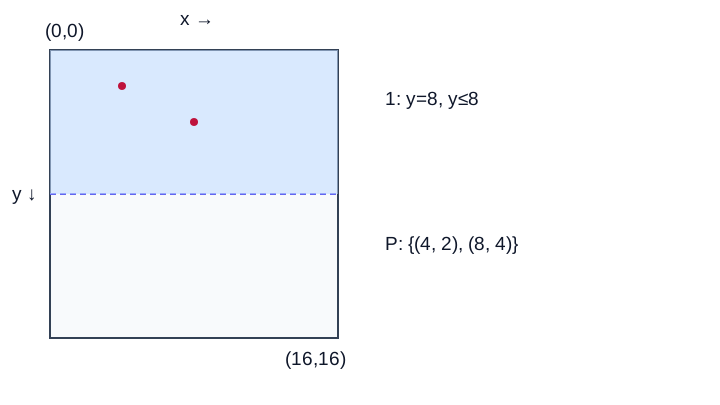
- A. 5
- B. 6
- C. 4
- D. 8
Practice 20
The paper is the square 0≤x≤16, 0≤y≤16. The origin is at top-left; x increases rightward and y downward. 1. Fold at x=8, moving the side with larger x over and retaining x≤8. Ideal point punctures are made through all layers at {(8, 8)}. Count DISTINCT puncture centres after full unfolding. Coincident centres on a crease count once; do not count finite hole areas or merged shapes.
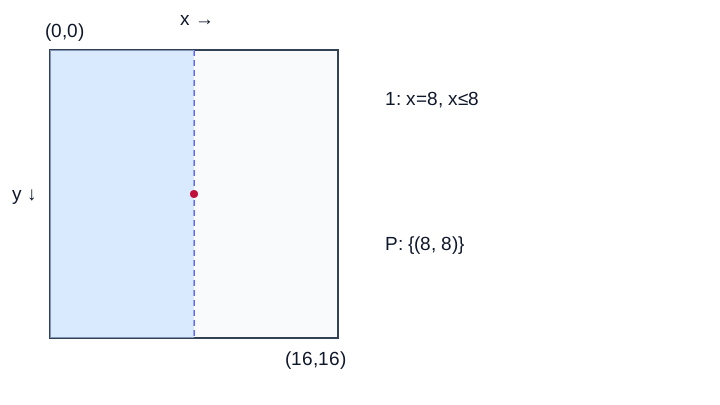
- A. 2
- B. 1
- C. 3
- D. 5
Practice 21
The paper is the square 0≤x≤16, 0≤y≤16. The origin is at top-left; x increases rightward and y downward. 1. Fold at x=8, moving the side with larger x over and retaining x≤8. Ideal point punctures are made through all layers at {(4, 8)}. Count DISTINCT puncture centres after full unfolding. Coincident centres on a crease count once; do not count finite hole areas or merged shapes.
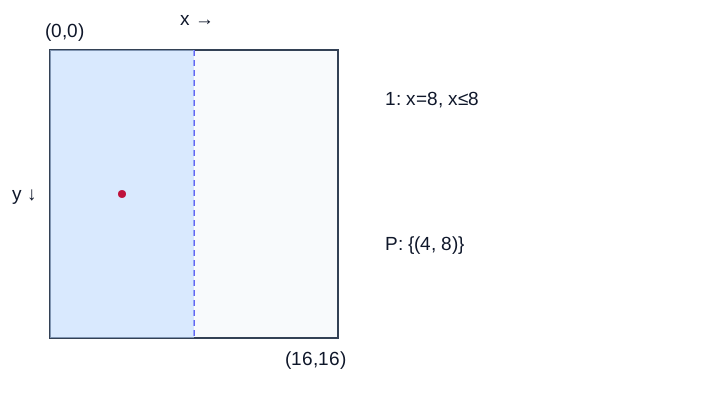
- A. 2
- B. 3
- C. 4
- D. 6
Practice 22
The paper is the square 0≤x≤16, 0≤y≤16. The origin is at top-left; x increases rightward and y downward. 1. Fold at y=8, moving the side with larger y over and retaining y≤8. Ideal point punctures are made through all layers at {(8, 8)}. Count DISTINCT puncture centres after full unfolding. Coincident centres on a crease count once; do not count finite hole areas or merged shapes.
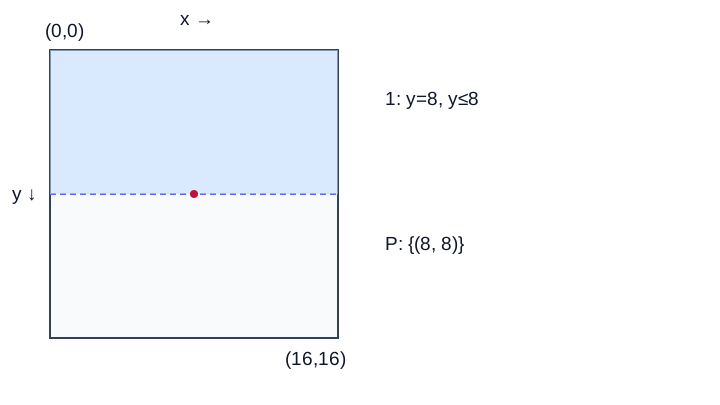
- A. 2
- B. 3
- C. 5
- D. 1
Practice 23
The paper is the square 0≤x≤16, 0≤y≤16. The origin is at top-left; x increases rightward and y downward. 1. Fold at x=8, moving the side with smaller x over and retaining x≥8. Ideal point punctures are made through all layers at {(10, 4), (12, 8)}. Count DISTINCT puncture centres after full unfolding. Coincident centres on a crease count once; do not count finite hole areas or merged shapes.
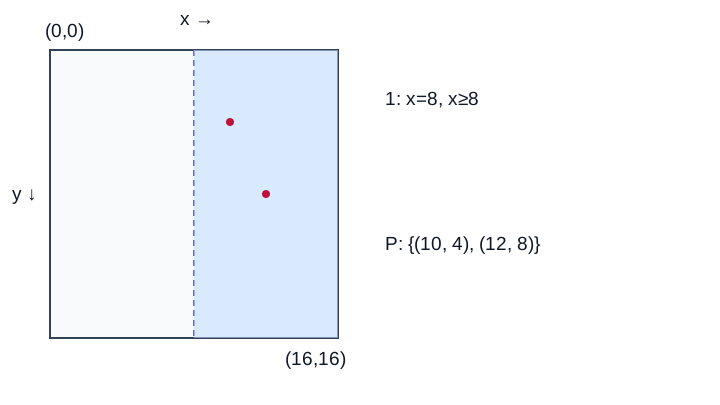
- A. 5
- B. 6
- C. 4
- D. 8
Practice 24
The paper is the square 0≤x≤16, 0≤y≤16. The origin is at top-left; x increases rightward and y downward. 1. Fold at y=8, moving the side with larger y over and retaining y≤8. 2. Fold at y=4, moving the side with larger y over and retaining y≤4. Ideal point punctures are made through all layers at {(8, 4)}. Count DISTINCT puncture centres after full unfolding. Coincident centres on a crease count once; do not count finite hole areas or merged shapes.
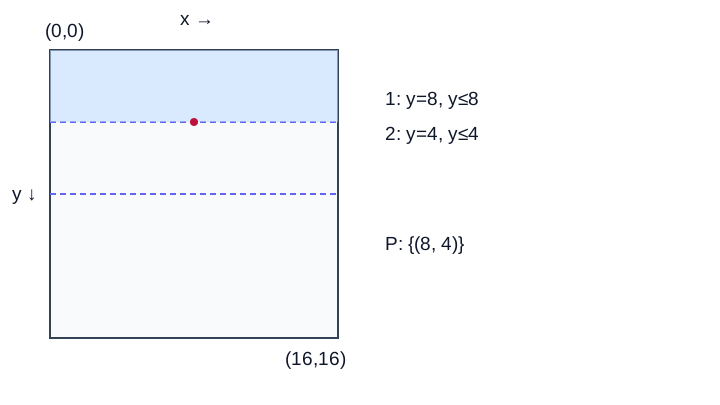
- A. 3
- B. 4
- C. 6
- D. 2
Practice 25
Use the square 0≤x,y≤16, with origin at top-left. Make ONE fold along x=8, folding right onto left. Cut a small triangle completely inside the folded stack, with vertices {(2, 3), (3, 5), (4, 3)}. What are the vertices of its REFLECTED COPY when opened? Give a set, not a clockwise ordering.
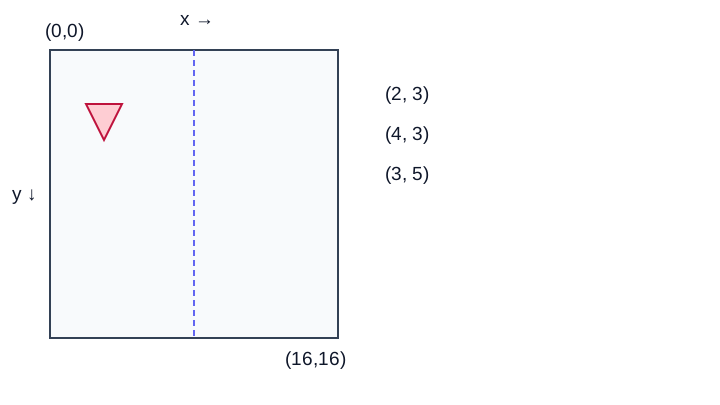
- A. {(12, 3), (13, 5), (14, 3)}
- B. {(13, 3), (14, 5), (15, 3)}
- C. {(12, 4), (13, 6), (14, 4)}
- D. {(11, 3), (12, 5), (13, 3)}
Practice 26
Use the square 0≤x,y≤16, with origin at top-left. Make ONE fold along x+y=16, retaining x+y≤16. Cut a small triangle completely inside the folded stack, with vertices {(2, 3), (3, 5), (4, 3)}. What are the vertices of its REFLECTED COPY when opened? Give a set, not a clockwise ordering.
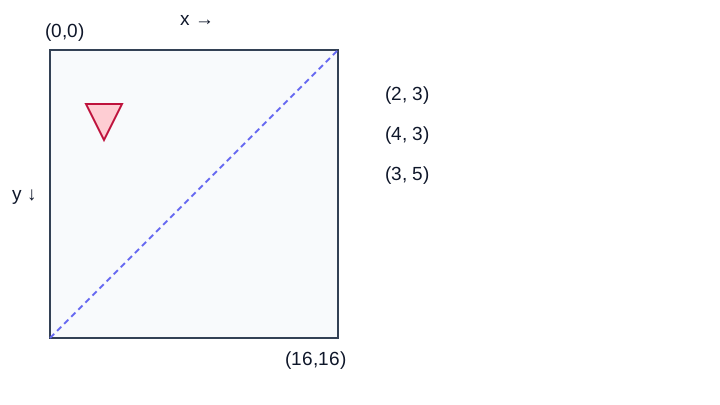
- A. {(12, 13), (14, 12), (14, 14)}
- B. {(11, 14), (13, 13), (13, 15)}
- C. {(10, 13), (12, 12), (12, 14)}
- D. {(11, 13), (13, 12), (13, 14)}
Practice 27
Use the square 0≤x,y≤16, with origin at top-left. Make ONE fold along y=x, retaining y≤x. Cut a small triangle completely inside the folded stack, with vertices {(9, 2), (11, 4), (12, 2)}. What are the vertices of its REFLECTED COPY when opened? Give a set, not a clockwise ordering.
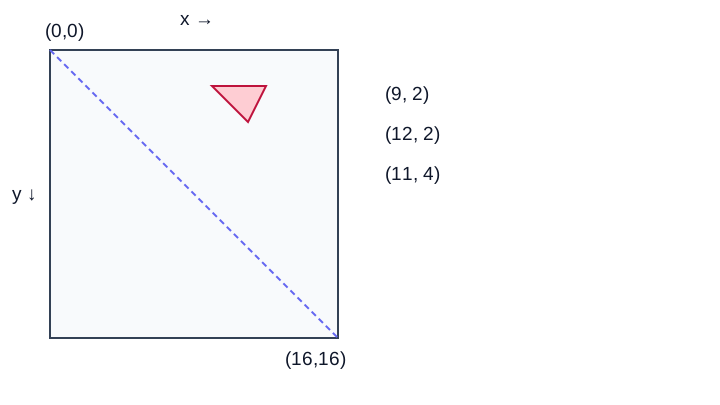
- A. {(3, 9), (3, 12), (5, 11)}
- B. {(2, 10), (2, 13), (4, 12)}
- C. {(2, 9), (2, 12), (4, 11)}
- D. {(1, 9), (1, 12), (3, 11)}
Practice 28
Use the square 0≤x,y≤16, with origin at top-left. Make ONE fold along y=8, folding bottom onto top. Cut a small triangle completely inside the folded stack, with vertices {(5, 2), (5, 4), (7, 2)}. What are the vertices of its REFLECTED COPY when opened? Give a set, not a clockwise ordering.
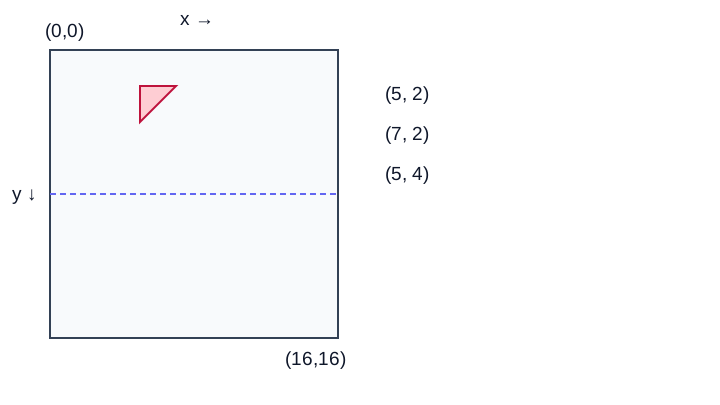
- A. {(6, 12), (6, 14), (8, 14)}
- B. {(5, 12), (5, 14), (7, 14)}
- C. {(5, 13), (5, 15), (7, 15)}
- D. {(4, 12), (4, 14), (6, 14)}
Practice 29
Use the square 0≤x,y≤16 with origin at top-left. Fold once along x=8, right onto left. Remove the triangular notch with vertices {(5, 5), (8, 4), (8, 6)}. Two vertices lie on the crease, and the notch is cut through both layers. After unfolding, what is the set of boundary vertices of the SINGLE resulting opening?
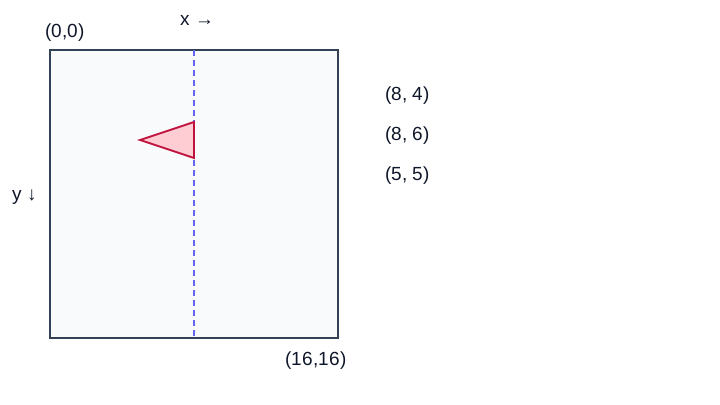
- A. {(5, 5), (8, 4), (8, 6), (11, 5)}
- B. {(6, 5), (9, 4), (9, 6), (12, 5)}
- C. {(5, 6), (8, 5), (8, 7), (11, 6)}
- D. {(4, 5), (7, 4), (7, 6), (10, 5)}
Practice 30
Use the square 0≤x,y≤16 with origin at top-left. Fold once along y=8, bottom onto top. Remove the triangular notch with vertices {(6, 8), (7, 7), (8, 8)}. Two vertices lie on the crease, and the notch is cut through both layers. After unfolding, what is the set of boundary vertices of the SINGLE resulting opening?
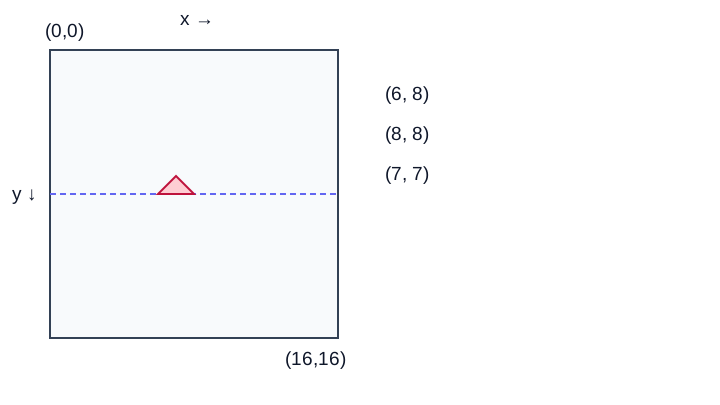
- A. {(7, 8), (8, 7), (8, 9), (9, 8)}
- B. {(6, 9), (7, 8), (7, 10), (8, 9)}
- C. {(5, 8), (6, 7), (6, 9), (7, 8)}
- D. {(6, 8), (7, 7), (7, 9), (8, 8)}
Answers and explanations
Answer 01
A. (5, 13)
Apply folds in the stated forward order. Reflect a point only when it is on the moving side. Final position: (5, 13).
Answer 02
D. (9, 3)
Apply folds in the stated forward order. Reflect a point only when it is on the moving side. Final position: (9, 3).
Answer 03
C. (14, 15)
Apply folds in the stated forward order. Reflect a point only when it is on the moving side. Final position: (14, 15).
Answer 04
B. (8, 8)
Apply folds in the stated forward order. Reflect a point only when it is on the moving side. Final position: (8, 8).
Answer 05
A. (6, 3)
Apply folds in the stated forward order. Reflect a point only when it is on the moving side. Final position: (6, 3).
Answer 06
D. (1, 5)
Apply folds in the stated forward order. Reflect a point only when it is on the moving side. Final position: (1, 5).
Answer 07
C. (3, 10)
Apply folds in the stated forward order. Reflect a point only when it is on the moving side. Final position: (3, 10).
Answer 08
D. (3, 6)
Apply folds in the stated forward order. Reflect a point only when it is on the moving side. Final position: (3, 6).
Answer 09
A. {(31/2, 13/2), (31/2, 19/2)}
Undo the LAST fold first. Reflect the current centre set across each fold line in reverse order. The final set is {(31/2, 13/2), (31/2, 19/2)}.
Answer 10
D. {(1/2, 6), (1/2, 10)}
Undo the LAST fold first. Reflect the current centre set across each fold line in reverse order. The final set is {(1/2, 6), (1/2, 10)}.
Answer 11
C. {(5, 10), (11, 10)}
Undo the LAST fold first. Reflect the current centre set across each fold line in reverse order. The final set is {(5, 10), (11, 10)}.
Answer 12
B. {(5/2, 15), (27/2, 15)}
Undo the LAST fold first. Reflect the current centre set across each fold line in reverse order. The final set is {(5/2, 15), (27/2, 15)}.
Answer 13
A. {(19/2, 1), (19/2, 15)}
Undo the LAST fold first. Reflect the current centre set across each fold line in reverse order. The final set is {(19/2, 1), (19/2, 15)}.
Answer 14
D. {(8, 1), (8, 15)}
Undo the LAST fold first. Reflect the current centre set across each fold line in reverse order. The final set is {(8, 1), (8, 15)}.
Answer 15
C. {(1/2, 1), (1/2, 15)}
Undo the LAST fold first. Reflect the current centre set across each fold line in reverse order. The final set is {(1/2, 1), (1/2, 15)}.
Answer 16
D. {(2, 8), (6, 8), (10, 8), (14, 8)}
Undo the LAST fold first. Reflect the current centre set across each fold line in reverse order. The final set is {(2, 8), (6, 8), (10, 8), (14, 8)}.
Answer 17
A. 2
Reverse all folds and remove duplicate coordinates. Centres: {(8, 4), (8, 12)}. There are 2 distinct centres. A centre on a reflection line does not produce a second distinct point in that step.
Answer 18
D. 1
Reverse all folds and remove duplicate coordinates. Centres: {(8, 8)}. There are 1 distinct centres. A centre on a reflection line does not produce a second distinct point in that step.
Answer 19
C. 4
Reverse all folds and remove duplicate coordinates. Centres: {(4, 2), (4, 14), (8, 4), (8, 12)}. There are 4 distinct centres. A centre on a reflection line does not produce a second distinct point in that step.
Answer 20
B. 1
Reverse all folds and remove duplicate coordinates. Centres: {(8, 8)}. There are 1 distinct centres. A centre on a reflection line does not produce a second distinct point in that step.
Answer 21
A. 2
Reverse all folds and remove duplicate coordinates. Centres: {(4, 8), (12, 8)}. There are 2 distinct centres. A centre on a reflection line does not produce a second distinct point in that step.
Answer 22
D. 1
Reverse all folds and remove duplicate coordinates. Centres: {(8, 8)}. There are 1 distinct centres. A centre on a reflection line does not produce a second distinct point in that step.
Answer 23
C. 4
Reverse all folds and remove duplicate coordinates. Centres: {(4, 8), (6, 4), (10, 4), (12, 8)}. There are 4 distinct centres. A centre on a reflection line does not produce a second distinct point in that step.
Answer 24
D. 2
Reverse all folds and remove duplicate coordinates. Centres: {(8, 4), (8, 12)}. There are 2 distinct centres. A centre on a reflection line does not produce a second distinct point in that step.
Answer 25
A. {(12, 3), (13, 5), (14, 3)}
Reflect every vertex across the stated line, without changing lengths. Reflected vertices: {(12, 3), (13, 5), (14, 3)}. The original cut and its reflected copy are separate here.
Answer 26
D. {(11, 13), (13, 12), (13, 14)}
Reflect every vertex across the stated line, without changing lengths. Reflected vertices: {(11, 13), (13, 12), (13, 14)}. The original cut and its reflected copy are separate here.
Answer 27
C. {(2, 9), (2, 12), (4, 11)}
Reflect every vertex across the stated line, without changing lengths. Reflected vertices: {(2, 9), (2, 12), (4, 11)}. The original cut and its reflected copy are separate here.
Answer 28
B. {(5, 12), (5, 14), (7, 14)}
Reflect every vertex across the stated line, without changing lengths. Reflected vertices: {(5, 12), (5, 14), (7, 14)}. The original cut and its reflected copy are separate here.
Answer 29
A. {(5, 5), (8, 4), (8, 6), (11, 5)}
Reflect the off-crease apex; the two crease vertices stay fixed. The two triangular pieces join along the crease, producing one four-vertex opening: {(5, 5), (8, 4), (8, 6), (11, 5)}.
Answer 30
D. {(6, 8), (7, 7), (7, 9), (8, 8)}
Reflect the off-crease apex; the two crease vertices stay fixed. The two triangular pieces join along the crease, producing one four-vertex opening: {(6, 8), (7, 7), (7, 9), (8, 8)}.
Online exams
Four tests contain 20 questions each: point tracking, unfolding holes, centre counts and cut shapes. The complete test contains all 80 questions. Use the stated coordinates and instructions as the exact geometry.
This is AI-generated information.