Number, Ranking & Time Sequence Test
Learning goals
Understand the rules, draw a row or timeline, reproduce worked examples and attempt practice before checking answers. Identify the assumptions in every question first.
1. Scope and study plan
This combined preparation heading covers positions in a row, numerical order, relative ranks and event order. Chapter groupings vary by examination; these are teaching headings, not a claim that every examination uses one official title. Begin with a numbered row, then reverse ranks, compare two people, handle swaps and finally place events on a timeline. The separate Time Sequence Test and Clock chapters develop calendar and hand-motion questions in depth. Unless stated otherwise, all people occupy distinct positions and ranks have no ties.
2. One person counted from both ends
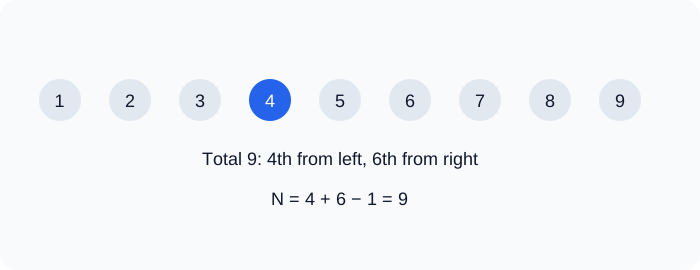
Let N be the total, L the rank from the left and R the rank from the right. N = L + R − 1; L = N − R + 1; R = N − L + 1. Subtract one because the same person is counted in both ranks. People before the person = L − 1; people after = R − 1. Example: 13th from the left and 18th from the right gives 13 + 18 − 1 = 30 people. A 35-person row with a student 12th from the left gives right rank 35 − 12 + 1 = 24. Front/back and top/bottom use the same rule when the order is unambiguous.
3. Two people and the gap
First convert both ranks to the same end. If positions are p and q, the number strictly between them is |p − q| − 1. Example: A is 8th from the left and B is 11th from the right in 30 people. B is 30 − 11 + 1 = 20th from the left; the gap is 20 − 8 − 1 = 11. Inclusive counting from A through B gives |p − q| + 1 instead. Adjacent people have zero people between them. A distance of five positions is a gap of four people, not five.
4. Unknown total: order must be known
A is Lth from the left, B is Rth from the right and k people are between them. If A is left of B, N = L + R + k. If B is left of A, N = L + R − k − 2, provided the resulting ranks are feasible. Example: L = 12, R = 10, k = 3 gives N = 25 or N = 17. In the second arrangement B is 8th from the left and A 12th. If the order is not given, do not choose one total without checking both. A candidate N must be at least each stated rank and positions must be distinct and positive.
5. Swapping places
When A and B exchange positions, A inherits B’s old position and B inherits A’s. Example: A is 9th from the left. After swapping, A becomes 16th from the left; B was originally 16th. Their original gap was 16 − 9 − 1 = 6. If A after the swap is also 12th from the right, N = 16 + 12 − 1 = 27. Do not add an old rank of A to an unrelated old rank of B as though they belonged to one person. Mark old and new positions separately.
6. Joining, leaving and moving
If x people ahead leave, a person’s front rank decreases by x. If y people join ahead, it increases by y. Changes behind do not change the front rank. Example: a person is 14th; four ahead leave and two ahead join, so the new rank is 14 − 4 + 2 = 12. If the initial total is 40, five people leave overall and three join overall, the new total is 38. Moving forward by five positions reduces a front rank by five; moving backward increases it. Check that the new rank stays between 1 and the new total.
7. Height, marks and partial order
Write taller-than or higher-than as > and translate each statement before combining it. A > B > C proves A > C. But A > B and A > C do not determine whether B > C or C > B. Example: P > Q > R and S > Q place both P and S above Q, but do not fix the tallest. For a shortest-first rank, reverse a tallest-first rank using N − r + 1 only when all heights differ. Do not infer gender, age or ability from a name.
8. Ties and number positions
Tied ranks need a stated convention. Competition ranking for scores 95, 90, 90, 80 is 1, 2, 2, 4; dense ranking is 1, 2, 2, 3. Ordinary reverse-rank formulas do not directly apply to these labels. In an increasing sequence a, a+d, …, the rth term is a+(r−1)d. Example: the 12th positive odd number is 1+11×2 = 23. Count integers from a through b inclusively as b−a+1. Count multiples of m in [a,b] as floor(b/m) − floor((a−1)/m). From 11 to 50, multiples of 4 number 12−2 = 10.
9. Order of events and information sufficiency
For chronology, replace greater-than by earlier-than and draw arrows. If A happens before B, and B before C, A precedes C. If A and C are both before B, their own order is unknown. “Immediately before” means consecutive positions; “before” need not. If four tasks satisfy A before B before C and D immediately after C, the unique order is A, B, C, D. If only A before B and C before D are known, multiple orders are possible. In data-sufficiency questions, test whether the answer is unique rather than whether one arrangement works.
10. Revision and exam approach
Underline the reference end, whether endpoints count, and whether ranks are distinct. Draw a small row; convert all ranks to one end; solve; substitute into the original statements. Use N=L+R−1 only for the same person. Distinguish people between from distance in positions. Check two possible orders when total size is unknown. For timed practice, complete the foundation set first, then the applied and mixed sets; use the complete test only after correcting your mistakes.
Practice set: 30 questions
Choose one correct option. Minutes written as fractions are exact rather than decimal approximations.
Practice 01
A student is 7th from the left and 15th from the right. How many students are in the row (no ties)?
- A. 21
- B. 22
- C. 20
- D. 23
Practice 02
A student is 10th from the left and 18th from the right. How many students are in the row (no ties)?
- A. 28
- B. 26
- C. 29
- D. 27
Practice 03
A student is 14th from the left and 22th from the right. How many students are in the row (no ties)?
- A. 36
- B. 34
- C. 37
- D. 35
Practice 04
In a row of 35, a person is 9th from the front. What is their rank from the back?
- A. 27
- B. 28
- C. 26
- D. 29
Practice 05
In a row of 38, a person is 12th from the front. What is their rank from the back?
- A. 28
- B. 26
- C. 29
- D. 27
Practice 06
In a row of 42, a person is 16th from the front. What is their rank from the back?
- A. 28
- B. 26
- C. 29
- D. 27
Practice 07
In 40 people, A is 6th from the left and B is 10th from the right. How many people are strictly between them?
- A. 24
- B. 25
- C. 23
- D. 26
Practice 08
In 43 people, A is 9th from the left and B is 10th from the right. How many people are strictly between them?
- A. 25
- B. 23
- C. 26
- D. 24
Practice 09
In 47 people, A is 13th from the left and B is 10th from the right. How many people are strictly between them?
- A. 25
- B. 23
- C. 26
- D. 24
Practice 10
A is 9th from the left, B is 11th from the right, and A is left of B with 3 people between. Find the total.
- A. 23
- B. 24
- C. 22
- D. 25
Practice 11
A is 12th from the left, B is 11th from the right, and A is left of B with 6 people between. Find the total.
- A. 30
- B. 28
- C. 31
- D. 29
Practice 12
A is 16th from the left, B is 11th from the right, and A is left of B with 10 people between. Find the total.
- A. 38
- B. 36
- C. 39
- D. 37
Practice 13
A is 17th from the left, B is 14th from the right, and B is left of A with 4 people between. Find the total.
- A. 25
- B. 26
- C. 24
- D. 27
Practice 14
A is 20th from the left, B is 14th from the right, and B is left of A with 4 people between. Find the total.
- A. 29
- B. 27
- C. 30
- D. 28
Practice 15
A is 24th from the left, B is 14th from the right, and B is left of A with 4 people between. Find the total.
- A. 33
- B. 31
- C. 34
- D. 32
Practice 16
A starts 5th from the left. After swapping with B, A is 19th from the left and 12th from the right. Find the total.
- A. 30
- B. 31
- C. 29
- D. 32
Practice 17
A starts 8th from the left. After swapping with B, A is 22th from the left and 12th from the right. Find the total.
- A. 34
- B. 32
- C. 35
- D. 33
Practice 18
A starts 12th from the left. After swapping with B, A is 26th from the left and 12th from the right. Find the total.
- A. 38
- B. 36
- C. 39
- D. 37
Practice 19
A is 18th from the front. 4 people ahead leave and 2 new people join ahead. What is A’s new front rank?
- A. 16
- B. 17
- C. 15
- D. 18
Practice 20
A is 21th from the front. 7 people ahead leave and 2 new people join ahead. What is A’s new front rank?
- A. 17
- B. 15
- C. 18
- D. 16
Practice 21
A is 25th from the front. 11 people ahead leave and 2 new people join ahead. What is A’s new front rank?
- A. 17
- B. 15
- C. 18
- D. 16
Practice 22
In the increasing sequence 3, 7, 11, 15, …, what is term number 12?
- A. 47
- B. 48
- C. 46
- D. 49
Practice 23
In the increasing sequence 3, 7, 11, 15, …, what is term number 15?
- A. 60
- B. 58
- C. 61
- D. 59
Practice 24
In the increasing sequence 3, 7, 11, 15, …, what is term number 19?
- A. 76
- B. 74
- C. 77
- D. 75
Practice 25
A is 14th from the left and B 13th from the right with 3 people between. Their order is unspecified. Which totals are possible?
- A. 22 or 30
- B. 30
- C. 22
- D. No arrangement
Practice 26
A is 17th from the left and B 13th from the right with 3 people between. Their order is unspecified. Which totals are possible?
- A. 33
- B. 25
- C. No arrangement
- D. 25 or 33
Practice 27
A is 21th from the left and B 13th from the right with 3 people between. Their order is unspecified. Which totals are possible?
- A. 37
- B. 29
- C. No arrangement
- D. 29 or 37
Practice 28
How many multiples of 4 occur from 11 through 90, including both endpoints when applicable?
- A. 20
- B. 21
- C. 19
- D. 22
Practice 29
How many multiples of 7 occur from 14 through 99, including both endpoints when applicable?
- A. 14
- B. 12
- C. 15
- D. 13
Practice 30
How many multiples of 11 occur from 18 through 111, including both endpoints when applicable?
- A. 10
- B. 8
- C. 11
- D. 9
Answers and explanations
Answer 01
A. 21
Total = 7+15−1 = 21; the student was counted twice.
Answer 02
D. 27
Total = 10+18−1 = 27; the student was counted twice.
Answer 03
D. 35
Total = 14+22−1 = 35; the student was counted twice.
Answer 04
A. 27
Reverse rank = 35−9+1 = 27.
Answer 05
D. 27
Reverse rank = 38−12+1 = 27.
Answer 06
D. 27
Reverse rank = 42−16+1 = 27.
Answer 07
A. 24
B is 31th from the left. Gap = 31−6−1 = 24.
Answer 08
D. 24
B is 34th from the left. Gap = 34−9−1 = 24.
Answer 09
D. 24
B is 38th from the left. Gap = 38−13−1 = 24.
Answer 10
A. 23
The non-overlapping blocks give 9+3+11 = 23.
Answer 11
D. 29
The non-overlapping blocks give 12+6+11 = 29.
Answer 12
D. 37
The non-overlapping blocks give 16+10+11 = 37.
Answer 13
A. 25
Overlapping rank counts: N = 17+14−4−2 = 25.
Answer 14
D. 28
Overlapping rank counts: N = 20+14−4−2 = 28.
Answer 15
D. 32
Overlapping rank counts: N = 24+14−4−2 = 32.
Answer 16
A. 30
Use A’s two new ranks: 19+12−1 = 30. The old rank is not needed.
Answer 17
D. 33
Use A’s two new ranks: 22+12−1 = 33. The old rank is not needed.
Answer 18
D. 37
Use A’s two new ranks: 26+12−1 = 37. The old rank is not needed.
Answer 19
A. 16
New rank = 18−4+2 = 16.
Answer 20
D. 16
New rank = 21−7+2 = 16.
Answer 21
D. 16
New rank = 25−11+2 = 16.
Answer 22
A. 47
a+(r−1)d = 3+(12−1)×4 = 47.
Answer 23
D. 59
a+(r−1)d = 3+(15−1)×4 = 59.
Answer 24
D. 75
a+(r−1)d = 3+(19−1)×4 = 75.
Answer 25
A. 22 or 30
A left of B gives 30; B left of A gives 22. Both satisfy the ranks.
Answer 26
D. 25 or 33
A left of B gives 33; B left of A gives 25. Both satisfy the ranks.
Answer 27
D. 29 or 37
A left of B gives 37; B left of A gives 29. Both satisfy the ranks.
Answer 28
A. 20
floor(90/4)−floor(10/4) = 22−2 = 20.
Answer 29
D. 13
floor(99/7)−floor(13/7) = 14−1 = 13.
Answer 30
D. 9
floor(111/11)−floor(17/11) = 10−1 = 9.
Online exam practice
This chapter links to four tests of 20 questions each and a complete 80-question test. After each attempt, review explanations for mistakes and revise the relevant rule.
This is AI-generated information.